
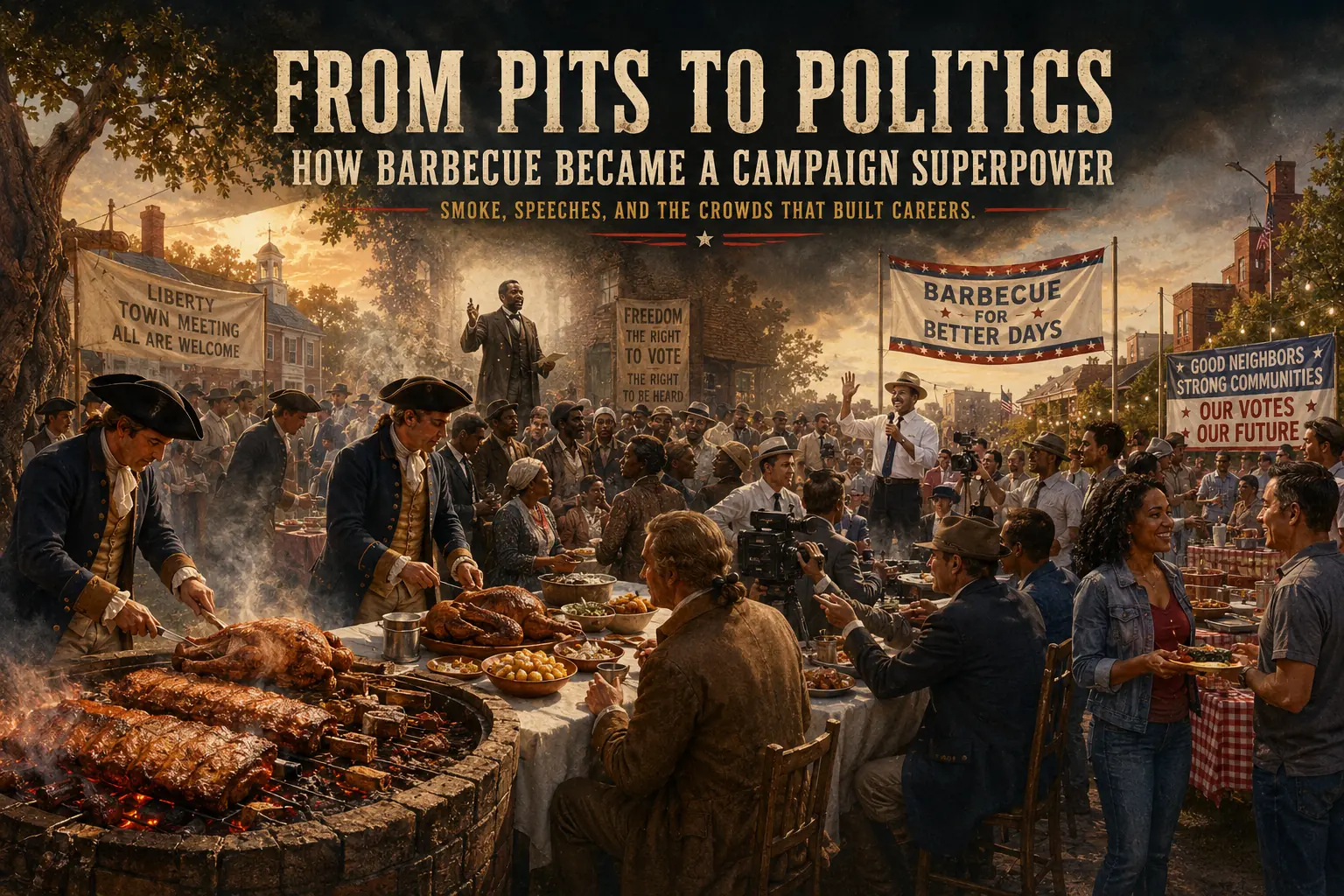
THE QUESTION
So you want to talk about American culture.
What is more American than barbecue?
Smoke rolling across a field. Meat cooking slowly over fire. Folding tables. Paper plates. People standing around talking while somebody tends the pit. Depending on where you grew up, the sauce changes, the meat changes, the wood changes, and people will argue with you all afternoon about which version is the real one.
That argument alone is pretty American.
But barbecue has been doing something else in this country for a very long time. It has been bringing people together.
Long before television commercials, political consultants, campaign buses, polling operations, social media feeds, and candidates livestreaming from their phones, American politics depended on a much simpler piece of technology:
A crowd.
And one of the oldest ways to build one was to feed it.
Americans gathered around food before the country was fully formed. Candidates treated voters to meals and drink. Public feasts became places for speeches, persuasion, celebration, and political argument. By the eighteenth and nineteenth centuries, barbecue had become one of the distinctly American ways those gatherings took shape, particularly across the South.
But the history is not as simple as politicians handing out ribs for votes.
Follow the smoke long enough and barbecue takes you through some of the biggest questions in American history.
Who gets to participate?
Who gets heard?
Who does the cooking?
Who gets invited to the table?
Who is being persuaded?
Who has political power?
And what happens when people once denied that power begin gathering to claim it?
That is where this story begins.
Before Ballots, Politics Already Had a Menu
Food and politics were connected in America long before anyone thought about television debates or campaign advertising.
George Washington's own 1758 election accounts document large quantities of rum punch, wine, and dinner purchased during his successful campaign for the Virginia House of Burgesses. It was part of an old practice often called election “treating”—providing food and drink in the political world surrounding an election.
But that does not mean Washington held some famous barbecue to buy votes. The surviving record establishes food, drink, and political hospitality. It does not establish that his meal was barbecue.
Barbecue enters the political record through other doors.
In 1766, North Carolina royal governor William Tryon tried to calm militia members angered by the Stamp Act with beer and a feast that included a whole barbecued ox. The attempt did not exactly go according to plan. The men reportedly dumped the beer and threw the ox into the Cape Fear River.
Even then, apparently, barbecue could get political.
By the 1770s, Virginia satire was already referring to candidates attending pre-election barbecues. An 1803 Maryland gathering brought Republican citizens together around barbecue. By the 1820s, political barbecues had become common enough in parts of the South that critics were complaining about candidates using barbecue and liquor to court voters.
The important point is not that barbecue invented political gathering. It didn't. The larger tradition was older: food, drink, hospitality, celebration, speeches, and persuasion.
What barbecue did was become one distinctly American form of it.
Before you could persuade a crowd, you first had to gather one.
When Campaigning Became a Spectacle
By the late 1820s and 1830s, American campaigning was changing. Voting rights were expanding among white men. Political parties were becoming more organized. Newspapers became fiercely partisan. Campaigns increasingly used parades, banners, songs, clubs, bonfires, stump speeches, and enormous public gatherings to turn elections into something people could see, hear, and participate in.
And barbecue fit perfectly into that world.
A newspaper account from 1828 described more than 300 people gathering at a barbecue honoring Congressman George McDuffie, complete with meat, whiskey, political speeches, and toasts.
The important correction is that Andrew Jackson did not invent the political barbecue, and political barbecue did not belong exclusively to Jackson's Democrats.
Whigs used them too.
In 1843, Abraham Lincoln spoke at a Whig barbecue in Jacksonville, Illinois. The speeches went on so long that the event continued toward darkness and resumed by candlelight.
Imagine that for a moment. No microphone. No giant video screen. No campaign livestream. Food cooking nearby, a crowd gathered outdoors, politicians talking until people needed candles to keep going.
It was the nineteenth-century version of keeping the event alive.
Barbecue had become so recognizable as part of politics that in 1834 artist Henry R. Robinson created a lithograph called The Political Barbecue. It showed Andrew Jackson with a pig's body roasting over flames labeled “Public Opinion.”
Barbecue had moved beyond the pit.
It had become a political metaphor.
The People Behind the Smoke
There is another part of this history that the old political accounts did not always bother recording.
Somebody had to cook.
The politicians got their names in the newspapers. The speakers were identified. The dignitaries were remembered.
The cooks often were not.
Much of the skilled culinary labor behind Southern hospitality—including barbecue—was performed by enslaved and later free Black cooks and pitmasters, even when contemporary political accounts focused almost entirely on the white hosts and politicians standing near the food.
American barbecue itself grew from multiple traditions. Indigenous cooking practices contributed to early methods Europeans encountered in the Americas. European settlers adapted those traditions. African and African American cooks brought culinary knowledge, seasoning traditions, whole-animal cooking expertise, and generations of skilled labor into what eventually became Southern barbecue.
We should be careful here. The historical record does not allow us to claim that an enslaved Black pitmaster cooked every major political barbecue. Many records simply do not tell us who cooked.
But the absence of names does not mean the labor was absent.
And after emancipation, Black cooks and caterers continued turning those skills into businesses, professions, and institutions of their own.
That history matters, because barbecue cannot honestly be separated from the people whose hands built the tradition.
Reconstruction Changed What Gathering Meant
Then came the Civil War. Emancipation. Reconstruction.
And one of the most profound changes in American political life: Black men in the South gaining the right to vote and participate in government.
Suddenly, gathering for politics meant something entirely different.
Black citizens organized political clubs, joined Union Leagues, built institutions, created newspapers, spoke at rallies, registered voters, ran for office, debated party politics, and demanded recognition of their civil and political rights.
Barbecue was already one of the South's familiar forms of mass gathering, so naturally it entered that new political world too.
In July 1869, a broadside in Virginia advertised the “Grand Barbecue of the Walker Colored Voters!! of Richmond and Henrico.”
That title alone tells us something.
Black voters were not simply standing around waiting for white politicians to explain democracy to them. Their votes had political value. Parties competed for them. Black political organizations participated in the process. Both Black and white speakers were advertised, and the gathering invoked political and civil equality.
Barbecue could become an open-air forum for citizenship, political education, organizing, speeches, party competition, and the exercise of newly gained political power.
But there was another America standing beside it.
Some political gatherings courted Black voters while remaining socially segregated. Contemporary reports describe events where Black attendees were given separate tables.
The message could become strangely American:
We want your vote. We still do not consider you equal.
And the stakes could turn deadly.
In September 1875, a Republican political barbecue attended by Black citizens in Clinton, Mississippi, became the scene of gunfire and subsequent racial violence. The episode became part of the larger white supremacist campaign to destroy Reconstruction politics and suppress Black political participation in Mississippi.
That changes the meaning of the barbecue.
A gathering was no longer merely a gathering.
During Reconstruction, gathering publicly for politics was itself an exercise of newly claimed citizenship—and that citizenship could be dangerous to exercise.
Food brought people together. But once people gathered, power became visible.
And people who feared that power noticed too.
The Smoke Did Not Disappear With Reconstruction
It would be easy to jump from Reconstruction directly to Lyndon Johnson and assume political barbecue disappeared somewhere in between.
It didn't.
It split into different American political worlds.
Across the white South, barbecue remained deeply embedded in courthouse politics, rural campaigns, county rallies, and political machines.
In 1906, a South Carolina political barbecue advertised Senator Ben Tillman as a major attraction. By the 1930s, Georgia politician Eugene Talmadge made enormous barbecue gatherings part of his rural campaign style. His 1932 campaign kickoff in McRae reportedly drew around 10,000 people.
Barbecue remained useful.
But democracy did not remain equally available to everyone standing near the pit.
Talmadge defended segregation and opposed Black political participation. Across the Jim Crow South, Black citizens were systematically pushed out of the political system through white primaries, poll taxes, literacy tests, violence, intimidation, and other methods of disenfranchisement.
So political barbecue continued while political equality collapsed.
Yet Black political and civic life did not disappear. Churches, Black newspapers, civic organizations, civil-rights groups, businesses, and community leaders kept organizing. Barbecue remained part of Black community gatherings and Emancipation celebrations.
And then in 1952, the old connection between food and political assembly appeared again in a way that almost perfectly links Reconstruction to the coming civil-rights movement.
Mound Bayou: The Missing Bridge
In May 1952, thousands of Black Mississippians gathered in Mound Bayou, an all-Black town in the Mississippi Delta, for the first mass meeting of the Regional Council of Negro Leadership.
There was music. High-school marching bands. Speeches. Barbecue.
And Congressman William L. Dawson urged Black Mississippians to register and vote.
Myrlie Evers later remembered the gathering as something that felt part revival, part political rally, and part church picnic.
Think about the historical line that creates.
After slavery, Black citizens gathered during Reconstruction to exercise newly recognized political rights. Those rights were attacked and suppressed during Jim Crow. Yet communities continued organizing. Then, decades later, thousands gathered again around food, music, speeches, and voter registration in the Mississippi Delta.
Different generation. Different political conditions.
Same basic act:
Gather people. Build community. Speak. Organize. Persuade.
That is why Mound Bayou matters so much to this story. It fills the space between Reconstruction and the modern civil-rights movement.
The barbecue did not create Black political organization.
But once again, food helped create the place where political organization could happen.
Reconstruction ended. Black political organization did not.
Then Barbecue Went Presidential
A little more than a decade later, Lyndon Baines Johnson took this already centuries-old political tradition and placed it inside the machinery of the modern presidency.
Johnson did not invent political barbecue.
He nationalized its imagery.
Walter Jetton, the Fort Worth caterer often described as Johnson's preferred barbecue caterer and pitmaster, could cook at extraordinary scale. Contemporary accounts describe operations involving thousands of pounds of meat and enough equipment to feed crowds in the thousands.
Johnson understood Texas. He understood the ranch. He understood informality. And he understood what happened when politicians, reporters, diplomats, lawmakers, and guests were removed from formal rooms and placed around regional food.
One of the best examples came only weeks after John F. Kennedy's assassination.
On December 29, 1963, newly sworn-in President Johnson hosted West German Chancellor Ludwig Erhard in the Texas Hill Country.
The event had been planned for the ranch, but cold, wet weather forced it into the Stonewall High School gymnasium.
So they transformed the gym.
Hay bales. Saddles. Lassos. Red-checkered decorations. Walter Jetton's barbecue. Ribs. Pinto beans. Coleslaw. Fried apricot pies.
Pianist Van Cliburn performed. Broadcaster Cactus Pryor helped run the show.
And in the middle of all that Texas imagery, the president of the United States and the leader of West Germany were conducting serious diplomacy.
Erhard later spoke positively about the personal friendship created during the Texas visit and what it meant for relations between their governments.
That is what made Johnson's use of barbecue different.
The barbecue was no longer simply a county campaign stop.
It had become presidential hospitality on an international stage.
Johnson continued using ranch gatherings with foreign diplomats, including Latin American ambassadors.
The smoker was now sitting beside the presidency.
Regional identity had become diplomacy.
Barbecue had gone global.
The Food Changed. The Politics Didn't.
Political food did not disappear when campaigns became television-driven.
It diversified.
Kentucky's Fancy Farm picnic evolved into one of the state's defining political traditions, combining barbecue, church fundraising, crowds, and sharp stump speeches. In Iowa, Senator Tom Harkin's Steak Fry grew from a gathering of a few dozen people into an event attracting thousands and major presidential candidates. And in South Carolina, Congressman Jim Clyburn's World Famous Fish Fry became one of the most important food-centered gatherings in modern presidential politics.
In 2019, 21 Democratic presidential candidates showed up. Thousands of voters came. Thousands of pounds of fish were prepared.
The meal changed.
The political logic did not.
Candidates still needed to stand in front of actual people, shake actual hands, listen to actual conversations, be seen, be questioned, and make an impression that did not begin with an algorithm.
Barbecue belongs to a much larger American tradition of political food: fish fries, steak fries, pancake breakfasts, church suppers, picnics, fried-chicken dinners, and county fairs.
But barbecue has an unusual combination of traits.
It scales. It happens outdoors. It creates spectacle. You can see the smoke before you reach the crowd. The cooking itself becomes part of the event. It carries strong regional identity. And unlike a meal hidden inside a kitchen, barbecue announces itself.
Something is happening over there.
People are gathering.
Why the Table Still Matters
None of this proves that sharing barbecue makes political disagreement disappear.
History certainly tells us otherwise.
Some of the people standing around political pits hated each other. Some gatherings were segregated. Some were manipulative. Some were places of liberation. Some became places of violence.
Food does not erase politics.
But eating together does something more basic.
Research on shared meals and commensality has repeatedly linked eating together with social bonding, cooperation, trust, belonging, and community connection.
That makes sense even without a study.
A campaign advertisement talks at you. A social-media post reaches you. A television interview performs for you.
A table puts people near one another.
And for generations, American politics has repeatedly returned to that physical act of gathering.
Maybe that is why barbecue fits so naturally into our political history.
Barbecue has been hospitality and political strategy. Celebration and persuasion. Community and commerce. It has gathered voters, politicians, newly enfranchised citizens, diplomats, families, and neighbors.
It has existed inside some of the best parts of the American story and some of the hardest.
People gathered around those pits to campaign, organize, argue, celebrate, demand rights, protect power, challenge power, and sometimes simply hear what another person had to say.
The politicians changed. The parties changed. The laws changed. The people standing around the pit changed. The country changed.
But the basic act remained remarkably familiar:
Gather people. Feed people. Talk. Listen. Persuade. Organize.
So maybe barbecue was never just about what was cooking.
Maybe the real story was always about who gathered around the fire—and what happened once they got there.
We started by asking:
What is more American than barbecue?
Now that you know the history behind the smoke, the speeches, the politics, the people, and the plates, there is really only one question left:
Was it what you thought it was?
Sources & References (114)
SOURCES & REFERENCES
National Archives / Founders Online
“Account with Henry Heth”
July 24–26, 1758
George Washington election treating; food, rum punch, wine, and dinner during the 1758 Virginia election.
https://founders.archives.gov/documents/Washington/02-05-02-0273-0004
Robert F. Moss / University of Alabama Press
Barbecue: The History of an American Institution, Revised and Expanded Edition
Colonial barbecue, the 1766 William Tryon episode, political barbecues, nineteenth-century campaign culture, Reconstruction, Jim Crow, and Emancipation celebrations.
https://www.jstor.org/stable/jj.30347600
Encyclopedia Virginia
“Robert Munford”
Revolutionary-era reference to a pre-election barbecue in Virginia.
https://encyclopediavirginia.org/entries/munford-robert-d-1783/
Georgia Historic Newspapers
Augusta Chronicle and Georgia Advertiser
July 26, 1828
Contemporary reporting on a political barbecue honoring Congressman George McDuffie.
https://gahistoricnewspapers.galileo.usg.edu/lccn/sn82014184/1828-07-26/ed-1/seq-3/ocr/
Library of Congress
“The Political Barbecue”
Henry R. Robinson, 1834
Political cartoon depicting Andrew Jackson being roasted over the fire of “Public Opinion.”
https://www.loc.gov/pictures/item/2008661772/
Library of Congress
Presidential Election of 1840 Resource Guide
Mass rallies, campaign songs, slogans, symbols, and the growth of theatrical mass campaigning.
https://guides.loc.gov/presidential-election-1840
Papers of Abraham Lincoln
Speech at Whig Barbecue, Jacksonville, Illinois
October 6, 1843
Documents Lincoln speaking at a political barbecue and the connection between barbecue and stump speaking.
https://papersofabrahamlincoln.org/documents/D200341
Virginia Department of Historic Resources
Vauxhall Chain Bridge / 1869 Political Barbecue
Documents the “Grand Barbecue of the Walker Colored Voters!!” and Black political participation during Reconstruction.
https://www.dhr.virginia.gov/blog-posts/vauxhall-chain-bridge-tragedy-richmond-james-river-virginia/
University of Richmond
Reconstructing Virginia
Black political agency, suffrage, political organizing, and constitutional politics during Reconstruction.
https://reconstructingvirginia.richmond.edu/overview
U.S. Congress / University of Michigan
Mississippi in 1875 — Report of the Select Committee to Inquire Into the Mississippi Election of 1875
Primary government record concerning political violence surrounding the Clinton, Mississippi election and Republican barbecue.
https://quod.lib.umich.edu/m/moa/AEY0467.0001.001
University of North Carolina Press
Adrian Miller
Black Smoke: African Americans and the United States of Barbecue
2021
Black pitmasters, cooks, restaurateurs, and African American influence on the development of American barbecue.
https://uncpress.org/book/9781469662817/black-smoke/
Smithsonian
Kelley Fanto Deetz
“How Enslaved Chefs Helped Shape American Cuisine”
2018
Enslaved culinary labor and its contribution to Southern and American food traditions.
https://www.smithsonianmag.com/history/how-enslaved-chefs-helped-shape-american-cuisine-180969697/
New Georgia Encyclopedia
“On the Stump: What Does It Take to Get Elected in Georgia?”
Barbecues, fish fries, stump speaking, and food-centered political campaigning in Georgia.
https://www.georgiaencyclopedia.org/exhibition/on-the-stump-what-does-it-take-to-get-elected-in-georgia/
Southern Foodways Alliance
Georgia Barbecue / Southern BBQ Trail
Eugene Talmadge’s 1932 campaign barbecue and the role of barbecue in twentieth-century Southern political campaigns.
https://www.southernfoodways.org/oral-history/southern-bbq-trail/georgia-bbq/
New Georgia Encyclopedia
“Eugene Talmadge”
Segregation, white-primary politics, and the political context surrounding Talmadge’s campaigns.
https://www.georgiaencyclopedia.org/articles/government-politics/eugene-talmadge-1884-1946/
SNCC Digital Gateway
“RCNL Holds First Mass Meeting in Mississippi Delta”
May 1952
Regional Council of Negro Leadership gathering in Mound Bayou, Mississippi; barbecue, music, mass attendance, and voter-registration appeals.
https://snccdigital.org/events/rcnl-holds-first-mass-meeting-mississippi-delta/
National Park Service
Lyndon B. Johnson National Historical Park
1963 Stonewall barbecue and Chancellor Ludwig Erhard visit.
https://www.nps.gov/lyjo/learn/news/special-weekend-of-holiday-activities.htm
The American Presidency Project
“Remarks in Stonewall, Texas, at a Barbecue in Honor of Chancellor Erhard”
December 29, 1963
President Lyndon B. Johnson’s remarks and official event record.
https://www.presidency.ucsb.edu/documents/remarks-stonewall-texas-barbecue-honor-chancellor-erhard
Library of Congress
Presidential Food: A Resource Guide
Walter Jetton, Lyndon Johnson, presidential food traditions, and barbecue diplomacy.
https://guides.loc.gov/presidential-food
U.S. Department of State — Office of the Historian
Foreign Relations of the United States, 1964–1968
Documents the April 1, 1967 barbecue for Latin American ambassadors at the LBJ Ranch.
https://history.state.gov/historicaldocuments/frus1964-68v31/d49fn5
Harkin Institute, Drake University
Harkin Steak Fry Historical Exhibit
Modern food-centered presidential campaigning and the growth of the Iowa Steak Fry.
https://harkininstitute.drake.edu/2023/08/18/exhibit-audio-description-representing-iowans/
PBS / Associated Press
“Clyburn’s World Famous Fish Fry”
June 21, 2019
Modern food-centered campaigning involving Democratic presidential candidates and South Carolina voters.
https://www.pbs.org/newshour/amp/politics/watch-live-democratic-candidates-speak-at-clyburns-world-famous-fish-fry
Claudia Giacoman, Appetite
“The Dimensions and Role of Commensality”
2016
Peer-reviewed research on communal eating, group cohesion, and belonging.
https://pubmed.ncbi.nlm.nih.gov/27570185/
Robin Dunbar et al.
“Breaking Bread: The Functions of Social Eating”
Peer-reviewed research associating social eating with bonding, trust, support networks, and community engagement.
https://pmc.ncbi.nlm.nih.gov/articles/PMC6979515/
EDITORIAL NOTE
This historical feature examines the long relationship between food, public gathering, political persuasion, Black political participation, campaign culture, and American barbecue. The article does not argue that barbecue created American political life or that every political barbecue served the same social purpose. Instead, it traces how barbecue repeatedly appeared within broader traditions of public assembly, campaigning, political organizing, hospitality, diplomacy, and community life.
Where the historical record does not identify specific cooks or pitmasters, the article does not assign individual labor without evidence. The broader discussion of Black culinary influence relies on documented scholarship concerning enslaved and free Black cooks, pitmasters, caterers, restaurateurs, and their contributions to Southern and American barbecue traditions.
© 2026 Sunday Dinner Media. All rights reserved.
The table is always open. The conversation matters.
The conversation is open
Be the first reader to add a thoughtful response.