
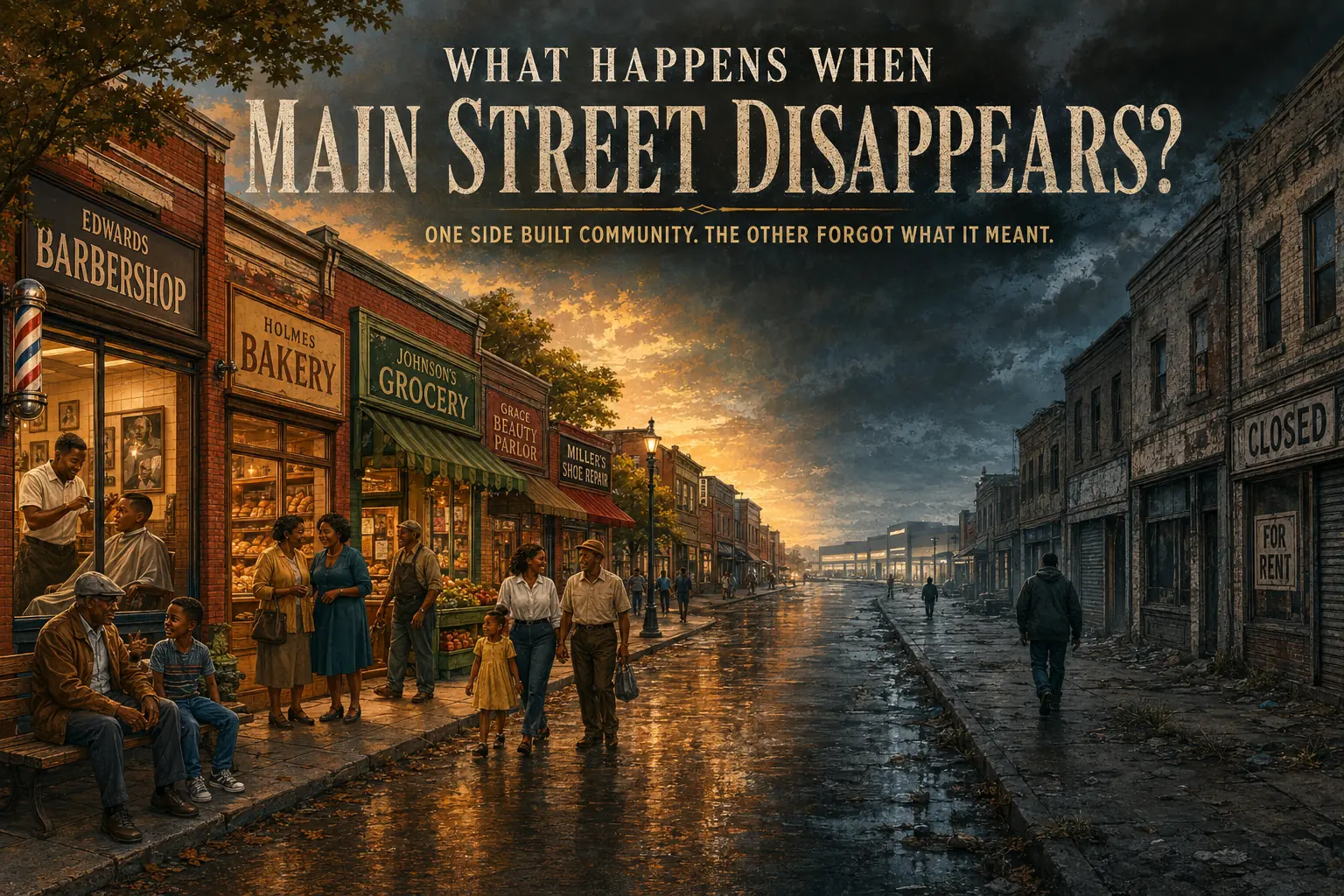
THE QUESTION
We call it growth when the stock market climbs, but down on Main Street, the only thing growing is the number of shuttered storefronts.
Capitalism. Capitalism. Capitalism.
We look at the stock market and call it growth, cheering every uptick as if it were the heartbeat of America. But economies look different depending on where you are standing.
Stand on Wall Street and you see numbers. Stand on Main Street and you see people.
You see the storefront that has been there since you were a child. You see the owner who knew your parents before they knew you. You see the barber who gave three generations of the same family their first haircut. You see the grocery-store owner who knew when somebody was having a difficult week.
And then, sometimes, you come back years later and see a dark window, a “For Rent” sign, an empty building.
What happens when Main Street disappears?
I remember Sam’s Grocery Store on the corner, where the bell above the door jingled whenever somebody walked in. Sam knew his customers. He knew their children. He might hand a kid a lollipop on the way out. When times were tight, there were families he trusted enough to carry on a tab until payday.
Sam sold groceries. But there were things inside that store that never appeared on the receipt: trust, familiarity and community.
A block away was the barbershop. It was more than a place to get a haircut. On Saturday mornings, three generations could sit in the same room while the scissors moved and the conversation traveled from sports to politics to somebody’s children to whatever was happening in the neighborhood.
Across the street, the beauty parlor had its own rhythm—hair dryers, laughter, news, family stories and Friday rituals. Nearby, the shoe-repair shop kept working people on their feet. The owner could look at a child and remember when he had fitted that child’s father for shoes.
These places may sound like nostalgia.
But that is not what this story is about.
Main Street was never valuable simply because it had stores. It was valuable because some of those stores stayed long enough to become institutions.
The Vanishing Backbone
Small businesses remain enormous parts of the American economy. According to the U.S. Small Business Administration, America had about 36.2 million small businesses in 2026. They represented 99.9 percent of U.S. businesses, employed 45.9 percent of private-sector workers and accounted for about 43.5 percent of the nation’s economic output.
So let’s get something straight.
Small business is not disappearing. America is still creating businesses. Entrepreneurship is alive.
But that is not the same question as whether we are still producing the kind of Main Street businesses that survive long enough to become part of a community’s identity.
That distinction matters.
A consultant working from home can be an entrepreneur. An online seller can be an entrepreneur. A two-year startup can be a small business. A locally owned franchise can be a small business. And the family-owned shoe store that has been on the same street for forty years can be a small business.
The statistics may put them in similar categories.
The community experiences them very differently.
Business creation tells us something. Business survival tells us something else.
Research from the Bureau of Labor Statistics shows that about 57 percent of establishments started in 2018 survived five years. Looking at businesses started in 2013, only about 35 percent were still operating ten years later. Retail performed somewhat better, but even there only about 42 percent of establishments from that cohort remained after a decade.
Those numbers do not prove that every Main Street used to be better.
They do tell us something important:
You can have more entrepreneurs and still have less durable Main Street.
A new store opening is worth celebrating. But a store staying open for thirty years is something different.
Time gives a business the chance to become more than a business. Customers become regulars. Regulars become families. Employees become managers. Young workers become owners. Relationships accumulate. Trust accumulates. Memory accumulates.
Eventually the storefront becomes part of the neighborhood’s story.
When Progress Makes the Neighborhood More Expensive
There is another way a good business can disappear.
Sometimes it fails. Sometimes competition beats it. Sometimes the owner makes bad decisions. Sometimes customers simply stop wanting what it sells.
But sometimes the business survives long enough to help make an area desirable—and then discovers it can no longer afford to stay there.
Commercial revitalization has a contradiction hidden inside it.
A neighborhood improves. More people arrive. New development comes. Property values rise. Investment increases. The commercial corridor becomes more desirable.
That can be good.
But if the value of the property beneath a longtime business rises faster than the business itself can grow, the owner may eventually be staring at a rent the business was never designed to carry.
I watched versions of that transformation on Jamaica Avenue in Queens. I remember a commercial street filled with independent merchants, businesses that had been there for years and owners people knew.
Then larger retailers came. Redevelopment came. The street changed.
Research does not support the simple version of that memory—that national chains came in and destroyed Jamaica Avenue.
The truth is more complicated.
Jamaica still has hundreds of independent businesses alongside national retailers. In fact, New York City’s own planning documents now talk about the importance of helping locally owned, Black-owned, immigrant-owned and other diverse businesses thrive alongside larger retailers.
That word matters.
Alongside.
Because this should never have been a choice between having national retailers or local businesses. A healthy commercial district should be capable of making room for both.
The danger comes when redevelopment makes the neighborhood more valuable but leaves the businesses that helped build its value unable to afford the new neighborhood.
That problem is real enough that cities such as San Francisco have created formal Legacy Business programs designed specifically to keep long-running businesses from being displaced, including incentives for landlords to provide qualifying businesses with longer leases.
Think about what that says.
A city looked at its economy and decided:
Business continuity itself has value.
Commerce Didn’t Disappear. It Moved.
Main Street has also been transformed by something none of those old merchants could have imagined.
The store is now in your pocket.
E-commerce accounted for nearly 17 percent of U.S. retail sales in early 2026. You can buy shoes without visiting the shoe store, order groceries without seeing the grocer, buy a book without walking into a bookstore, get medicine delivered, or order hardware, furniture, clothes, dinner and almost anything else.
That convenience is real.
People chose it because it provides value.
We should not write a dishonest story pretending consumers were helpless while corporations changed Main Street around them.
We helped change it.
We chose price, selection, speed and convenience.
I use those things too. Most of us do.
And e-commerce has created opportunities for small businesses as well. An independent company that once depended entirely on foot traffic can now sell across the country.
So this is not a story about turning off the internet.
But commerce moving online changes the geography of work. The Bureau of Labor Statistics has documented huge growth in warehouses, storage, courier services and delivery networks as e-commerce expanded.
The jobs did not necessarily disappear.
Some of them moved.
From the neighborhood sales floor to the fulfillment center. From Main Street to the warehouse. From the teenager stocking the neighborhood shelves to somebody sorting packages miles away.
Retail is still one of the largest employers of young Americans.
But it is worth asking what changes when some of the first opportunities to work move farther away from the streets where young people actually live.
Because Main Street once provided more than products.
For a lot of young people, it provided the first rung on the ladder.
You bagged groceries, stocked shelves, swept floors, carried boxes, answered phones and worked the register. You learned to show up on time. You learned how to talk to customers. You learned what happened when you were late. You learned what a paycheck felt like.
Sometimes the owner knew your mother. Sometimes that mattered when you made your first mistake.
And sometimes working beside an owner taught a young person something larger:
Maybe one day I could own something too.
Ownership Changes the Equation
That may be one of the most important things Main Street gave communities.
Owners.
A paycheck creates income.
Ownership can create an asset.
A business can grow. It can be sold, borrowed against, transferred, inherited, passed to an employee or passed to a child. It can become part of a family’s wealth.
Research from the Urban Institute describes business equity as one of the largest sources of household wealth after homeownership.
That does not mean every business owner becomes wealthy.
Far from it.
But ownership creates a possibility that employment alone does not.
That matters especially in communities where generations have had fewer opportunities to accumulate property, capital and financial assets.
And locally owned businesses can have another economic effect.
Place-based studies repeatedly find that independently owned businesses often recirculate a larger share of their revenue within the surrounding economy than comparable national chains. The exact number varies widely by business, industry and community, so there is no honest universal rule that says a certain number of cents from every local dollar always stays home.
But the reason for the difference is easy to understand.
The local owner may hire a local accountant, use a local lawyer, bank nearby, buy from another nearby supplier, spend the owner’s income where the owner lives, sponsor the team, donate to the church or hire the neighbor’s child.
A national chain also contributes. It hires people, pays taxes, rents or owns property, may give money locally, and may offer lower prices and better logistics.
But part of what that business earns also moves through a larger corporate system—to centralized services, distant suppliers, headquarters, shareholders or franchise fees.
That does not make the corporation evil.
It makes the economic footprint different.
And ownership location matters.
What Happens When the Replacement Leaves?
Here is where the story becomes more complicated.
The independent pharmacy closes. A chain replaces it. The local grocery disappears. A larger retailer becomes the place everybody shops. The neighborhood becomes dependent on fewer providers.
Then one day the corporation makes another decision.
The numbers do not work anymore.
The store closes.
And the independent business that disappeared years earlier does not magically return.
That problem is especially visible in pharmacy access. Research has documented widespread pharmacy closures and growing pharmacy deserts, particularly affecting some rural, lower-income, Black and Latino communities.
Independent pharmacies have been especially vulnerable.
So now the question is no longer:
Did the national chain offer lower prices or more convenience?
Maybe it did.
The question becomes:
What happens when the community organizes its access around one large provider and that provider leaves?
How far does an older resident travel for a prescription?
What does a person without a car do?
What happens to groceries?
What happens to banking?
What happens to jobs?
The building may still be there.
The ecosystem isn’t.
And that is the danger of concentration.
Not simply that the large business came, but that once the smaller alternatives disappear, the community becomes more vulnerable to decisions made somewhere far away from the people who have to live with the consequences.
What a Community Loses
Some losses are harder to put into a spreadsheet.
Sam’s Grocery wasn’t just cans on shelves. It was where people ran into one another. It was where somebody might notice that Mrs. Johnson had not been in for a week.
The barbershop wasn’t just haircuts. Research on Black barbershops has documented what communities already knew: these businesses can serve as trusted gathering places, information networks, informal counseling spaces, health-intervention sites and community anchors.
The beauty shop did its own version of the same work.
A forty-year-old neighborhood business has something a brand-new business cannot buy on opening day:
History.
Years of conversations. Years of favors. Years of people watching each other’s children grow. Years of trust.
A new business may eventually build that.
But it takes time.
That is what business statistics have difficulty measuring.
Two stores can occupy the same storefront in two consecutive years. On paper, the space stayed occupied. But if one business had spent forty years building relationships and its replacement lasts eighteen months, the economic count may not fully capture what changed.
New York City’s own storefront research helps show why this matters. Small businesses have not simply surrendered the city’s storefronts to national chains since the pandemic.
But vacancy and turnover remain real problems.
And vacancies can cluster.
One dark storefront makes the next one harder. Then another. Then another.
That is how a block can slowly change character without one dramatic moment announcing:
Main Street is gone.
Main Street disappears one light at a time.
The Pressure Is Different in 2026
Today’s independent merchant is carrying pressures the older merchant did not face in quite the same combination: commercial rent, insurance, labor costs, interest rates, card-processing fees, online competition, shipping, inventory and, for many goods-producing and retail businesses, tariffs.
Federal Reserve research released in 2026 found more than four in ten employer firms reported tariff-related cost increases as a financial challenge. The pressure was much higher among retail and manufacturing firms.
New York Federal Reserve research found many affected small businesses did two things at once: they passed some of the cost to customers and absorbed some of the cost themselves.
That matters because a large corporation may have more leverage to negotiate with suppliers, stockpile inventory, diversify sourcing or spread costs across thousands of locations.
The corner merchant may have far fewer options.
At the same time, the truth is not as simple as “small businesses hate tariffs.”
Surveys also show significant numbers of small-business owners support them because they believe domestic producers may benefit from less foreign competition.
Both things can be true.
That is the reality of Main Street.
There is rarely one Main Street.
A domestic manufacturer and an import-dependent retailer may experience the exact same policy in completely different ways.
And the overall picture in 2026 is not collapse.
Small-business optimism has shown resilience. Many firms expect to survive and grow.
Main Street is under pressure.
It is not universally dying.
That distinction matters because this story is not supposed to scare people into nostalgia.
It is supposed to ask what we value enough to protect.
Help Good Businesses Become Old Businesses
Maybe we have spent too much time measuring how many businesses America creates and not enough time asking how many good businesses America helps stay.
Opening a business is one challenge.
Becoming a thirty-year business is another.
And saving Main Street cannot simply mean cutting a ribbon on another startup.
Sometimes saving Main Street means helping a good business become an old business.
That might mean helping the owner buy the commercial property instead of remaining vulnerable to every future rent increase. It can mean longer leases, access to capital, community banks and CDFIs willing to understand the business instead of only feeding numbers into an algorithm, cities putting vacant storefronts back into productive use, government, hospitals, colleges and large institutions deliberately including local firms in procurement, schools connecting young people with neighborhood employers, apprenticeships and entrepreneurship, and merchant associations helping small businesses buy, market and advocate together.
And it means planning for something almost nobody likes thinking about:
retirement.
Old Man Joe’s shoe store in the original Main Street story did not close because Amazon beat him.
Joe got old.
Nobody took over.
That is a different kind of loss.
The Department of Labor now encourages business owners to begin succession planning years before they retire because a profitable business can disappear simply because nobody prepared for what happens after the owner leaves.
Maybe an employee buys it. Maybe a manager does. Maybe the children take it. Maybe another local entrepreneur takes over. Maybe employee ownership becomes the answer.
But the important thing is that the lights do not have to go dark simply because the person who spent forty years turning the business into an institution is ready to go home.
Saving Main Street does not always mean opening another business. Sometimes it means refusing to let a good one disappear.
Consumers have a role too.
Buying local matters.
But consumers cannot solve commercial rent, access to capital, succession, zoning, healthcare costs and economic development by themselves.
This cannot become another guilt trip telling somebody that ordering from Amazon is destroying America.
That is too easy.
Consumers are part of the solution.
They are not the whole solution.
Cities matter. Banks matter. Property owners matter. Schools matter. Large institutions matter. Public policy matters. Business owners themselves matter.
And communities have to decide what kind of commercial ecosystem they actually want.
What Kind of Main Street Will They Remember?
We are not bringing back 1965.
We probably should not try.
The old Main Street had flaws too. Not every business welcomed everybody. Not every owner was fair. Not every product was affordable. Not every business deserved to survive.
Modern commerce gave us extraordinary benefits: lower prices, selection, technology, delivery, convenience and access to products people in small towns could once never find locally.
Those things have value.
But so does continuity.
So does ownership.
So does a teenager getting a first job three blocks from home.
So does the pharmacist who knows the family.
So does the barber who remembers your father.
So does the grocer who asks about your mother.
So does the restaurant owner who sponsors the team.
So does the merchant who has been standing behind the same counter so long that the business becomes part of how a neighborhood remembers itself.
Maybe Main Street was never about the buildings.
Maybe it was about connection.
Businesses became employers. Employers became mentors. Owners built equity. Customers became generations of customers. Commercial spaces became gathering places. Relationships accumulated. Trust accumulated.
And eventually a storefront became part of a community’s memory.
America is still creating businesses.
That is good.
But creation is only the beginning.
The harder question is whether we are creating the conditions that allow enough of those businesses to survive long enough to become institutions.
Maybe bringing Main Street back is not about recreating the stores our grandparents remember.
Maybe it is about giving the businesses opening today a real chance to become the places our grandchildren remember.
So perhaps the question we should leave on the table is not simply:
What happens when Main Street disappears?
Maybe it is this:
What are we willing to do today so the next generation has a Main Street worth remembering?
Sources & References (92)
Imported from Sunday DinSOURCES & REFERENCES
1. U.S. Small Business Administration — Office of Advocacy
Small Business FAQs 2026
https://advocacy.sba.gov/2026/02/03/advocacy-releases-frequently-asked-questions-about-small-businesses-2026/
2. U.S. Bureau of Labor Statistics — Business Employment Dynamics
Business Employment Dynamics: Twentieth Anniversary
https://www.bls.gov/spotlight/2024/business-employment-dynamics-twentieth-anniversary/
The Decline of Job Creation at New Establishments
https://www.bls.gov/opub/btn/volume-12/the-decline-of-job-creation-at-new-establishments.htm
3. Main Street America
Legacy Businesses, Small-Scale Producers and High Performers — 2026 Small Business Survey
https://mainstreet.org/the-latest/news/main-spotlight-a-closer-look-at-legacy-businesses-small-scale-producers-and-high-performers-in-our-spring-2026-small-business-survey
Nationally Designated Main Street Programs — 2026
https://mainstreet.org/the-latest/news/main-spotlight-celebrating-1291-nationally-designated-main-street-programs-in-2026
4. U.S. Department of Agriculture — Economic Research Service
Dollar Stores and Independent Grocery Stores
https://www.ers.usda.gov/data-products/charts-of-note/109257
Rural Grocery Store Changes
https://www.ers.usda.gov/data-products/charts-of-note/102752
5. New York City Comptroller
Who’s Minding the Storefronts?
https://comptroller.nyc.gov/reports/whos-minding-the-storefronts/
6. New York City Department of Small Business Services
Downtown Jamaica Commercial District Needs Assessment
https://www.nyc.gov/assets/sbs/downloads/pdf/neighborhoods/avenyc-cdna-downtown-jamaica.pdf
7. New York City Department of City Planning
Jamaica Neighborhood Plan — 2025
https://www.nyc.gov/assets/planning/download/pdf/about/jamaica-neighborhood-plan-booklet-march-2025.pdf
8. Jamaica Center Business Improvement District
Downtown Jamaica Business District
https://jamaicacenter.org/see-do/
9. Brookings Institution
Businesses Are Victims of Gentrification Too
https://www.brookings.edu/articles/businesses-are-victims-of-gentrification-too/
10. Urban Institute
Development and Displacement in Queens
https://www.urban.org/urban-wire/how-developing-casino-public-land-queens-new-york-city-could-displace-nearby-residents
11. City and County of San Francisco
Legacy Business Program Annual Report
https://media.api.sf.gov/documents/LBP_Grants_Annual_Report_2024-25.pdf
12. U.S. Census Bureau
Quarterly Retail E-Commerce Sales
https://www.census.gov/retail/eCommerce.html
13. U.S. Bureau of Labor Statistics
Retail Trade Employment Before, During and After the Pandemic
https://www.bls.gov/opub/btn/volume-11/retail-trade-employment-before-during-and-after-the-pandemic.htm
14. U.S. Bureau of Labor Statistics
Youth Employment by Industry
https://www.bls.gov/opub/ted/2025/over-half-of-employed-youth-worked-in-leisure-and-hospitality-retail-trade-or-education-and-health-services.htm
15. Urban Institute
How Racial Disparities in Small Business Ownership Affect Black Wealth and Economic Prosperity
https://www.urban.org/research/publication/how-racial-disparities-small-business-ownership-affect-black-wealth-and
16. Brookings Institution
Black Business Parity and Metro Economies
https://www.brookings.edu/articles/what-if-black-businesses-were-equitably-represented-in-every-metro-area-in-america/
17. National Institutes of Health / PubMed Central
Black Barbershops and Community Health
https://pmc.ncbi.nlm.nih.gov/articles/PMC4749262/
Barbershops as Trusted Community Settings
https://pmc.ncbi.nlm.nih.gov/articles/PMC7572982/
Barbershops and Beauty Salons as Community Anchors
https://pmc.ncbi.nlm.nih.gov/articles/PMC9618922/
18. USC Schaeffer Center / Health Affairs
Pharmacy Closures in the United States
https://schaeffer.usc.edu/research/pharmacy-closures-united-states-health-affairs/
19. National Institutes of Health / PubMed Central
Role of Independent Versus Chain Pharmacies in Providing Geographic Pharmacy Access
https://pmc.ncbi.nlm.nih.gov/articles/PMC10519705/
20. Institute for Local Self-Reliance / Civic Economics
Key Studies on Why Independent and Local Ownership Matters
https://ilsr.org/article/independent-business/key-studies-why-local-matters/
21. Federal Trade Commission
A Consumer’s Guide to Buying a Franchise
https://www.ftc.gov/business-guidance/resources/consumers-guide-buying-franchise
22. Federal Deposit Insurance Corporation
2024 Small Business Lending Survey
https://www.fdic.gov/news/press-releases/2024/fdic-issues-2024-small-business-lending-survey-report
23. U.S. Department of Labor
Small Business Succession Planning / Employee Ownership Initiative
https://www.dol.gov/agencies/ebsa/about-ebsa/our-activities/programs-and-initiatives/employee-ownership-initiative/tools-and-resources/succession-planning
24. Federal Reserve Small Business
2026 Report on Employer Firms
https://www.fedsmallbusiness.org/2026-report-on-employer-firms
25. Federal Reserve Bank of New York — Liberty Street Economics
Effect of Tariffs on U.S. Small Businesses
https://libertystreeteconomics.newyorkfed.org/2026/07/effect-of-tariffs-on-u-s-small-businesses/
26. National Federation of Independent Business
2026 Tariff and Trade Policy Report
https://www.nfib.com/wp-content/uploads/2026/04/2026-NFIB-Tariff-and-Trade-Policy-Report.pdf
27. U.S. Census Bureau
COVID-19 Impact on Small Businesses — Small Business Pulse Survey
https://www.census.gov/library/stories/2020/05/new-small-business-pulse-survey-shows-breadth-of-covid-19-impact-on-businesses.htmlner Magazine, Issue 001: At the Table. Verify and refresh factual sources before publication.
The conversation is open
Be the first reader to add a thoughtful response.