
THE TRUTH ABOUT AMERICAN RETIREMENT
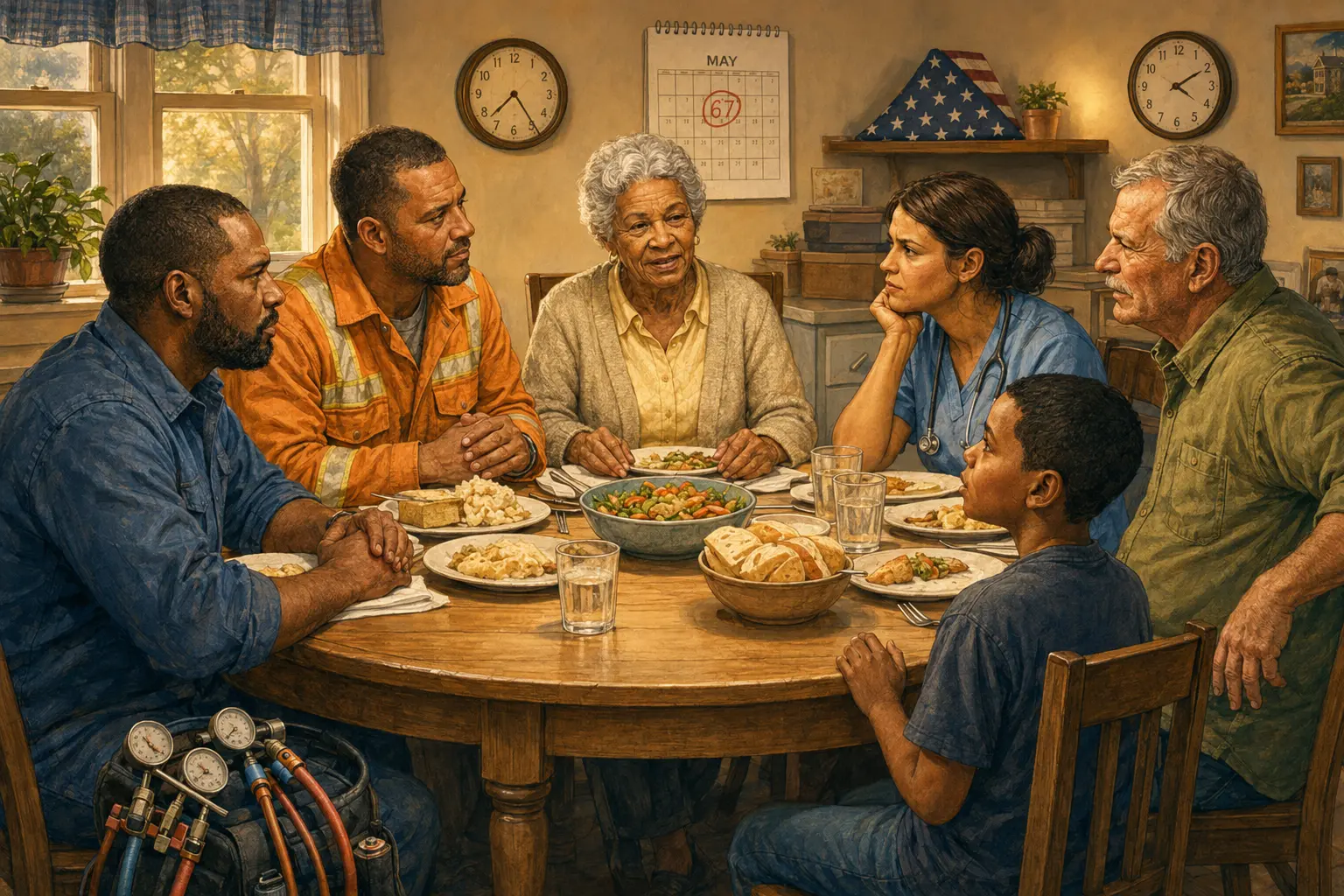
Editor’s Note: This story is written as a kitchen-table conversation among family, neighbors, and loved ones gathered for Sunday dinner. There is no narrator telling you what to believe. You, the reader, are simply the fly on the wall. Pull up a chair and listen.
“Y’all hear they talking about raising the retirement age again?”
Aunt Bernice sets her sweet tea down hard enough to rattle the ice in the glass. “I swear, they’re gonna have us working till we in the grave.”
For a second, nobody says anything. Forks keep moving. Somebody passes the potatoes. A serving spoon scrapes against the bottom of a bowl.
Near the edge of the room, a little girl sits quietly. She isn’t part of the grown-folks conversation. At least nobody thinks she is.
But she can hear everything.
Uncle Joe leans back in his chair. “That’s easy to say when your job don’t beat your body up.”
He shakes his head. “Somebody sitting behind a desk can talk about working till seventy. They ain’t thinking about somebody whose back been hurting since fifty-five.”
Cousin Deon looks up from his plate. “Exactly. I do HVAC. You ever carry a sixty-pound compressor up three flights of stairs in July?”
A couple people laugh.
Deon doesn’t.
“I’m serious. Thirty years climbing ladders, crawling through attics, squeezing into spaces that feel like ovens, kneeling down, getting back up. After thirty years of that, your knees ain’t asking what Congress thinks. Your knees just tell you they’re done.”
Maurice points his fork toward him. “Try putting antennas on rooftops.”
Everybody turns.
“When we were building cell sites, you’d be up there in hundred-degree weather with the sun bouncing off that roof. Feels ten degrees hotter up there than it does on the ground. Then winter comes and you’re working near the water with that wind cutting through everything you got on.”
He reaches over and rubs his shoulder. “People drive down the highway and see a cell tower. They don’t think about who climbed it.”
Grandma has been listening. She puts her fork down.
“Your granddaddy worked sanitation.”
The room changes. Everybody knows this story, but Grandma tells it anyway.
“That man worked his whole life. Rain. Snow. Heat. Didn’t matter. Got up every morning and went to work because he had children to feed.”
She pauses.
“He retired.”
Nobody interrupts.
“Lived three years.”
Aunt Bernice looks down. “Three years?”
“Three years.”
Grandma rubs her hands together. “Wore his body out making sure his children could have something better. And when he finally got his chance to sit down and rest, he barely got any rest at all.”
The little girl looks toward Grandma.
The Body Gives Out Before the Paycheck Does
Uncle Reggie folds his napkin. “That’s the part people don’t understand. A whole lot of folks don’t retire because they wake up one morning and decide they’re finished working.”
He taps the table.
“They retire because something gives out.”
“Back,” Uncle Joe says.
“Knees,” Deon adds.
“Shoulders,” says Maurice.
“Hips,” Grandma says.
Uncle Reggie nods.
The body gives out before the paycheck does.
That one sits at the table for a while.
Aunt Bernice leans forward. “And that’s why I get mad when they talk about adding another year or two like it ain’t nothing.”
She looks around.
“Nothing to who?”
Nobody answers.
“Seventy looks one way if you spent your career sitting in meetings. Seventy looks different when you poured concrete your whole life. It looks different when you cleaned hospital rooms, drove trucks, stocked warehouses, roofed houses, lifted patients, cut hair standing on your feet all day, worked sanitation, worked construction.”
She points toward Deon.
“His seventy ain’t everybody else’s seventy.”
Deon nods. “And the finish line already moved before.”
Grandma looks at him.
“What moved?”
“Full Social Security retirement.”
He wipes his mouth. “For a long time everybody talked about sixty-five like that was retirement. For people born later, full Social Security retirement moved up. For people born in 1960 or after, it’s sixty-seven.”
Grandma shakes her head. “I knew I wasn’t crazy.”
“And people have proposed moving it higher,” Deon says. “Sixty-nine. Even seventy has been modeled. That ain’t the law today, but people keep putting the idea on the table.”
Uncle Joe shakes his head. “People live longer now. That’s what they always say.”
Maurice leans forward. “Living longer ain’t the same as being able to work longer.”
“Thank you,” Aunt Bernice says.
“People talk about life expectancy like everybody lived the same life getting there,” Maurice continues. “A man who spent forty years behind a desk and a man who spent forty years climbing roofs might both make it to seventy.”
He points toward Deon.
“That don’t mean they arrived there with the same body.”
His seventy ain’t everybody else’s seventy.
Deon laughs. “Shoot, my forty-five-year-old body don’t want to do what my thirty-year-old body did.”
That gets the table laughing. Even Grandma smiles.
The little girl smiles too.
Then Uncle Reggie clears his throat.
When Retirement Gets Too Expensive
“My neighbor Mr. Curtis is seventy-two.”
Grandma looks at him. “What about him?”
“Still working nights stocking shelves.”
“At seventy-two?”
“At seventy-two.”
Aunt Bernice shakes her head. “He like working?”
“No.”
The answer comes quickly.
“He already retired once.”
That gets everybody’s attention.
“Retired at sixty-seven,” Uncle Reggie says. “Thought he had done everything right. Worked his whole life. Saved what he could. Had Social Security coming. Had some retirement money put away.”
“So why he back working?” Deon asks.
Uncle Reggie pauses.
“Healthcare.”
Nobody says anything.
“His and his wife’s.”
Grandma’s expression changes. “Something happen?”
“They both started having health problems. Doctor visits. Prescriptions. Copays. Tests. Things insurance didn’t cover. Little stuff at first. Then some bigger stuff.”
He shakes his head. “And little by little, healthcare started eating through what they had saved.”
Aunt Bernice looks at him.
“So he had enough to retire until they got sick?”
“He thought he did.”
Uncle Reggie sits back. “Five years later, Mr. Curtis is stocking shelves at night.”
Nobody touches their food.
“Not because he got bored with retirement.”
He pauses.
“Because retirement got too expensive.”
That sentence changes the conversation.
Maurice pushes his plate away. “See, that’s the part people don’t talk about.”
He looks around the table. “It ain’t just about saving enough to retire.”
He pauses.
You gotta save enough to afford being retired.
Aunt Bernice nods slowly. “Exactly.”
“Because you can save,” Maurice says. “You can plan. You can do what everybody tells you to do. Then you get sick.”
“Or your husband gets sick,” Grandma says.
“Or your wife.”
“Or both,” Uncle Reggie adds.
Maurice nods. “And now that retirement money got another job.”
Aunt Bernice leans back.
“Healthcare.”
“Healthcare,” Maurice repeats. “Medicine. Doctors. Insurance. Copays. Dental work. Hearing. Eyes. Whatever Medicare covers. Whatever it doesn’t. And then maybe somebody needs help at home for a long time.”
He shakes his head. “Medicare helps. Nobody saying it don’t. But Medicare ain’t free, and it don’t cover everything.”
Deon looks at him. “That’s what scares working people. It ain’t always, ‘Do I have enough money to retire?’”
He pauses.
“It’s, ‘Do I have enough money to stay retired if I get sick?’”
Grandma nods. “That’s different.”
“Way different,” Uncle Joe says.
Aunt Bernice takes another drink of tea. “You spend your whole life trying to save enough so you won’t have to work anymore. Then you finally get old enough to stop working and find out the biggest bill might be keeping yourself alive.”
The room gets quiet again.
Maurice looks toward Uncle Reggie.
“So what happens when the savings run low?”
“You go back to work.”
“And if you can’t?”
Uncle Reggie shrugs.
Nobody says anything.
Then Uncle Joe speaks. “Now, I know people who kept working because they wanted to.”
“So do I,” Grandma says.
“My cousin retired and went right back to work because he couldn't stand being home with his wife all day,” Maurice says.
The table explodes with laughter.
Grandma waves her hand. “Leave that man’s wife alone.”
“I’m just saying,” Maurice says, laughing. “Everybody working after sixty-five ain’t trapped. Some people like working. Some people want extra money. Some people need somewhere to go every morning.”
His smile fades.
“But some people are there because the numbers stopped working.”
Uncle Reggie points at him. “That’s Mr. Curtis.”
The little girl is still listening. She has heard every word.
Granddaddy worked his body down and only got three years of retirement. Mr. Curtis made it to retirement and then healthcare costs helped push him back into the workforce.
She doesn’t understand Medicare. She doesn’t know what a deductible is. She has never seen a Social Security statement.
But she understands enough.
Something about growing old sounds scary.
Where Did the Finish Line Go?
Grandma reaches for another piece of chicken. “When I was younger, retirement sounded like a finish line.”
Everybody looks at her.
“You worked. Raised your children. Paid on your house. Tried to save something. And one day, if God let you live long enough, you got to sit down.”
Uncle Joe smiles. “Sit on the porch.”
“Go fishing,” Deon says.
“Take a trip,” Aunt Bernice adds.
Grandma grins. “Mess with everybody else’s business.”
Maurice points at her. “You still doing that.”
“I sure am.”
The table breaks into laughter.
For a moment, it feels light again.
Then Grandma’s smile fades.
“But there was still a finish line.”
She looks down at her hands. “That’s what felt different.”
Uncle Reggie nods. “Now people don’t know where the line is.”
“Or if they can afford to cross it,” Maurice says.
“Or if they gonna have to cross it twice,” Aunt Bernice adds.
Everybody looks at her.
She points toward Uncle Reggie. “Like Mr. Curtis. Man retired once already. Now he working again.”
Deon shakes his head. “That ain’t retirement.”
“No,” Uncle Joe says. “That’s survival.”
Maurice leans back. “And retirement itself changed too.”
“What you mean?” Aunt Bernice asks.
“Those old pensions.”
He shrugs. “A lot of people used to work somewhere thirty years and knew a pension check was coming every month. That kind of retirement ain’t as common anymore. Now a lot more of the responsibility is on you—401(k), IRA, whatever you managed to save.”
“So if the market falls?” Uncle Joe asks.
“Your problem.”
“You don’t save enough?”
“Your problem.”
“You live longer than you expected?”
“Your problem.”
“You get sick?”
Maurice looks at Uncle Reggie.
“Apparently, your problem too.”
Nobody laughs at that one.
Aunt Bernice folds her arms. “And then you got people making retirement policy talking like everybody got the same job, the same money and the same body.”
She looks around the table.
“They don’t.”
“The person pouring concrete ain’t living the same work life as somebody sitting behind a desk.”
“The nurse lifting patients ain’t,” Grandma says.
“The truck driver ain’t,” Uncle Joe adds.
“The warehouse worker ain’t,” Uncle Reggie says.
“The roofer sure ain’t,” Maurice says.
Deon laughs. “HVAC definitely ain’t.”
Aunt Bernice smiles. “You see what I’m saying.”
Then she grows serious.
“Retirement ain’t just an age.”
Nobody speaks.
“It’s your body.”
Grandma nods. “Your health.”
“Your money,” Maurice says.
“Your family,” Uncle Reggie adds.
“Your job,” says Deon.
Aunt Bernice looks around the table.
Retirement ain’t just an age. It’s your body. Your health. Your money. Your family. Your job. Your life.
The conversation keeps going.
Uncle Joe remembers a man he worked with years ago who retired earlier than he planned because his knees finally gave out. “He didn’t want to leave,” Joe says. “Couldn’t do it anymore.”
Grandma remembers a woman from church who spent years caring for her husband after he got sick. “She used up almost everything taking care of that man,” Grandma says. “Loved him till the end. But by the time he passed, she didn’t have much left for herself.”
Maurice talks about somebody he knows who retired from one job and took another part-time job just to keep up with prescription costs and household bills. Deon remembers an older technician who kept working longer than he wanted because he was afraid to give up his employer health coverage.
One story becomes another. Then another. And another.
Nobody is arguing. Nobody is trying to win. They are simply remembering people they know.
People who worked. People who saved. People who got sick. People who retired earlier than they expected. People who kept working because they wanted to. People who kept working because they had to.
People whose bodies gave out.
People whose money gave out.
People who died before they had enough time to enjoy what they had spent their whole lives working toward.
The little girl looks from one face to another.
The grown folks keep talking. They talk about Social Security, pensions, 401(k)s, Medicare, medicine, housing, how expensive everything has become, how much longer people live, how differently people age, and how different sixty-seven feels depending on what you did for the forty years before you got there.
Finally, there is a pause.
Not because the conversation is finished.
Just one of those little pauses that happens at a dinner table when everybody reaches for something at once.
That is when the little girl speaks.
“Grandma?”
The whole table turns toward her.
Grandma smiles. “Yes, baby?”
The girl hesitates. She hadn't planned on joining the conversation.
But she has been listening for too long.
“So…”
She looks around the table.
“If Granddaddy worked all those years and barely got to retire…”
Grandma’s smile disappears.
“And Mr. Curtis retired and had to go back to work…”
Nobody moves.
“And y’all saying people keep talking about moving full retirement farther away…”
She pauses.
Her voice gets quieter.
“What’s gonna happen to me?”
Silence.
Nobody reaches for a fork. Nobody takes a drink. Nobody laughs.
For the first time all evening, the people who had a story for everything have nothing to say.
Grandma looks around the table—at her children, at her grandchildren, at the people who have spent the evening telling stories about working America.
Then she looks back at the little girl.
Her eyes drop.
“Baby…”
She pauses.
“I don’t know.”
Sources & References (11)
Imported from Sunday Dinner Magazine, Issue 001: At the TableSocial Security Administration — Benefits Planner and Full Retirement Age guidance. Full retirement age is 67 for people born in 1960 or later; Medicare eligibility generally remains 65.
Congressional Budget Office — “Raising the Full Retirement Age for Social Security” and related budget-option analyses examining potential increases to age 69 or 70. These are policy analyses and proposals, not current law.
Federal Reserve Board — Report on the Economic Well-Being of U.S. Households, retirement findings on health-related retirement, continued work among retirees, retirement assets, and financial reasons for working.
U.S. Bureau of Labor Statistics — Research on older Americans in the labor force, retirement-benefit access, and the long-term shift from traditional defined-benefit pensions toward defined-contribution plans.
U.S. Government Accountability Office — Retirement Security research examining life-expectancy differences by income and the retirement implications for lower-earning workers.
Centers for Disease Control and Prevention / National Center for Health Statistics — U.S. life-expectancy and older-age longevity data.
Centers for Medicare & Medicaid Services / Medicare.gov — Medicare premiums, deductibles, prescription-drug costs, and services generally not covered by Original Medicare, including most routine dental, vision, hearing aids, and long-term custodial care.
KFF — Research on healthcare spending and medical debt among Medicare beneficiaries and older Americans.
U.S. Department of Health and Human Services, Office of the Assistant Secretary for Planning and Evaluation — Research on lifetime long-term-services-and-supports costs.
Employee Benefit Research Institute — 2024 Spending in Retirement Study; 2025 Retirement Confidence Survey; and 2026 research on potential healthcare savings needs for Medicare households.
NIH / Health and Retirement Study research literature — Studies examining lifetime physical job demands, hazardous work environments, later-life disability, and early retirement associated with health limitations.. Verify and refresh factual sources before publication.


The conversation is open
Be the first reader to add a thoughtful response.