
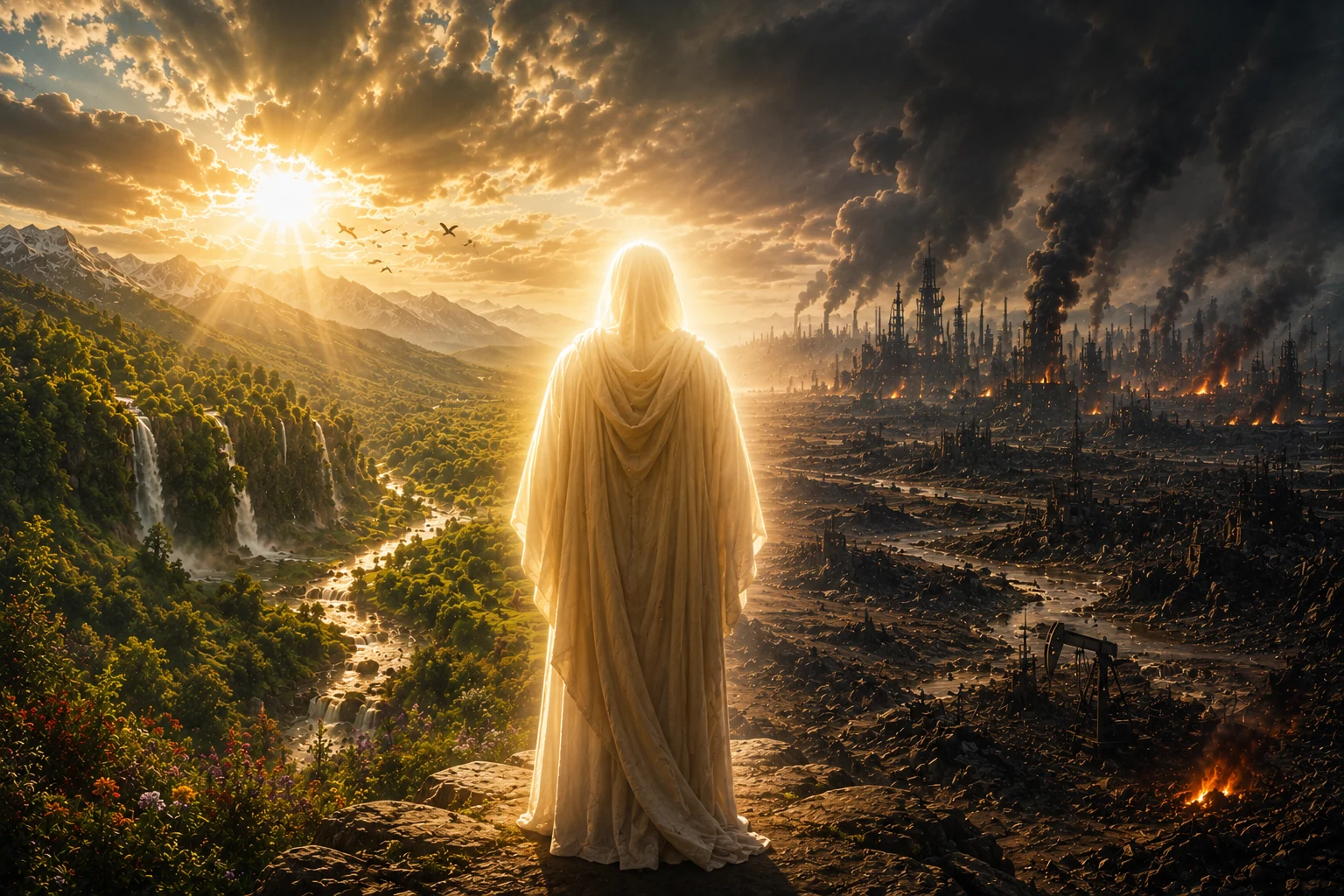
A conversation about faith becomes a larger question about responsibility, moral choice and what humanity does with what has been entrusted to it.
If God remains sovereign while our choices still carry consequences, when does trusting God become faith—and when does it become an excuse for refusing responsibility?
THE QUESTION
A conversation I had with a friend stayed with me longer than I expected. We were talking about the condition of the world—war, division, hatred, politics, what we're doing to one another, what we're doing to the land, and the way people seem increasingly unable to sit across from somebody who thinks differently without turning that person into an enemy.
Eventually the conversation turned toward God, and the question became something like this:
With everything going on in the world, aren't we really just waiting for God to come back and fix it?
I understood the question. I believe in God. I believe there are things larger than us, and I believe there are things human beings cannot control, understand or repair by themselves. But something about the question kept bothering me, because before I could ask what God was eventually going to do with the world, another question came into my mind:
What did God tell us to do with it?
That is where this story begins. Not with an argument against God. Not with an argument against faith. And certainly not with the idea that human beings can solve everything by themselves.
My question is almost the opposite. If you believe that God created humanity for a reason, placed humanity within creation for a reason, gave humanity abilities for a reason and allowed human choices to carry consequences for a reason, then at some point we have to ask what our part was supposed to be—and when we accept responsibility for it.
The Beginning Wasn't Empty
The opening chapters of Genesis do not describe humanity arriving in an empty universe with nothing to do. The creation account repeatedly calls what God makes good, and finally describes the whole of creation as “very good.” The text later says the work of creation was finished.
Then humanity appears.
Even the language used to describe humanity tells us something. The Hebrew narrative deliberately connects adam, the human, with adamah, the ground from which the human is formed. Humanity is not presented as something completely detached from the earth. We come from the ground in the story, we live from the ground, we work within it, and eventually, Genesis says, we return to it.
That relationship matters.
Then comes one of the most misunderstood words in the conversation: dominion.
For years, I thought of dominion almost automatically as stewardship. The research made me slow down. The Hebrew term behind dominion is stronger than that. It involves rule and authority. Dominion really does grant humanity authority within creation.
Stewardship is the next question:
What kind of authority are we supposed to exercise?
Because authority does not automatically mean ownership, and ownership does not automatically mean we can do whatever we want without consequence.
Authority doesn't only give you power. Authority gives you something to answer for.
The House
Suppose I own a house and I have a son. One day I tell him, “This is the house you're going to live in. Use it. Enjoy it. Make a life here. Take care of it. Maintain it. Make decisions about it.”
The house is still mine in the larger sense, but I have entrusted it to him. I'm not going to come through the front door every morning and decide where he puts the couch. I'm not going to cut his grass every Saturday, wash every dish or stand over him while he replaces a lightbulb. At some point, if I have entrusted him with the house, the responsibility for how he lives in it becomes real.
Suppose he takes good care of it. He fixes it, improves it, keeps it safe and one day hands something valuable to his own children.
Would we say I deserve all the credit because I originally owned the property?
No.
He took responsibility for what was placed in his hands.
Now change the story.
Suppose he tears the house apart. He never repairs the roof, destroys the plumbing, punches holes through the walls and sets the kitchen on fire. Then he stands in the ashes looking at me and says:
“Why did you let my house get destroyed?”
Now we have a different question.
I entrusted him with the house. I remained his father. I could advise him. I could warn him. I could help him. I could remain present in his life. None of that changes the fact that he made choices inside the house.
So who destroyed it?
That is not abandonment.
That is responsibility.
And that is where I think the idea of dominion becomes uncomfortable.
It Was Never Really Ours
The biblical tradition doesn't stop at dominion. It repeatedly returns ownership to God. The earth ultimately belongs to God. Human beings exercise authority within something they did not create and will not possess forever.
That changes the way I think about ownership.
We spend our lives saying my house, my land, my company, my money, my community, my country and my resources. There are practical reasons we need ownership. Society has to know who is responsible for property. Businesses need owners. Land has titles. Homes have deeds.
But none of us are permanent owners.
Eventually we leave. Somebody else gets the house. Somebody else walks the land. Somebody else operates the business. Somebody else spends the money. Somebody else sits in the chair.
Countless generations lived before us, and if we take care of what has been entrusted to us, countless generations may come after us. Our own species, Homo sapiens, has existed for roughly 300,000 years.
So maybe the true measure of ownership isn't simply what we possessed while we were here. Maybe part of the measure is what condition we left it in when our turn was over.
Work Was Already There
There's another part of Genesis that changed for me once I actually stopped and looked at it.
Work existed before the Fall.
Humanity was placed in the garden with something to do: work it, keep it, guard it and care for it. The Hebrew words carry ideas of working or serving and keeping or guarding. The text doesn't say humanity sat in paradise doing nothing until sin arrived and God punished everybody with a job.
Responsibility was already present. Purpose was already present.
What changes afterward is the condition surrounding the work. The ground becomes resistant. Thorns and thistles appear. Sweat, painful toil and mortality enter the story.
Work didn't disappear. It changed.
That distinction matters to me because somewhere along the way we began thinking of responsibility itself as punishment. We talk about freedom as if freedom means nobody can tell us anything—no responsibility, no obligation, no accountability, just do whatever you want.
But what if meaningful freedom was never freedom from responsibility?
What if meaningful choice is valuable precisely because our choices matter?
Choice, Consequence and Accountability
This is where I have to be careful with language. Different religious traditions argue deeply about “free will”—what it means, how free human beings really are and how human freedom fits beside divine sovereignty.
I am not going to solve that debate here, and I don't need to.
The Bible clearly treats human beings as morally accountable creatures who make meaningful choices. Commands would make little sense otherwise. Consequences would make little sense. Accountability would make little sense.
Deuteronomy places life and death, blessing and curse, before people and tells them to choose life—not only for themselves, but for their descendants. Choice, consequence and generation are tied together.
So whatever theological language we prefer, human agency matters.
And that raises another question.
If human beings were given meaningful choices, what would those choices mean if every consequence were immediately erased?
If every time we destroyed something God immediately restored it, would responsibility be real?
If every time we harmed one another God automatically repaired the relationship, would responsibility be real?
If every time we made a terrible decision God removed the consequences, would responsibility be real?
Would we learn?
Would we mature?
Would the choices matter?
I don't pretend to know the full answer. I am asking the question.
Because God permitting human beings to make a choice is not necessarily the same thing as God choosing the action for us.
God commanded something. God permitted something. Human beings chose something. Those are not automatically the same statement.
This is where religion can become uncomfortable. It is easy to thank God when things go right. It is easy to blame God when things go wrong.
But what happens when the thing that went wrong can be traced back to choices we made?
If I destroy a relationship because I refuse to apologize, can I blame God for the relationship ending?
If people build systems that reward exploitation, can we place every consequence of those systems at God's feet?
If governments choose war, can humanity act as if no human decision was involved?
If communities choose hatred over cooperation, do we really get to say that division simply appeared?
If we destroy the thing we were entrusted with, how quickly do we turn toward the Owner and ask why He allowed it?
That doesn't explain every tragedy, and it shouldn't. Disease exists. Natural disasters exist. People suffer things they did not choose. Children suffer things they never caused. There are questions of pain, evil and suffering far larger than anything this article can answer.
So I am not saying that everything bad that happens is humanity's fault.
I'm asking something narrower:
When something clearly sits within the area of human responsibility, why are we sometimes so reluctant to accept that responsibility?
Grace and What We Owe the Next Generation
Responsibility cannot mean we never fail. We do. I have. You have. Humanity has.
The point isn't perfection. If faith means anything to me, grace has to remain somewhere inside the conversation. Grace means failure does not have to be the final chapter. We can repair. We can apologize. We can rebuild. We can forgive. We can learn. We can change direction. We can recognize the damage we've caused and decide not to hand that same damage to the people coming behind us.
Grace does not eliminate responsibility.
Maybe grace gives responsibility another chance.
And that leads to another question:
What do we owe people who aren't here yet?
Children not born. Grandchildren we may never meet. Communities that will exist after our names are forgotten.
We inherited a world other people touched before us. Some left us extraordinary things: knowledge, roads, schools, medicine, science, art, technology, institutions, faith traditions, stories, family names and land.
Other generations left us wounds: war, hatred, pollution, debt, prejudice, broken communities, violence and ideas about whose humanity mattered more.
We inherited both.
And eventually somebody will inherit what we leave.
So maybe stewardship isn't just about protecting trees or rivers. Maybe stewardship includes protecting possibilities—leaving the next generation a world where they still have choices.
If nothing here ultimately remains ours, perhaps the measure was never simply how much we possessed, but what condition we left it in when our turn was over.
Future Hope and Present Responsibility
This was another place where the research changed my thinking.
Popular religious language often makes the afterlife sound like humanity's goal is simply to leave Earth behind: die, go to heaven and leave this broken place forever.
But historic Christian teaching is much more centered on resurrection and renewed creation than many casual conversations suggest. The biblical imagery includes bodily resurrection and a new heaven and new earth—not simply humanity escaping creation as disembodied spirits forever.
That makes the question even more interesting.
If the beginning of the biblical story places humanity inside creation with responsibility, and the end points toward resurrection and renewed creation, then what are we supposed to be doing in between?
Future restoration cannot automatically mean present responsibility disappears.
Which means “God will fix it someday” cannot automatically answer another question:
What are we supposed to do today?
The Bedroom
I think about my son.
When children are small, you help them with everything. You straighten their room. You show them where the clothes go. You pick things up together. You teach them how to make the bed. You explain what belongs where.
At first, they need help.
But eventually you say, “This is your bedroom. You need to take care of it.”
That doesn't mean you stopped loving them. It doesn't mean you abandoned them. It doesn't mean you stopped being their parent. It means part of parenting is teaching responsibility.
Now suppose the child destroys the room every week. Clothes everywhere. Food everywhere. Everything broken. Then he comes to you and says:
“Dad, you didn't clean my room this week?”
At some point I'm going to look at him and say, “It's your room.”
I can help you. I can guide you. I can teach you. But you have to start taking responsibility for your own space.
Otherwise, when do you grow up?
And maybe that's one of the questions humanity doesn't like asking itself.
When do we grow up?
When do we stop demanding adult authority while expecting someone else to clean every mess we make with it?
Put It in God's Hands
I've heard that phrase my entire life: Put it in God's hands.
Sometimes it is exactly what a person needs to do. There are moments when you've done everything you know to do. You've prayed. You've worked. You've apologized. You've fought. You've tried. You've reached the limits of your control.
At that point, faith can mean accepting that you are not God. There are things you cannot control.
But there is another way the phrase can be used.
I don't want to change, so put it in God's hands. I don't want to apologize, so put it in God's hands. I don't want to forgive, so put it in God's hands. I don't want to participate, so God will handle it. I don't want to examine what my choices contributed, so God has a plan.
Those are not necessarily acts of faith.
Sometimes they can become acts of abdication.
Scripture itself repeatedly refuses to separate belief from action. Religious profession without ethical responsibility is criticized throughout the biblical tradition. Faith and action are not enemies. Prayer and responsibility are not enemies.
At what point does trusting God become faith—and at what point does it become an excuse for refusing to do what was placed in our hands?
One Shared House
This is where the conversation becomes larger than the land, because if humanity has responsibility, surely that responsibility includes how we treat one another.
We have divided ourselves in almost every way imaginable: race, religion, politics, nationality, class, sexuality, culture, language and ideology.
I'm not saying those differences aren't important. They are important to people. Religious beliefs matter. Political ideas have consequences. Cultural differences are real. Moral disagreements are real.
But disagreement does not erase personhood.
Your differences do not make the person across the table less human.
Maybe we have spent so much time fighting over who deserves which room that we've forgotten everybody is living in the same house.
You can hate the person in the bedroom across the hall. You can argue about who belongs in the kitchen. You can fight over the furniture. You can insist your room is better. But if the entire house catches fire, eventually everybody is breathing smoke.
And all those arguments about which room belonged to whom suddenly become very small.
We pray for peace, but Scripture also asks people to make peace. That matters because peace isn't simply the absence of war. Peace takes participants. Reconciliation takes participants. Forgiveness takes participants. Justice takes participants. Relationships take participants. Communities take participants.
That does not mean every war can be solved by people simply sitting down and being nice to one another. Human conflict is more complicated than that. Power matters. Territory matters. Resources matter. History matters. Security matters.
But people still make decisions. Leaders make decisions. Communities make decisions. Individuals make decisions.
We can pray for peace and still have responsibilities inside the prayer.
Maybe peace doesn't begin when everybody agrees.
Maybe it begins when disagreement stops becoming permission to destroy one another.
The Conversation About Consciousness
That brings me back to the conversation that started all of this.
The person I was speaking with believed that in whatever world comes next, we might not carry the same consciousness or memories with us.
I later learned that this is not a settled Christian teaching. In fact, major Christian traditions generally preserve personal continuity through resurrection, even though they disagree about what happens between death and resurrection.
Jehovah's Witness teaching—which was relevant to the original conversation—also explicitly says resurrected people retain their identity, personality and memories.
So I am not presenting memory loss as doctrine.
I'm asking a hypothetical question.
If that belief were true—if we remembered nothing, carried nothing forward, and nothing about what we learned mattered because everything were simply wiped clean—then what was the lesson?
What was choice for?
What were consequences for?
What did responsibility teach?
What did love teach?
What did hatred teach?
What did loss teach?
What did forgiveness teach?
What did building teach?
What did destroying teach?
If humanity were placed onto a completely restored world with none of the understanding from what came before, what would prevent us from eventually making the same choices again?
I don't know.
That's the point.
I'm asking.
What Happens in Between?
Maybe this life isn't simply about owning things. Maybe it isn't simply about building things. Maybe it isn't simply about religion. Maybe it isn't simply about getting through enough years until God changes everything.
Maybe responsibility itself is teaching us something about choice and consequence, about one another and ourselves, about what authority does to people, what love requires, how difficult forgiveness is and how easy hatred can become.
Maybe it is teaching us how much easier it is to destroy something than to build it, what happens when power is separated from accountability, what happens when faith is separated from action, and what happens when we inherit something valuable and forget that somebody else is coming behind us.
I don't know the full purpose for why humanity is here. I would be suspicious of anybody who claimed they could explain God's entire purpose in an article.
But I do know this: we were given extraordinary abilities. We reason. We remember. We teach. We learn. We create. We cooperate. We adapt. We repair. We forgive. We pass knowledge forward.
And our choices affect people we will never meet.
So maybe the harder question isn't why God hasn't fixed everything.
Maybe it's why we were entrusted with anything at all.
Because if the house was placed in our care, if we were given the ability to reason, to choose, to build, to repair, to forgive and to change, if our choices carry consequences, and if another generation is eventually going to inherit whatever condition we leave this place in, then at some point we have to stop standing in the middle of the ashes asking why the Father hasn't cleaned this up for us.
At some point, the children have to take responsibility for what they've done to the house.
We cannot pray for peace while choosing hatred. We cannot pray for stronger communities while refusing to know our own neighbors. We cannot pray for our children while handing them problems that we are creating, problems we refuse to solve and problems we continue making worse.
We cannot pray for the Earth while continuing to consume it as though nobody is coming behind us. We cannot ask God to repair relationships we are too proud to apologize for. We cannot ask God to fix governments we refuse to hold accountable. And we cannot ask God to heal divisions that we continue feeding each and every single day.
At some point, responsibility has to become ours.
Not because God stopped being God. Not because faith stopped mattering. Not because prayer stopped mattering.
But because being entrusted with something has to mean more than having permission to use it.
It has to mean being accountable for what we do with it.
Maybe that is what dominion was supposed to teach us.
Not that everything belonged to us. Not that we could do whatever we wanted. Not that somebody would always come behind us and repair whatever we destroyed.
But that authority carries responsibility.
Choice carries consequence.
And maturity means eventually accepting both.
What Are We Going to Leave Behind?
Countless generations were here before us. Countless generations may come after us. None of us gets to stay.
We are only holding the house for a little while.
One day our names will be gone. Someone else's children will walk across the ground we once called ours. They will inherit the communities we built, the divisions we healed—or deepened—the resources we protected—or exhausted—the institutions we strengthened—or abandoned—and the relationships we repaired—or allowed to break.
The house will eventually become another generation's responsibility.
So what are we going to leave them?
A house we cared for?
Or the ashes of one we spent our lives destroying while asking the Father why He didn't stop us?
If we were trusted with the house, given the ability to choose what we would do inside it, and given enough wisdom to know that somebody would come after us—what excuse will we give them for what we chose to leave behind?
Sources & References (89)
SOURCES & NOTES
This essay was developed with research from the Sunday Dinner Media Research & Historical Intelligence Desk. The research examined the Genesis creation narratives, Hebrew terminology, Jewish and Christian interpretations of dominion and stewardship, human moral agency, divine sovereignty and providence, resurrection and new-creation theology, personal continuity after death, peacemaking, intergenerational responsibility and the history of modern Homo sapiens.
The article is a work of commentary and philosophical reflection. Where Jewish and Christian traditions disagree, those disagreements are not presented as settled doctrine.
The Hebrew term commonly translated as dominion conveys rule or authority. The argument that such authority should be exercised as stewardship is a theological interpretation informed by Genesis 2, God's continuing ownership of creation and broader biblical traditions of responsibility.
The article also distinguishes divine permission from human choice. It does not argue that every tragedy or form of suffering results from human wrongdoing, nor does it attempt to resolve the larger theological problem of evil.
The discussion of lost memory in a restored world is presented as a hypothetical arising from the conversation that inspired the essay. It is not presented as established Christian doctrine or as the official doctrine of Jehovah's Witnesses.
PRINCIPAL SOURCES & REFERENCES
Genesis 1:26–31 — Sefaria / Jewish biblical text and translations
Dominion, humanity in God's image, and creation described as “very good.”
View source:
https://www.sefaria.org/Genesis.1.26?lang=bi
Genesis 2:7 and Genesis 2:15 — Sefaria / Academic Hebrew analysis
Humanity's relationship to the ground and the commission to work and keep the garden.
View source:
https://www.sefaria.org/Genesis.2.15?lang=bi
TheTorah.com — The Exposition of the Garden of Eden Story
Academic discussion of adam, adamah, Genesis 2–3 and the human-ground relationship.
View source:
https://www.thetorah.com/article/the-exposition-of-the-garden-of-eden-story
Luther Seminary / Working Preacher — “To Till It and Keep It?”
Discussion of the Hebrew terms avad—work/serve—and shamar—keep/guard.
View source:
https://www.workingpreacher.org/dear-working-preacher/to-till-it-and-keep-it
Radak on Genesis 1:26 — Sefaria
Classical Jewish interpretation of dominion as genuine human authority.
View source:
https://www.sefaria.org/Radak_on_Genesis.1.26
Pope Francis — Laudato Si'
Creation, stewardship, God's ownership, human responsibility and care for future generations.
View source:
https://www.vatican.va/content/francesco/en/encyclicals/documents/papa-francesco_20150524_enciclica-laudato-si.html
Catechism of the Catholic Church — Divine Providence and Created Causes
Divine sovereignty, human agency, cooperation and responsibility without divine abandonment.
View source:
https://www.vatican.va/content/catechism/en/part_one/section_two/chapter_one/article_1/paragraph_4_the_creator.html
Catechism of the Catholic Church — Freedom and Responsibility
Human freedom, voluntary action, moral responsibility and accountability.
View source:
https://www.vatican.va/content/catechism/en/part_three/section_one/chapter_one/article_3/i_freedom_and_responsibility.html
Deuteronomy 30:15–20 — NRSVUE
Choice, consequence and responsibility toward future generations.
View source:
https://www.biblegateway.com/passage/?search=Deuteronomy+30%3A15-20&version=NRSVUE
James 1 — Doers and Hearers
Religious profession, action and responsibility toward others.
View source:
https://www.biblegateway.com/passage/?search=James+1&version=NRSVUE
Orthodox Presbyterian Church — Westminster Confession of Faith
Reformed treatment of divine sovereignty, providence, human agency and responsibility.
View source:
https://opc.org/documents/MESV_col.html
United Methodist Church — What We Believe / Social Principles
Grace, human response, stewardship, dignity, justice and social responsibility.
View source:
https://www.umc.org/en/content/what-we-believe-what-it-means-to-be-united-methodist
Catechism of the Catholic Church — The New Heaven and the New Earth
New creation, future restoration and the relationship between future hope and present responsibility.
View source:
https://www.vatican.va/content/catechism/en/part_one/section_two/chapter_three/article_12/vi_hope_of_the_new_heaven_and_the_new_earth.html
Orthodox Church in America — Resurrection and Renewed Creation
Bodily resurrection and the Christian expectation of renewed creation.
View source:
https://www.oca.org/orthodoxy/the-orthodox-faith/doctrine-scripture/the-symbol-of-faith/resurrection
Jehovah's Witnesses — Official Resurrection Teaching
Relevant to the conversation that inspired the essay; official teaching states that resurrected persons retain identity, personality and memories.
View source:
https://www.jw.org/en/bible-teachings/questions/what-is-the-resurrection/
General Conference of Seventh-day Adventists — Fundamental Beliefs
A contrasting Christian view of unconsciousness during death while awaiting resurrection.
View source:
https://gc.adventist.org/beliefs/
Catholic doctrinal statement on eschatology
Continued personal identity, consciousness and will after death in Catholic teaching.
View source:
https://www.vatican.va/roman_curia/congregations/cfaith/documents/rc_con_cfaith_doc_19790517_escatologia_en.html
Smithsonian Institution — Human Origins Program: Homo sapiens
Scientific basis for the approximately 300,000-year history of modern Homo sapiens.
View source:
https://humanorigins.si.edu/evidence/human-fossils/species/homo-sapiens
Catechism of the Catholic Church — Respect for the Human Person
Human dignity and responsibility toward people who differ from us.
View source:
https://www.vatican.va/content/catechism/en/part_three/section_one/chapter_two/article_3/i_respect_for_the_human_person.html
Catechism of the Catholic Church — Safeguarding Peace
Peace as a moral responsibility involving justice, dignity and human participation.
View source:
https://www.vatican.va/content/catechism/en/part_three/section_two/chapter_two/article_5/iii_safeguarding_peace.html
EDITORIAL RESEARCH NOTE
Research concluded that the essay's central argument is supported with qualifications.
The conversation is open
Be the first reader to add a thoughtful response.