
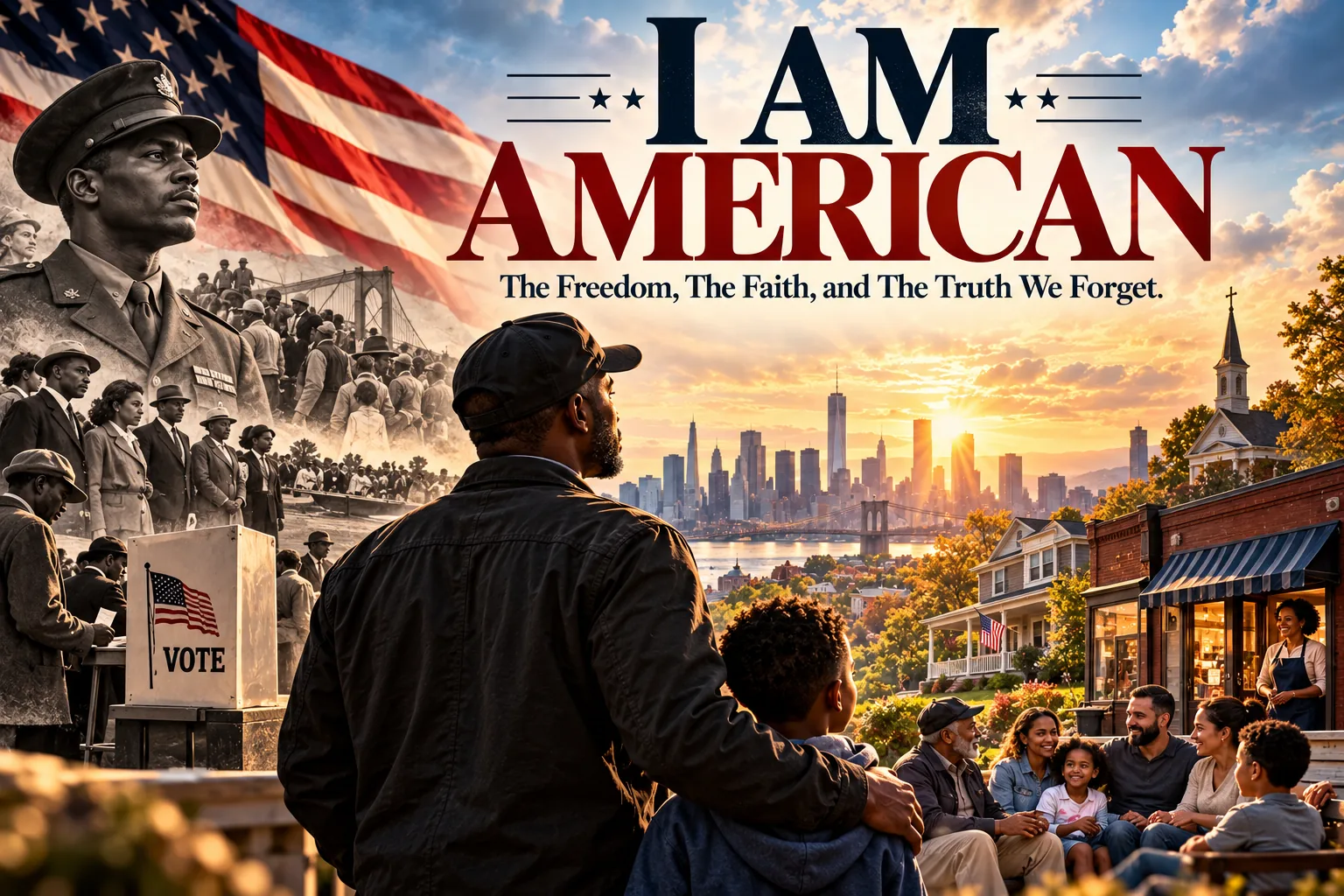
I am American first, New Yorker second.
When I travel across this country, people often hear New York in my voice before I tell them where I’m from. Maybe it is my walk, my speech, or the way I carry myself. New York stays with you wherever you go. And when I have traveled abroad, the first thing people have recognized is that I am American.
Then I come home, fill out a form, and find a box asking me to explain who I am.
I am a Black American. I know who I am and where I come from. But I will not let anybody use one part of my identity to make me less American. I was born here. This is my home. If you were born here, or became a citizen here, this is your home, too. I say that with conviction because my family has given too much to this country for me to speak of belonging as if someone else could grant it to me.
THE FREEDOM THEY WERE ASKED TO DEFEND
My father fought in the Korean War. On my mother’s side, three of my uncles and an aunt served in the military; one of those uncles fought in Vietnam. My aunt later married a Navy admiral. Military service runs deep in my family. When I think about what it means to answer America’s call, I think first of them.
I also think about the America they knew. My father served while the military was still working to end segregation within its ranks. Outside the service, Jim Crow shaped daily life. It could dictate where Black Americans sat, which water fountain they used, and which restroom they entered. In much of the South, the Constitution’s promise of a vote did not mean a Black person could safely register and cast one. Officials used discriminatory rules to block the ballot, while intimidation and violence made the attempt dangerous.
Think about this for a minute. Young Americans were asked to put on a uniform and defend freedom while Jim Crow policed their most basic rights at home. They were asked to risk everything for a country that did not fully honor them in return. Let that sit for a moment before anyone questions whether their families belong here.
The struggle for freedom at home was also service to this country. Black Americans marched, organized, registered voters, challenged unjust laws, and endured beatings and threats. White Americans, Jewish Americans, and people from other communities stood alongside them. Their work helped bring about civil rights protections that reached far beyond the people who first marched. The laws changed what the country had to recognize; each generation still has to decide whether it will live up to that promise.
That is the history I carry when I hear someone announce who is a “real American,” who should stay, and who should leave. Nobody has to agree with every belief I hold. But no one gets to make my family’s service disappear or treat my freedom as smaller than theirs.
WHAT IT MEANS TO STAND HERE
I have the freedom to build a business, raise my son, speak my mind, and make choices about the life we live. I want him to know how hard earlier generations fought for those possibilities. I want him to stand ten toes up when somebody tells him to make himself smaller. And I intend to show him what that looks like by making my own stand.
You have the right to believe what you believe. I have the right to believe what I believe, including the right to disagree with you in public. You have the freedom to use your voice; so do I. Patriotism cannot mean that one person gets to speak while another is told to hush. I will not pledge myself to a man who wants to be treated like a king. If I bow down, it is to my God. My faith guides my conscience; it does not require me to hand my conscience to someone else.
Loving America does not require me to forget where it failed. My father and my uncles answered its call. My aunt answered it, too. The people who confronted Jim Crow asked this country to answer its own promise. I can honor those who served in uniform and those who stood up at home, and still ask America to become better than it has been.
Being American is more than a box on a form. It is a claim we make on one another: that the freedom we prize must be freedom other people can live. If you use your freedom to spread hate, I will use mine to stand against it. I will not be quiet so that hate can feel comfortable. I choose love that speaks up.
My freedom is equal to yours.
This country does not belong to one race, one religion, or one way of thinking. When I say “U.S.,” I hear *us*. We will not agree on everything, but we can decide whether our differences become an excuse to exclude people or a reason to build a nation wide enough for all of us. That is the America I am willing to stand for.
THE SUNDAY DINNER QUESTION
How do we come together and build a better nation for all, not just for some?\
Sources & References (8)
## SOURCES & REFERENCES
- [Original personal essay, Uncle Clarence BBQ Sunday Dinner Magazine](https://uncleclarencebbq.com/blogs/sunday-dinner-magazine/i-am-american-the-freedom-the-faith-and-the-truth-we-forget). Source for the author’s previously published voice and original version.
- [National Archives, Executive Order 9981](https://www.archives.gov/milestone-documents/executive-order-9981). The 1948 order on equality of treatment and opportunity in the armed services.
- [Library of Congress, “Jim Crow and Segregation”](https://www.loc.gov/classroom-materials/jim-crow-segregation/). Segregation in daily life and barriers to voting.
- [Library of Congress, “Voting Rights”](https://www.loc.gov/collections/civil-rights-history-project/articles-and-essays/voting-rights/). Registration barriers, intimidation, and the movement for access to the ballot.
- [National Archives, Civil Rights Act of 1964](https://www.archives.gov/milestone-documents/civil-rights-act). Federal protections in public accommodations, education, and employment.
- [National Archives, Voting Rights Act of 1965](https://www.archives.gov/milestone-documents/voting-rights-act). Federal enforcement against discriminatory voting practices.
*Editorial note: This personal essay was first published by Uncle Clarence BBQ Sunday Dinner Magazine. It has been substantially revised for Sunday Dinner Media, including the author’s expanded family account and updated historical context. Family service details are based on the author’s account.*


The conversation is open
Be the first reader to add a thoughtful response.