
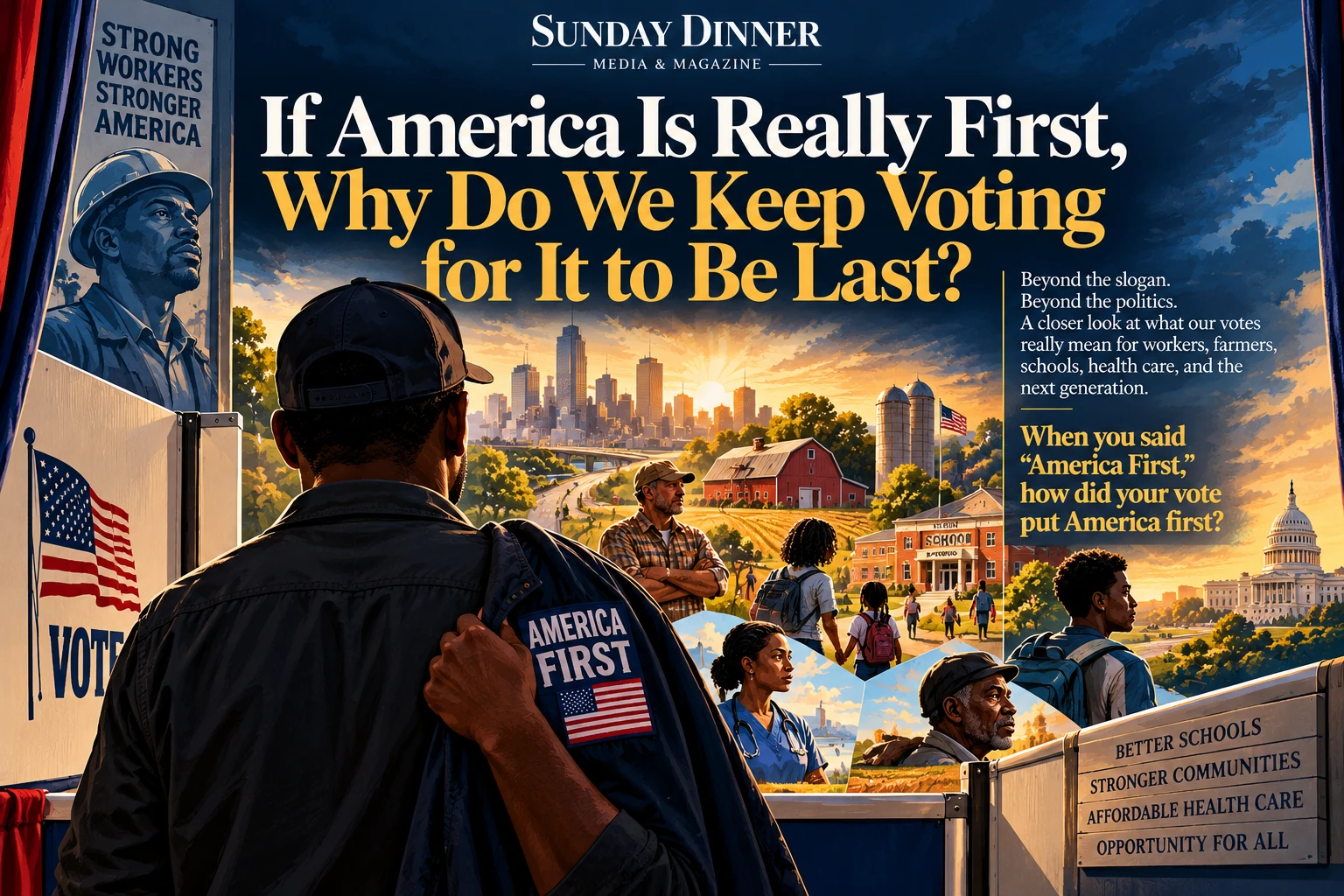
America First fits on a bumper sticker. It sounds good at a rally. You can print it on a shirt, put it on a hat, and feel proud wearing it. But the words mean little until you ask what happens after someone wearing that hat steps into a voting booth. Who gets a better chance to work and build a life? Whose rights are protected? What problems will the people seeking office actually solve?
For years, I heard the chant grow louder. I understood its appeal. Who would not want their country to be strong, its workers respected, its children educated, and its families able to live without fear of one bill they cannot pay? But I kept coming back to a different question: If we wanted to put America first, what did we vote to put first instead?
The Worker Behind the Words
That question did not begin in 2026. For generations, Americans have argued about what government owes to workers and what it owes to powerful businesses. When coal miners went on strike in 1902, President Theodore Roosevelt stepped into a dispute that threatened the country’s fuel supply. His Square Deal held that labor deserved consideration alongside management. Roosevelt’s America was far from fair to everyone, but his intervention gives us a test worth carrying into our own time: when working people and powerful interests pull in opposite directions, does the government treat workers as part of the nation it exists to serve?
My uncle once told me about a shirt he wore. He remembered its softness, its craftsmanship, and the pride of knowing where it came from. Later, he said, the company moved production overseas. The familiar name and price remained, but the shirt did not feel the same to him. I cannot verify that company’s costs from a family story, but I can tell you why it stayed with me. When a business finds a cheaper way to make something, who gets the benefit? Does the customer pay less? Does a worker find another good job? Or does the name on the label simply become more profitable for someone else?
I understand why a company watches its costs. We own a business ourselves. But what is good for a company’s balance sheet does not automatically strengthen the country that gave it a market. American manufacturing employment fell over decades for several reasons, including technology, trade, recessions, and changes in the kinds of jobs our economy creates. We cannot blame every lost factory job on one decision or one president. We can ask whether leaders who praise American workers are willing to build an economy in which those workers can earn a secure living.
What Were We Warned About?
That question became urgent in the 2024 election. Kamala Harris warned that Donald Trump would impose broad tariffs and that families could bear some of the cost. She warned of moves against the Department of Education and said he would grant clemency to people convicted in connection with January 6. Those warnings were public. You were free to disagree with her, challenge the numbers, or decide that other issues mattered more. But you could examine what she said before anyone cast a ballot.
Since the election, the administration has imposed broad tariffs, directed steps toward closing the Department of Education, and issued sweeping January 6 pardons and commutations. The Affordable Care Act was not repealed, but the 2025 law changed Medicaid and Marketplace coverage. Major new Medicaid eligibility requirements are generally scheduled to begin in January 2027. We cannot say every warning came true exactly as described, but we also cannot call the health care warning unfounded simply because the ACA still bears its name.
Now some of the people who helped carry the political promise are asking questions of their own. Marjorie Taylor Greene publicly challenged Trump over affordability and foreign commitments before their alliance broke over the Epstein files. Tucker Carlson, who campaigned with Trump in 2024, later said he regretted that support as they split over the war with Iran. They are entitled to change their views. You are entitled to ask them what changed: the actions they saw, the information they had, or their willingness to speak against a leader they once helped elect.
That question does not stop with the people on television. It reaches you and me. An election never comes with perfect information, and no voter can know everything a president will do. But when serious warnings are out in the open, a vote carries responsibility for weighing them. We cannot hand that responsibility to someone else after the fact.
First for Whom?
A tariff may sound like a way to stand up for American production. Its results have to be judged across the people it affects. Farmers have described losing export opportunities amid trade conflict while also facing low crop prices and rising costs. The administration has provided aid, but farmers interviewed by the Associated Press questioned whether temporary payments could replace dependable customers. At the same time, a policy meant to ease beef prices by allowing more imports from Argentina drew objections from American ranchers. A shopper wants an affordable meal; a rancher needs a future for the herd. Both are Americans. If a policy puts one first at the expense of the other, leaders owe both an honest explanation of the trade-off.
Families deserve that honesty about their own finances. The cost of living was already too high for many people before this administration took office. Prices have continued rising since. Some households can pay their credit-card bills in full; others carry expensive balances or use credit to get through the month. A national jobs announcement cannot tell you what remains after food, housing, insurance, transportation, and debt are paid. When politicians say the economy is strong, you have every right to ask: Strong for whom?
Who Taught You to Fear an Investment in Yourself?
Think about the last time a politician announced public money for a company. You may have wanted to know how many jobs it would create and whether the company would keep its promise. Those are good questions. But were you told that using your tax dollars to help that company was “socialism”?
Now picture your own workday. You need child care so you can get to your job. When school ends, you need somewhere safe for your child to go until you can pick them up. You want that child to eat lunch, learn well, and have a path to college or training that will not bury them in debt. You work and pay taxes, yet when you ask whether those things could be more affordable, someone tells you to fear the cost. Someone calls it “socialism.”
Why does the word change when the investment could help you?
A tax break for a wealthy household means the government collects less money. A contract for a corporation uses money collected from taxpayers. You have every right to ask whether those choices serve the public. But ask the same question about child care and education: could they help you keep working and help your child build a life? Why are you encouraged to question whether your neighbor deserves a school lunch, but seldom invited to examine with the same suspicion what a powerful company receives?
You are also asked to understand why America commits your tax dollars to other countries. You can recognize that those commitments may serve a purpose and still notice that some of the countries we support have made broader health care and education available to their own people. The point is not that an American dollar pays another country’s doctor or a student’s tuition. The point is the question you are entitled to ask at home: Why is investing in a country’s future a respectable idea until the country is yours and the person who needs help is you?
None of these choices is free. You know that better than anyone; you see taxes taken from your paycheck and bills waiting when you get home. So do not let a label end the discussion before you get an answer. Ask what a program costs. Ask whether it works. Ask who benefits. Then ask those questions of the corporate contract, the tax break, and the foreign commitment, too.
The next time someone calls an after-school center, affordable health care, or a meal for an older neighbor “socialism,” think about your own family. Think about the help they may need one day. Then ask: Who benefits when I am taught to vote against an investment in people like us?
What Did We Build?
That question follows us to the work of rebuilding the country. The infrastructure law has continued to fund projects, but federal reviews have also canceled awards and left others awaiting decisions. Construction spending slowed in 2026. Those facts do not mean that no bridges are being built or that every delayed project cost someone a job. They mean you should be able to follow a promise through to the project, the worker, and the community waiting for it. Calling a plan “America First” is easier than showing people the finished work.
Too often, a candidate offers a long account of what is broken and a short account of what they will do. Government is the problem. The other party is the problem. Your neighbor is the problem. Naming an enemy may win attention, but governing requires a solution you can examine. What will it cost? Who will benefit? Who might be harmed? When should you expect results? And if the plan fails, will the person who asked for power take responsibility?
What Would “America First” Require of Us?
I do not believe one party can be the whole solution. There is no single kind of American. We are a country of people with different histories, faiths, jobs, and ideas. We will argue about how to spend public money, how to protect rights, and how to build a fair economy. We should argue. But if every disagreement turns a fellow citizen into an enemy, how do we sit down long enough to solve anything together? How do we draw a truce long enough to repair a bridge, strengthen a school, or make care accessible? How do we break bread?
America will not become perfect when it reaches 250 years, and it will not be perfect 250 years from now. Each generation has a responsibility to leave the next one a stronger foundation. That takes labor, investment, compromise, and the courage to tell people what a solution will cost as well as what it might deliver. It asks elected leaders to represent the public rather than spend every term campaigning against someone to blame.
I try to live those words before I ask anyone else to. I buy from local farmers and businesses when I can. I look for goods made by American workers, and I am willing to pay more when I can afford to support that work. I know every purchase is a choice, and I cannot make every choice perfectly. But if I say American labor matters, I want that belief to show up in my home as well as in my vote.
Now think back to the voting booth. You may have wanted a stronger border or a different direction for the country. But after the vote, look beyond the hat, the flag, and the slogan. Look at the worker, the farmer, the school, the family trying to afford care, and the child who will inherit what we build.
When you said “America First,” how did your vote put America first?
Sources & References (42)
SOURCES & REFERENCES
National Park Service. “John Mitchell.” Background on the 1902 coal strike and President Theodore Roosevelt’s intervention.
https://www.nps.gov/thri/john-mitchell.htm
U.S. Bureau of Labor Statistics. “Forty Years of Falling Manufacturing Employment.” Historical manufacturing employment and the shift toward service-sector jobs.
https://www.bls.gov/opub/btn/volume-9/forty-years-of-falling-manufacturing-employment.htm
Kamala Harris. Remarks prepared for delivery at the 2024 Democratic National Convention. Source for her public warnings concerning the Department of Education and the Affordable Care Act.
https://d3i6fh83elv35t.cloudfront.net/static/2024/08/REMARKS-AS-PREPARED-FOR-DELIVERY-Vice-President-Harris-Acceptance-Speech.pdf
ABC News. “Harris–Trump Presidential Debate Transcript,” September 10, 2024. Source for Harris’s warning that proposed tariffs could increase costs for families.
https://abcnews.com/Politics/harris-trump-presidential-debate-transcript/story?id=113560542
The White House. “Improving Education Outcomes by Empowering Parents, States, and Communities,” March 20, 2025. Executive order directing the education secretary to take steps toward closing the Department of Education.
https://www.whitehouse.gov/presidential-actions/2025/03/improving-education-outcomes-by-empowering-parents-states-and-communities/
U.S. Department of Justice, Office of the Pardon Attorney. “President Trump’s Proclamation Granting Pardons and Commutations of Sentences for Certain Offenses Relating to the Events at or Near the United States Capitol on January 6, 2021.” Record of the January 20, 2025, clemency action.
https://www.justice.gov/pardon/president-trumps-proclamation-granting-pardons-and-commutations-sentences-certain-offenses
Centers for Medicare & Medicaid Services. “Medicaid Community Engagement Requirement for Certain Individuals,” June 1, 2026; and “CMS Issues New State Guidance on Transformative Medicaid Reforms,” December 8, 2025. Sources for Medicaid eligibility changes under Public Law 119-21 and the January 1, 2027, implementation deadline.
https://www.cms.gov/newsroom/fact-sheets/medicaid-community-engagement-requirement-certain-individuals-interim-final-rule-comment-period-cms
https://www.cms.gov/newsroom/press-releases/cms-issues-new-state-guidance-transformative-medicaid-reforms
Centers for Medicare & Medicaid Services. “2025 Marketplace Integrity and Affordability Final Rule”; and “HHS Notice of Benefit and Payment Parameters for 2027 Final Rule.” Sources for changes affecting Marketplace eligibility, enrollment, and coverage rules.
https://www.cms.gov/newsroom/fact-sheets/2025-marketplace-integrity-and-affordability-final-rule
https://www.cms.gov/newsroom/fact-sheets/hhs-notice-benefit-payment-parameters-2027-final-rule
TIME. “The Breakdown of Trump and Marjorie Taylor Greene’s Alliance—and How It Goes Beyond the Epstein Files,” November 2025; and “Tucker Carlson and Marjorie Taylor Greene Say They Are Done With the Republican Party,” June 2026. Reporting on disagreements involving two former Trump allies.
https://time.com/7334415/trump-marjorie-taylor-greene-relationship-breakdown-epstein-disagreements/
https://time.com/article/2026/06/23/tucker-carlson-marjorie-taylor-greene-republican-party-trump-iran-war/
The Associated Press. “Trump Is Giving Farmers $12B in Aid. They’ve Been Hit Hard by His Trade War With China,” December 8, 2025; and “Already Under Financial Pressure, Midwest Soybean Farmers Are Squeezed Further by Tariffs, Iran War,” April 13, 2026. Reporting on lost export sales, low crop prices, rising costs, farm aid, and farmers’ preference for income from selling crops over reliance on aid.
https://apnews.com/article/07328f260d1ebf26c2bfde79b426230e
https://apnews.com/article/5731e2d79ce125bfa0a667a862dbe35e
The Associated Press. “Trump Announces Plan to Lower Beef Prices, but Ranchers and Some Republicans Are Already Balking,” August 21, 2026. Reporting on the proposed increase in beef imports and objections from U.S. cattle producers.
https://apnews.com/article/e0e3dd60ae754d647527c7734a091edf
U.S. Customs and Border Protection. “Quota Bulletin 26-225: 2026 Argentina Beef Tranche 3.” Official record of additional Argentine beef permitted under the 2026 quota.
https://www.cbp.gov/quota-bulletin-26-225-2026-argentina-beef-tranche-3
U.S. Bureau of Labor Statistics. “Consumer Price Index — August 2026,” released September 11, 2026. Source for the statement that consumer prices continued to rise.
https://www.bls.gov/news.release/archives/cpi_09112026.htm
U.S. Government Accountability Office. “Tax Expenditures.” Explains how tax credits, deductions, and other tax provisions reduce federal revenue.
https://www.gao.gov/tax-expenditures
U.S. Department of State. “U.S. Security Cooperation With Israel.” Background on U.S. security assistance to Israel.
https://2021-2025.state.gov/u-s-security-cooperation-with-israel/
Government of Israel. “National Health Insurance” and “The Education System.” Sources describing national health coverage and publicly funded compulsory education in a country receiving U.S. security assistance. These sources do not establish that U.S. assistance pays for those domestic services.
https://www.gov.il/en/pages/national-health-insurance
https://www.gov.il/BlobFolder/generalpage/education_guides/en/edu_en.pdf
U.S. Government Accountability Office. “Funding Status: Infrastructure Investment and Jobs Act and Inflation Reduction Act.” Review of selected federal funding awards, including awards canceled or awaiting decisions.
https://www.gao.gov/products/gao-26-108434
U.S. Census Bureau. “Monthly Construction Spending, July 2026,” released September 1, 2026. Reports construction spending below its July 2025 level.
https://www.census.gov/construction/c30/current/index.html

The conversation is open
Be the first reader to add a thoughtful response.