
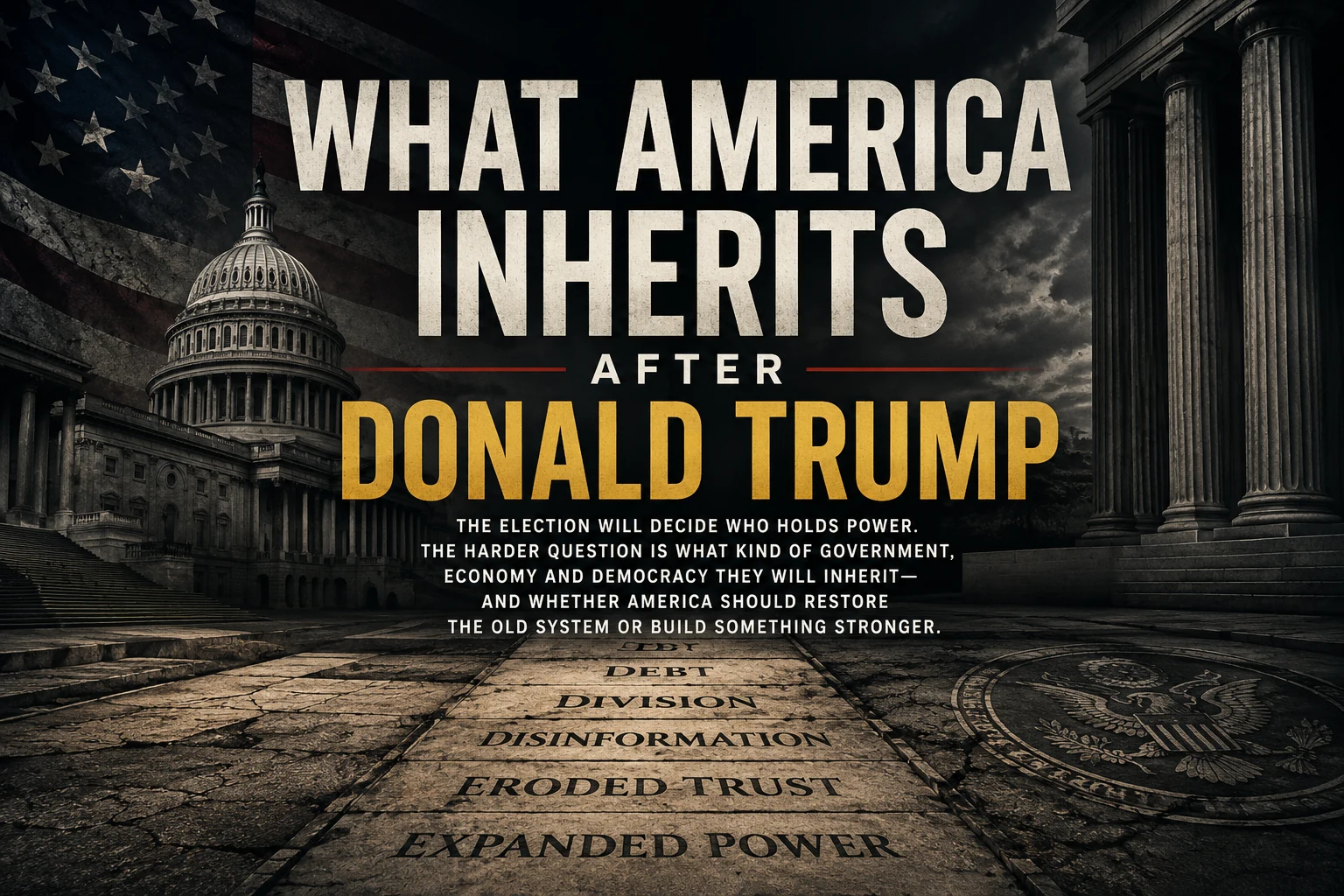
A presidency ends on a particular day. Its consequences do not.*
For the past two years, I have heard a lot from both sides of the aisle. Democrats talk about a blue wave and taking back power. Republicans talk about holding on to power. One side says that when it gets control, people will finally be held accountable. The other side warns about what will happen if its opponents take control.
Turn on television. Open social media. Listen to elected officials long enough and eventually the conversation seems to arrive at the same place: Who is going to win? Who is going to lose? Who is going to investigate whom? Who is going to be held accountable?
After listening to all of it, I found myself wondering whether anybody had stopped long enough to ask a much simpler question. Not what happens to Donald Trump.
What does America inherit after Donald Trump?
What happens to America?
What happens if Democrats win the House in 2026?
What if they win the Senate?
What if they win both?
What can Congress actually do while Donald Trump remains president?
And then comes the bigger question.
What remains after he is gone?
The debt does not disappear. The judges do not disappear. Laws do not disappear. Executive powers do not necessarily disappear. People who left the federal government do not automatically return. Countries that changed the way they think about America do not forget what happened because another president takes the oath of office.
MAGA does not disappear. The Democratic Party's problems do not disappear. The Republican Party's problems do not disappear. The money surrounding American politics does not disappear. And every presidential power Americans tolerate today becomes a power another president may inherit tomorrow.
That was where this investigation started, but it is not where it ended. Because once we started asking what America inherits after Donald Trump, another question emerged underneath it.
How much of what America will inherit did Donald Trump actually create—and how much of it was already here waiting to be used?
That question changed the story.
WINNING CONGRESS IS NOT WINNING WASHINGTON
Suppose Democrats produce the blue wave they have been talking about. Maybe they win the House, maybe they win the Senate, maybe they win both.
Then what?
Donald Trump would still be president.
That sounds obvious, but a surprising amount of political rhetoric seems to skip over what that actually means. A Democratic House would gain control of committees. It could conduct investigations. Committees could issue subpoenas. The House would control its side of appropriations negotiations and possess the constitutional authority to impeach federal civil officers.
A Democratic Senate would control committees and the confirmation process. Control of both chambers would give Democrats considerably greater legislative power, but it would not give them unlimited power.
For most contested ordinary legislation, a Senate majority may still need 60 votes to end debate and reach a final vote unless an exception applies or Senate rules are changed. A vice president can break certain simple-majority ties. A vice president cannot simply manufacture the votes needed to overcome a filibuster.
Budget reconciliation provides another legislative route for measures meeting particular budgetary requirements, but it cannot carry every policy Congress might want to enact.
And even when legislation clears both chambers, Donald Trump would still possess the presidential veto. Congress could override him, but that requires two-thirds of both houses.
That means something important gets lost when Washington describes everything simply as success or failure. Democrats could fail because they cannot agree among themselves. Republicans could prevent legislation from advancing in the Senate. Congress could pass legislation and Trump could veto it.
Those are three very different events.
Maybe one responsibility of a new Congress would be to make those differences visible. Write the legislation. Debate it. Vote.
If it fails because Democrats cannot agree, let the country see that.
If Republicans prevent it from advancing, let the country see that.
If it reaches Trump's desk and he vetoes it, let the country see that too.
None of those outcomes guarantees which party voters will reward or punish. Politics has never been that simple. But democracy becomes easier to judge when responsibility becomes easier to see.
WHO GIVES POWER BACK?
There is another problem waiting underneath the election: power.
Modern presidents possess considerable authority, and Donald Trump did not invent all of it. Congress delegated significant discretion to the executive branch over many decades and under presidents of both parties. Some delegation is unavoidable in a government as complicated as the United States.
But power has an interesting characteristic. Once government gives it away, getting it back can be much harder.
That raises what may be one of the most important questions in this entire investigation.
If Democrats believe a presidential power is dangerous when Donald Trump possesses it, will they still believe it is dangerous when a Democratic president possesses it?
Because restricting Trump is one thing. Restricting the presidency is another. The difference is whether the principle survives the party controlling the White House.
Consider something as basic as federal spending. Congress possesses the constitutional power of the purse. Congress appropriates money. Federal law establishes procedures governing circumstances in which a president seeks to withhold congressionally appropriated funds.
The Government Accountability Office has concluded in several recent cases that executive agencies violated the Impoundment Control Act by withholding appropriated money. In other disputes, GAO found no violation.
That distinction matters. Not every fight between Congress and a president over spending is automatically illegal.
But the larger constitutional question remains.
Congress can appropriate money.
What happens when the executive branch refuses or delays spending money Congress lawfully directed it to spend?
At that point, Congress may possess authority on paper while having to fight to make that authority effective in practice.
That is bigger than Trump, because the next president inherits whatever executive power remains.
At some point Congress has to decide whether it merely wants to stop Donald Trump—or whether it wants to reclaim authority from the presidency before someone else inherits the same power.
A guardrail that matters only when the other political party controls the White House is not much of a guardrail at all.
THE TWO-YEAR TRAP
Winning Congress may actually be the easier part. The harder part begins the morning afterward.
If Democrats take control in January 2027, the clock immediately starts running toward November 2028. Donald Trump remains president during those two years. His administration remains. His appointees do not automatically disappear. Laws already enacted do not automatically vanish. Court decisions do not reset. Policies already implemented do not necessarily reverse themselves.
And Americans do not stop paying bills while Congress conducts oversight.
That creates a dangerous political condition:
Visibility without complete control.
A new congressional majority could investigate, legislate and do both simultaneously. History proves Congress can conduct major investigations while also passing major legislation. The Watergate era alone demonstrates that oversight and lawmaking are not mutually exclusive.
So the question is not whether Congress can walk and chew gum. Government is considerably more complicated than that.
The real danger is allowing accountability to become the public identity of a congressional majority while voters are waiting to see governing.
If serious wrongdoing occurred, investigate it. If taxpayer money was misused, follow it. If constitutional authority was abused, establish what happened. If laws were violated, the appropriate institutions should address that according to law.
Accountability is part of government. But accountability cannot become a substitute for government, particularly when two years is not a long time and there is absolutely no guarantee about what happens in 2028.
And the political clock does not move the way it did generations ago. Cable news accelerated political reaction during the 1990s and 2000s, but social media, YouTube, TikTok, Facebook, podcasts, influencers and algorithm-driven feeds have compressed public attention even further. People who engage with one kind of political content can quickly be served more of the same, while legitimate reporting competes alongside partisan commentary, misinformation, foreign influence operations and increasingly convincing AI-generated images, audio and video. The result is not simply more information. It is an environment in which voters can encounter competing versions of the same event before government has even finished explaining what happened.
That makes political communication part of governing itself. A congressional majority can spend months developing legislation while the public conversation changes by the hour. For Democrats in 2027 and 2028—and for whoever governs after Trump—the challenge will not only be doing the work, but explaining it clearly and quickly enough that false or misleading narratives do not define the work first.
A Democratic Congress in January 2027 does not guarantee a Democratic president in January 2029. It does not guarantee Democrats retain the House. It does not guarantee they retain the Senate. The country could elect another Republican president, return one chamber to Republicans or produce another divided government.
Every congressional majority should therefore govern with the understanding that its power may be temporary.
Because it is.
AMERICA HAS SEEN THIS CLOCK BEFORE
America does not have to imagine how quickly two years can disappear.
Joe Biden entered office in 2021 with a Democratic House and a Senate divided 50–50, with Vice President Kamala Harris able to break certain ties. Democrats had unified control of the elected branches, but they did not have unlimited power.
The filibuster remained.
Voting-rights legislation encountered that barrier. In June 2021, all 50 senators in the Democratic caucus supported moving forward with the For the People Act, but the cloture vote failed because 60 votes were required to advance.
The bipartisan infrastructure bill did not meet the same fate. It received enough Republican support to advance and eventually passed the Senate 69–30, with 19 Republican senators joining Democrats.
Democrats also enacted other significant legislation during Biden's presidency.
So the historical record does not support saying Democrats simply did nothing. Nor does it support saying Republicans blocked everything.
But the period demonstrates something important about political time. Narrow majorities matter. Senate procedure matters. Opposition matters. Internal party disagreement matters. Negotiations and communication matter. And when all of those forces operate at the same time, months can disappear surprisingly quickly.
The Biden years showed that a party can pass consequential legislation and still allow internal conflict, procedural fights and political communication problems to become a larger public story than some of what it accomplished.
Democrats eventually lost the House in the 2022 midterms, but by nine seats—not the enormous red wave many had predicted. The election cannot honestly be reduced to one explanation.
That may itself be part of the lesson.
Politics rarely gives us one cause. But it does give us limited time.
Possessing power and having time to use it are two different things. Passing legislation is one challenge. Making Americans understand what you did—and convincing them that it improved their lives—is another.
WHAT ARE YOU DOING FOR US NOW?
Washington has its clock. Families have theirs.
Congress thinks about cloture, appropriations, committee jurisdiction, executive privilege, judicial review and vetoes. Americans think about groceries, rent, mortgage payments, electric bills, insurance, healthcare, jobs, schools and retirement.
Current voter research tells us something important about the difference.
In a July 2026 Pew Research Center survey asking registered voters what one issue they most wanted congressional candidates to discuss, economic issues led the responses. Affordability itself was prominent. Government ethics and reform mattered. Immigration mattered. Healthcare mattered.
Trump matters enormously too.
Forty-two percent of registered voters described their congressional vote at least partly as a vote against Trump. Among Democratic and Democratic-leaning voters, that figure reached 81 percent.
Those facts do not contradict each other.
Americans can want Donald Trump checked and still want cheaper healthcare. They can want accountability and affordable groceries. They can care about constitutional guardrails while worrying about whether their children will ever afford a house. They can want wrongdoing investigated and still ask whether anybody in Washington understands what their electric bill looks like.
That makes governing harder.
It also makes governing more important.
Americans may support accountability. The evidence gives us no reason to believe they will accept accountability as a substitute for governing.
And that means the next Congress eventually encounters a question no committee hearing can answer.
What are you doing for us now?
THE COUNTRY YOU INHERIT
Some consequences do not care which political party controls Congress when they arrive.
A law can be passed under one government and produce some of its effects under another. Public Law 119-21, the major 2025 reconciliation law commonly called the One Big Beautiful Bill Act, contains provisions taking effect on different schedules. Some arrive quickly, others arrive later, and some extend into 2027 and beyond.
One particularly clear example involves new Medicaid community-engagement requirements, which states generally must implement no later than January 1, 2027.
Think about the timing.
The midterm election occurs in November 2026. A newly elected Congress takes office in January 2027. And a significant household-facing policy enacted under the previous Congress begins taking broader effect at essentially the same moment.
That creates an uncomfortable political reality.
Yesterday's Congress can write the law.
Tomorrow's Congress can be standing in power when people begin feeling parts of it.
Voters do not necessarily experience government through legislative history.
They experience what is happening to them now.
The fiscal inheritance is enormous.
The United States has now crossed $40 trillion in gross federal debt. That figure is different from debt held by the public, which the Congressional Budget Office commonly uses when comparing federal debt with the size of the economy.
Donald Trump did not create America's accumulated federal debt. Presidents and Congresses of both parties built it over generations.
But that does not mean Trump's contribution should disappear inside that history.
When Trump first entered office in January 2017, gross federal debt stood at roughly $19.95 trillion. When his first term ended in January 2021, it stood at approximately $27.75 trillion—an increase of about $7.8 trillion.
Some of that extraordinary growth occurred during the COVID emergency and reflected bipartisan congressional spending, so assigning every dollar to one president would distort the history. But Trump's first administration also signed major tax and spending legislation that affected deficits and federal borrowing.
His second term has added another chapter.
When Trump returned to office in January 2025, gross federal debt was approximately $36.2 trillion. By August 2026, less than two years into his second term, gross federal debt had crossed $40 trillion for the first time.
That represents roughly another $3.8 trillion in gross federal debt accumulated while Trump has been back in office.
And legislation enacted under the Republican-controlled Congress and signed by Trump is projected to add considerably more over time. Congressional Budget Office analysis of Public Law 119-21 projects trillions of dollars in additional deficits over the coming decade relative to the baseline that existed before enactment, once its fiscal effects and associated debt-service costs are considered.
So there are two truths here, and neither should cancel out the other.
Donald Trump inherited a federal debt problem that had been accumulating for generations.
Donald Trump also contributed substantially to making that problem larger.
The same responsibility cannot be separated from Congress. Presidents propose policies, sign legislation and exercise executive authority. Congress writes tax law, appropriates money and authorizes spending. The fiscal record belongs to both branches, and which party controls Congress matters.
But whoever comes next does not get to start the ledger over.
CBO projects enormous continuing deficits, with debt held by the public around the size of the entire American economy and projected to continue rising over the coming decade. Rising interest costs add pressure of their own.
That affects everything else America may want to do: rebuild agencies, invest in infrastructure, strengthen national defense, improve healthcare, protect retirement and modernize government.
Every ambition eventually meets arithmetic.
The next president does not inherit Donald Trump's speeches. The next president inherits the debt Donald Trump inherited, the debt his government added to it, and the bills America was already carrying before either of them arrived.
That is inheritance too.
THE GOVERNMENT BEHIND THE HEADLINES
This may be one of the least discussed parts of the entire question.
Political coverage tends to focus on presidents, cabinet secretaries and agency heads. Government does not run only on those people.
It runs on people most Americans will never see interviewed on television: scientists, analysts, lawyers, engineers, inspectors, emergency managers, procurement specialists, regulators, program administrators and career diplomats.
It runs on people who know why an obscure government system works the way it does because they have spent fifteen or twenty years inside it.
The Government Accountability Office found that across 22 major federal agencies, nearly 378,000 employees separated during 2025 while approximately 127,000 were hired. Between December 2024 and January 2026, the workforce across those agencies declined by nearly 256,000 employees—more than 11 percent.
That does not mean every employee who left represented irreplaceable expertise. It does not establish that every workforce reduction damaged government performance.
But in particular agencies, GAO found something more specific.
At the Office of Personnel Management, the workforce declined by roughly 35 percent between December 2024 and March 2026. GAO reported that 57 percent of employees who left had at least 11 years of service and described the departures as a substantial loss of institutional knowledge.
At FEMA, more than 4,300 employees separated during fiscal 2025. Agency officials reported concerns about the loss of experienced personnel and institutional knowledge, while GAO raised questions about workforce planning and mission readiness.
That phrase matters:
Institutional knowledge.
A new president can appoint a new agency head.
A new president cannot appoint twenty years of experience.
A cabinet can change in an afternoon. An executive order can change with a signature. But an emergency manager who has handled multiple disasters does not reappear because another party wins an election.
A scientist who spent two decades understanding a federal program cannot be recreated by executive order. A procurement specialist who knows why one contract failed and another succeeded takes years to replace. A diplomat's relationships overseas cannot simply be downloaded into the next employee's computer.
That gives us one of the clearest findings in this entire investigation.
A new president can replace leadership faster than a government can replace experience.
Maybe the next administration can restore an agency's budget. Maybe it can reopen an office. Maybe it can reverse a policy.
Rebuilding capacity is different.
That can take years.
An election cannot fix it overnight.
WHAT HAPPENS TO THE GUARDRAILS?
Then there are institutions that depend not only upon written law but upon rules, practices and traditions developed around that law.
The Department of Justice is part of the executive branch. That does not mean its institutional purpose is to protect the president.
Modern American practice developed norms and internal procedures intended to protect individual investigations and prosecutorial decisions from inappropriate political interference. Those traditions are not the same thing as constitutional independence. DOJ is not a separate fourth branch of government.
That distinction matters because sometimes the executive branch has to investigate people within the executive branch, and the durability of a norm becomes especially important when different administrations interpret that norm differently.
Congress has investigative authority. It can issue subpoenas through its committees, expose findings and legislate. But Congress does not ordinarily prosecute federal crimes.
A congressional criminal-contempt referral can ultimately depend upon Justice Department enforcement, and history demonstrates that DOJ can decline prosecution. Congress also has civil-enforcement mechanisms, and courts remain an independent center of constitutional authority, but litigation can consume months or years.
That creates a difficult structural question.
What happens when Congress uncovers something it believes warrants prosecution but does not trust the executive branch to pursue it?
Washington is not the only remaining guardrail.
Federalism leaves states with independent authority over elections, education, major portions of Medicaid administration, state law enforcement and litigation against the federal government. Courts remain functioning centers of governmental power as well. They can block executive actions, uphold them, narrow them and resolve statutory and constitutional disputes.
But almost every enforcement mechanism encounters the same constraint: time. Subpoena disputes, appeals, privilege fights and judicial review can consume months or years.
And inside a two-year political window, time itself becomes power.
Which leaves another question behind.
How effective is a guardrail when enforcing the guardrail itself may consume much of the period in which the conflict matters?
TRUMP DID NOT BUILD THE ENTIRE HOUSE
This may be the most important distinction in the story.
It would be easy to write as though America was functioning perfectly until Donald Trump arrived.
It wasn't.
Trump did not invent presidential power, congressional dysfunction, political polarization, money in politics, lobbying or distrust of government. He did not create social media, the federal debt or every problem surrounding American immigration. He did not create every weakness his administrations encountered.
Some cracks were already in the house.
That does not mean his presidency had no effect upon them.
It means we need better words.
Some problems Trump inherited. Some he exploited. Some he accelerated. Some he changed. Some consequences belong directly to his administrations. And some weaknesses he exposed simply by demonstrating how much existing law, institutional structure and political custom already permitted a determined president to do.
Those distinctions matter because they determine what comes afterward.
If a problem predates Trump, simply reversing a Trump policy does not solve it.
If his presidency exposed a weakness rather than created it, restoring the previous arrangement restores the weakness too.
If Congress helped create a problem by delegating too much authority to presidents, replacing the president does not restore congressional authority.
And if money was shaping political access long before Trump, changing the person in the Oval Office does not change the financial structure surrounding government.
That is when the original question begins changing.
Because maybe America is not simply deciding how to recover from Donald Trump.
Maybe America has to decide what parts of the system that existed before him are actually worth restoring.
WHAT SURVIVES TRUMP POLITICALLY?
Donald Trump will eventually leave office.
His voters will not disappear with him.
Neither will the movement he helped build.
Whatever someone thinks of Trump, pretending he possesses no unusual political ability would make understanding this period impossible. Trump understands attention, branding, conflict, repetition, television and social media.
He has built an unusually personal relationship with a substantial part of the Republican electorate.
That creates a succession problem.
A politician can inherit policies more easily than a personal relationship with millions of voters.
So eventually the Republican Party has to confront a question it has been able to postpone.
Can MAGA survive Donald Trump?
Probably some form of it can.
MAGA contains ideas that exist independently of Trump: immigration restriction, economic nationalism, cultural politics, distrust of institutions, skepticism toward traditional alliances and a different conception of the federal government's role.
But it also contains intense loyalty to Trump himself.
Whether another politician can inherit that entire coalition intact is unknown.
Meanwhile, independent political identification has grown significantly. That may be evidence of political realignment, but it does not automatically mean America is moving toward a durable three-party system.
The more immediate possibility is that America's existing parties continue changing internally.
That is another inheritance.
Trump may leave.
The political America shaped during his era remains.
THE WORLD REMEMBERS TOO
America's elections do not happen only to Americans.
Other governments live through them too.
A foreign country can spend years negotiating with one American administration only to encounter a substantially different approach four years later.
Donald Trump's first presidency could have been interpreted abroad as an exception.
Then American voters elected him again.
That does not mean NATO has collapsed.
It has not.
It does not mean every Trump criticism of an ally is illegitimate.
It isn't.
Allies can reasonably be asked to contribute more to their own defense. Trade relationships can reasonably be reconsidered. Longstanding policy should not become immune from scrutiny merely because it is longstanding.
But predictability has value.
After two Trump presidencies, allied governments have greater reason to consider whether an American commitment will survive the next American election.
A future American president can reaffirm a treaty. A future president can make a speech. A future president can say America is back.
But trust is not an executive order.
The post-Trump international problem may be less about whether America's alliances survive than whether allies now permanently price American political volatility into their own planning.
They may build more independent defense capacity, diversify relationships, create contingency plans and hedge against changes in Washington.
That leaves a question larger than any one treaty.
What happens when America's allies begin planning not only around American policy, but around American elections?
TRUMP LEAVES. THE MONEY STAYS.
There is one more inheritance we almost missed.
Money.
Members of Congress change. Presidents change. Cabinet officials change. Party control changes. The political-financing machinery surrounding Washington survives all of them: campaign contributions, corporate and industry PACs, super PACs, billionaire donors, labor organizations, trade associations, advocacy organizations, dark-money nonprofits and lobbyists.
Those categories are not interchangeable. Direct campaign contributions are regulated differently from independent political expenditures. Lobbying is different from election spending.
And lobbying itself is not inherently corrupt.
A veterans' organization asking Congress for better benefits is lobbying. A civil-rights organization pushing legislation is lobbying. A small-business organization asking Congress to change tax policy is lobbying. A labor organization representing workers before lawmakers is lobbying. A corporation discussing regulations affecting its industry is lobbying.
The problem is not that organizations speak to government.
The harder question is whether everyone has anything approaching the same ability to be heard.
Federal lobbying spending reached approximately $4.4 billion in 2024.
The Federal Election Commission reports approximately $4.4 billion in disclosed independent expenditures during the 2023–2024 federal election cycle.
The Brennan Center estimates that at least $1.9 billion in dark money affected the 2024 federal election cycle, while cautioning that the true figure may be higher because some spending cannot be reliably traced. Its analysis also found that interests benefiting both major political coalitions received substantial dark-money support.
That matters because this is not a one-party problem.
And none of those numbers proves every contribution buys a vote. They do not prove that a particular donor received a government favor. They do not establish that every lobbyist is corrupt. Those claims require evidence.
But political money can amplify candidates, finance advertising, support challengers and help organizations maintain relationships with the people writing laws affecting their interests.
And outside political spending can shape not only general elections but primary elections—helping determine what kinds of Democrats and what kinds of Republicans ever reach November.
The system does not disappear when power changes hands.
Which gives us another question.
Can either political party seriously reform a political system that it still depends upon to finance its own survival?
That question belongs to Republicans.
It belongs to Democrats.
And it belongs to the American people.
An individual factory worker does not ordinarily have a government-relations department. A struggling family does not employ a permanent lobbying staff. A teacher does not have a super PAC, a truck driver does not have a corporate political-action committee, and a retiree trying to afford prescriptions does not have permanent representation on Capitol Hill.
Those people still possess something extremely important:
They live with the consequences.
Which raises another question.
Who gets heard before the law is written?
MAYBE AMERICA SHOULDN'T GO BACK
That may be where the entire investigation finally arrives.
For much of the conversation about post-Trump America, the implied goal is restoration: put things back, restore institutions, restore norms, restore alliances, restore federal agencies, restore congressional authority and restore trust.
Some things may absolutely need restoring.
But restoration contains an assumption worth examining.
It assumes what existed before was working well enough to deserve restoration.
What if it wasn't?
If a house survives a fire, rebuilding does not necessarily mean putting every wall back exactly where it stood.
First you inspect the foundation.
Then the wiring.
Then the plumbing.
Then the structure.
You determine what the fire destroyed.
You also determine why the fire spread.
And sometimes you discover that part of the house was weak before the fire ever started.
That gives America at least three choices.
RESTORATION
Put back what existed before Trump.
REPAIR
Strengthen the institutions and guardrails his presidency exposed as vulnerable.
RECONSTRUCTION
Ask whether some of the underlying systems that existed before Trump should be redesigned rather than restored.
America has faced versions of that decision before.
Watergate did not end simply because Richard Nixon left the presidency. Congress revisited campaign finance, ethics, transparency and institutional oversight. The reforms that followed did not solve every problem, but they reflected a recognition that changing the person was not enough.
The rules themselves deserved examination.
Campaign finance offers another example.
America has been wrestling with political money since long before Donald Trump. Federal regulation stretches back more than a century. Watergate produced another major round of reform. Later court decisions reshaped the system again.
The country has also experimented with alternatives.
The federal government has operated a presidential public-financing system for decades. Qualifying candidates can receive public matching funds in exchange for accepting particular requirements and restrictions, although major candidates increasingly abandoned the system as private fundraising became capable of producing vastly greater sums.
Seattle has experimented with Democracy Vouchers, allowing residents to assign publicly funded vouchers to participating candidates. Peer-reviewed research on the program's early elections found substantial increases in unique donors, small-dollar participation and candidate participation, while also identifying methodological limitations and leaving open the question of how such a system would perform nationally.
New York City has long operated another variation through small-donor public matching.
None of those models proves America has found the answer.
They prove America has choices.
Those choices could include expanded public financing, small-donor matching, democracy vouchers, stronger disclosure, greater transparency around dark money, tighter revolving-door rules, changes to lobbying disclosure and other ways of reducing the degree to which someone's ability to compete for public office depends upon access to enormous private wealth.
There are constitutional limits.
The Supreme Court has treated independent political expenditures as protected political speech. In *Citizens United v. Federal Election Commission*, the Court invalidated restrictions on corporate and union independent expenditures and electioneering communications.
The decision did not legalize direct corporate contributions to federal candidates; those remain prohibited.
Earlier constitutional doctrine also distinguished contribution limits from mandatory expenditure limits, while allowing voluntary spending restrictions tied to participation in public-financing systems.
That means Congress cannot simply pass an ordinary law tomorrow placing a universal ceiling on all independent political advocacy and assume the constitutional question is settled.
Sweeping changes would collide with existing First Amendment doctrine and potentially require changes in constitutional interpretation or, at the furthest end, constitutional amendment.
That difficulty is not an argument against asking the question.
It demonstrates how difficult reconstruction actually is.
And public financing alone would not remove private influence from government. Lobbying would remain. Advocacy would remain. Corporations would remain. Labor unions would remain. Think tanks would remain. Trade associations would remain. Citizens would retain the constitutional right to petition their government.
The objective cannot simply be silencing organizations we dislike.
The harder democratic question is whether private wealth should determine so much of who gets access, who can afford to run, who gets amplified and whose concerns occupy the government's attention.
Maybe qualified candidates could demonstrate genuine public support before receiving public matching funds. Maybe citizens could play a greater role in deciding which candidates receive that support. Maybe elected officials could spend less time raising money and more time governing.
None of those ideas is guaranteed to work.
All would have tradeoffs.
Some would encounter constitutional barriers.
Some could create unintended consequences.
They deserve scrutiny.
But that is what reconstruction means.
Not assuming the old system was perfect.
Not assuming every new idea is better.
Looking at what failed, what survived and what was already cracked—and deciding what deserves to be rebuilt.
WHAT DID AMERICA LEARN?
Donald Trump did not create every crack in the American system.
Some were already there.
Presidential power had been growing. Congress had delegated authority. Money had shaped elections for generations, lobbyists already possessed forms of access ordinary citizens could rarely match individually, political parties depended heavily upon donors, institutional trust was declining, polarization already existed and federal debt was already enormous.
The house had problems before Donald Trump walked through the door.
What his presidency may have done was demonstrate how far some of those cracks could be opened.
And that changes the meaning of what comes next.
There has to be room between revenge and amnesia.
Hold people accountable without turning revenge into a governing philosophy. Investigate wrongdoing without allowing investigation to become everything government does. Repair institutions while remembering the people those institutions exist to serve.
Americans will still be standing in grocery stores, paying insurance premiums, trying to afford homes, looking for work, sending children to school, caring for aging parents and wondering whether retirement will still be there when they reach it.
Washington may need years to rebuild itself.
The American people may not give Washington years to prove that it is trying.
And maybe the most important lesson is that replacing Donald Trump will not, by itself, answer any of this.
Another president will eventually sit behind the same desk. Another Congress will inherit many of the same powers. Another political movement will eventually test America's institutions. Another generation will inherit whatever we decide not to fix.
So perhaps the question after Donald Trump is not whether America can put everything back the way it was.
Perhaps the question is whether putting everything back the way it was would be enough.
If the same money finances the campaigns, the same incentives reward the politicians, the same powers remain concentrated, the same institutional weaknesses remain exposed, and the people with the greatest financial access continue receiving the loudest voice in government, then what exactly has been rebuilt?
Reconstruction has to begin with something older than Donald Trump and larger than either political party: the principle that government is accountable to the people who must live under its decisions.
Not just the people wealthy enough to finance the people making them.
And after everything this investigation uncovered, that leaves one question sitting at the table.
If America changes the president but leaves the system that helped produce this moment essentially untouched, what exactly did America learn from Donald Trump?
Sources & References (74)
Principal Sources & References
U.S. Constitution / Constitution Annotated — Congress.gov / Library of Congress
Constitutional authority concerning presidential vetoes and congressional overrides, the vice president's Senate role, impeachment, separation of powers, appropriations and the respective powers of Congress and the executive branch.
Congressional Research Service — Congressional Oversight Manual; Congress's Contempt Power and Enforcement of Congressional Subpoenas
Congressional investigative authority, subpoenas, criminal and civil contempt, executive-branch enforcement, inherent contempt and practical limitations on congressional oversight.
U.S. Senate — For the People Act Cloture Vote, June 22, 2021
Official roll-call record documenting the 50–50 cloture vote and the distinction between possessing a Senate majority and meeting the 60-vote threshold required to end debate.
U.S. Senate — Infrastructure Investment and Jobs Act Vote, August 10, 2021
Official roll-call record documenting the bill's 69–30 passage, including support from 19 Republican senators.
U.S. House of Representatives, Office of the Historian — Majority Changes in the House
Historical congressional election data, including the 222–213 Republican House majority following the 2022 midterm elections.
U.S. Government Accountability Office — Impoundment Control Act Decisions
Federal findings concerning executive withholding of congressionally appropriated funds, including decisions finding violations, no violations or mixed outcomes depending upon the facts involved.
Pew Research Center — As the 2026 Midterms Approach, Economy Is Front and Center, July 23, 2026
Current voter priorities, including economic issues, affordability, healthcare, government ethics and reform, and the role of Donald Trump in voters' congressional choices.
Pew Research Center — Americans' Evaluations of the Economy Remain Negative in Mid-2026, July 23, 2026
Public perceptions of economic conditions and concerns involving household costs, housing, food, healthcare and energy.
Pew Research Center — Should Congressional Candidates Seek Common Ground or Push Hard for Party Priorities?, July 23, 2026
Evidence concerning divisions among voters over compromise, bipartisanship and partisan priorities.
U.S. Department of the Treasury — Debt to the Penny / Historical Debt Outstanding
Official federal data for gross federal debt, including debt levels surrounding Donald Trump's first inauguration, departure from office, second inauguration and the crossing of the $40 trillion threshold in 2026.
Congressional Research Service — Federal Debt and Debt-Limit Historical Data
Historical federal debt figures and context concerning the growth of gross federal debt across presidential administrations and Congresses.
Congressional Budget Office — The Budget and Economic Outlook: 2026 to 2036
Federal deficit projections, debt held by the public, interest costs, long-term fiscal projections and the federal government's projected financial position.
Congressional Budget Office — Director's Statement on the Budget and Economic Outlook for 2026 to 2036
Projected cumulative federal deficits and additional fiscal context for the coming decade.
Congressional Budget Office — Budgetary Effects of Public Law 119-21 / 2025 Reconciliation Legislation
Analysis of the legislation's projected effects on federal deficits, revenues, spending and debt-service costs relative to prior baseline projections.
Congress.gov — Public Law 119-21
Primary statutory record for the 2025 budget reconciliation legislation commonly referred to as the One Big Beautiful Bill Act.
Centers for Medicare & Medicaid Services — Medicaid Community Engagement Requirement for Certain Individuals
Federal implementation documentation concerning community-engagement provisions enacted through Public Law 119-21 and the general January 1, 2027 implementation deadline.
U.S. Government Accountability Office — Federal Agency Workforce Changes: Update for July 2025 to January 2026
Federal workforce separations, hiring and overall workforce reductions across major agencies.
U.S. Government Accountability Office — Recent Federal Workforce Changes at the Office of Personnel Management
OPM workforce reductions, employee tenure, organizational changes and documented concerns regarding institutional knowledge and operational capacity.
U.S. Government Accountability Office — FEMA Workforce: Staff Reductions and Lack of Planning May Impact Mission Readiness
FEMA workforce departures, institutional-knowledge concerns, strategic workforce planning and potential implications for mission readiness.
U.S. Government Accountability Office — Federal Workforce and Securities and Exchange Commission Workforce Reviews
Additional evidence concerning federal workforce reductions, probationary employment changes, subject-matter expertise and institutional-knowledge concerns.
U.S. Department of Justice — Attorney General Memorandum on Department of Justice Communications with the White House, July 21, 2021
Historical DOJ policy concerning White House contacts, prosecutorial decision-making and institutional safeguards intended to protect law enforcement from inappropriate political influence.
U.S. Department of Justice — Office of Professional Responsibility Annual Reports
Federal documentation concerning internal professional-responsibility oversight within the Department of Justice.
Pew Research Center — 2026 Political Typology and Political-Affiliation Research
Evidence concerning ideological differences within the American electorate, political independents and the complexity of the Republican and Democratic coalitions.
Associated Press — U.S.–South Korea Military Exercise and Alliance Reporting, 2026
Contemporary reporting concerning changes to joint military exercises, alliance policy, readiness and strategic predictability.
Federal Election Commission — Statistical Summary of 2023–2024 Federal Campaign Activity
Official federal campaign-finance data, including approximately $4.4 billion in disclosed independent expenditures during the 2023–2024 election cycle.
Federal Election Commission — Citizens United v. FEC; Carey v. FEC
Legal history concerning corporate and union independent political expenditures, direct corporate contributions, independent-expenditure-only committees and the modern federal campaign-finance framework.
Federal Election Commission — Public Funding of Presidential Elections and Presidential Public-Funding History
Federal presidential public financing, primary matching funds, candidate eligibility, voluntary spending restrictions, audits and the historical development and declining use of the system by major-party nominees.
Federal Election Commission — Historical Campaign-Finance Materials
Federal campaign-finance regulation from the Tillman Act of 1907 through the Federal Election Campaign Act, Watergate-era reforms, creation of the Federal Election Commission and subsequent constitutional developments.
Brennan Center for Justice — Dark Money Hit a Record High of $1.9 Billion in 2024 Federal Races
Analysis of undisclosed political spending during the 2024 federal election cycle, including methodology, limitations and spending benefiting interests associated with both major political coalitions.
OpenSecrets — 2024 Annual Report / Federal Lobbying Data
Research concerning approximately $4.4 billion in federal lobbying expenditures during 2024 and the longer-term growth of federal lobbying activity.
Seattle Ethics and Elections Commission — Democracy Voucher Program
Official documentation concerning Seattle's publicly funded citizen-directed campaign-voucher system.
Journal of Public Economics — The Effects of Public Campaign Funding: Evidence from Seattle's Democracy Voucher Program
Peer-reviewed empirical research examining donor participation, small-dollar contributions, candidate participation and limitations associated with evaluation of Seattle's public-financing model.
Brennan Center for Justice — New York City Small-Donor Matching Funds Research
Research and historical analysis concerning New York City's public small-donor matching system and its campaign-finance structure.
U.S. Senate Historical Office — Select Committee on Presidential Campaign Activities / Watergate Investigation
Historical documentation concerning the Senate Watergate investigation and the institutional, campaign-finance, ethics and transparency reforms that followed.
Editorial Research Note
This investigation was developed through multiple rounds of research by the Sunday Dinner Media Research & Historical Intelligence Desk. The research examined constitutional authority, congressional procedure, appropriations, federal workforce capacity, fiscal policy, Department of Justice norms, congressional enforcement, public opinion, political realignment, international alliances, campaign finance, lobbying and historical reform efforts.
The investigation distinguishes between legal authority and practical political power. Congress may possess constitutional or statutory authority while still confronting Senate procedure, presidential vetoes, executive resistance, judicial review, litigation or enforcement delays.
The article also distinguishes among conditions that predated Donald Trump, conditions his presidencies exploited, exposed, accelerated or changed, and consequences that may remain after he leaves office. It does not attribute every structural weakness in American government to Donald Trump.
The same distinction applies to the federal debt. Donald Trump did not create the accumulated national debt, which developed across generations of presidents and Congresses controlled by both political parties. At the same time, the article does not remove Trump's administrations from responsibility for debt accumulated while he governed. Tax legislation, spending legislation, emergency expenditures, executive policy and congressional decisions all contribute to

The conversation is open
Be the first reader to add a thoughtful response.