
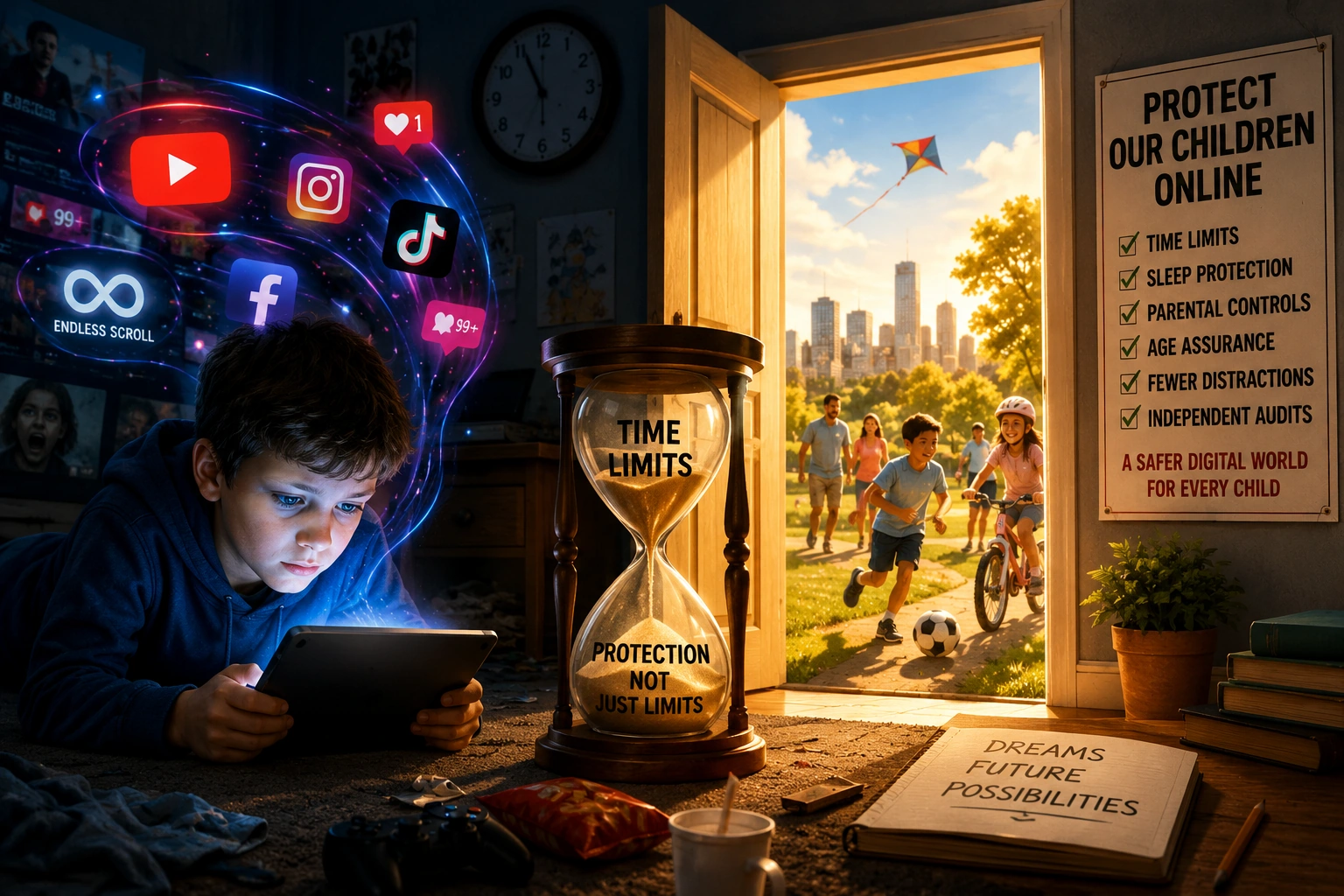
A time limit can tell us how long a child is online. It cannot tell us what is reaching them.
Meta has agreed to pay approximately $18 billion and introduce new protections for children and teenagers using Facebook and Instagram. The agreement, reached with 52 attorneys general from states, territories and the District of Columbia, was approved by a judge on August 27.
The protections include a default combined two-hour daily limit that teenagers can turn off only with a parent’s permission, required prompts during extended use, nighttime restrictions, muted school-hour notifications, stronger parental controls, age-assurance measures and independent auditing. Teenagers will also have the option of making a non-algorithmic feed their default, and parents will be able to require that setting.
Those protections matter. They recognize that placing a child in front of a platform designed to maintain attention is not the same as handing that child a book, a television remote or an ordinary toy.
But the agreement leaves me with a question.
Why did families have to wait for years of complaints, hearings, lawsuits and state action before protections of this scale arrived?
WHAT I SEE AS A FATHER
I ask that question not as a researcher looking at children from a distance, but as the father of an eight-year-old son.
In my house, YouTube can become the first thing my son wants in the morning and the last thing he wants at night. Turning it off can become an argument. We have had to remove access to devices and remote controls because he would wake up during the night and attempt to watch videos without our knowledge. I can tell him to take a shower, only to discover that he is rushing through it—or becoming distracted before getting there—because he wants to return to YouTube.
I have sometimes said that it behaves like a drug in our home. I am not offering a medical diagnosis, and I am not claiming that YouTube is literally a controlled substance. I am describing what the behavior looks like to me as a parent: the craving, the secrecy, the resistance to stopping and the willingness to interrupt sleep or ordinary responsibilities to get back to it.
Our family is not alone. Other parents describe children crying when devices are taken away, negotiating constantly for more time or sneaking access after bedtime. Parents are told to establish limits, and we should. But a limit answers only one question: How long may a child watch?
It does not answer the question that concerns me just as much.
What is the child watching during that time?
MORE THAN A PASTIME
Ninety percent of American teenagers surveyed by the Pew Research Center in 2024 said they used YouTube. Seventy-three percent visited it daily, and 15 percent described their use as almost constant. Roughly six in ten teenagers used TikTok and Instagram, while nearly half of American teenagers said they were online almost constantly.
Those numbers describe more than a pastime.
They describe an environment in which children are growing.
Much of what exists online is educational, creative and genuinely helpful. Children can learn mathematics, history, music, science, art and practical skills. The problem is not that every video or creator is harmful. The problem is that the systems distributing this material do not necessarily reward what helps a child mature.
They reward what holds attention.
The next video may be selected by a recommendation system. Autoplay may begin it before a child makes another choice. A creator may use loud reactions, conflict, humiliation or rapid editing to keep viewers engaged. An advertisement may appear inside or alongside material watched by a minor. A sponsored message may resemble ordinary content closely enough that a young child cannot fully understand the difference.
A time limit does not solve all of that.
Two hours of what?
RESPONSIBILITY MUST BE SHARED
Platforms are responsible for the systems they design and the material they recommend. Content creators should consider who is likely to watch what they produce. Advertisers should not be able to purchase access to children’s attention without meaningful age-appropriate restrictions. Parents must remain involved, establish boundaries and pay attention to what enters their homes.
But parents cannot carry this responsibility alone.
We did not build the recommendation systems. We do not select every advertisement. We cannot see every video before it appears, and we do not control what a platform places in front of a child next.
When I was growing up, we were taught that it takes a village to raise a child.
That principle should not disappear simply because the village has changed.
Today, that village includes parents and relatives, but it also includes educators, content creators, advertisers, technology companies and the lawmakers responsible for establishing the rules.
If all of these institutions can reach and influence a child, then all of them must accept some responsibility for the environment in which that child is growing. We cannot place the entire burden on one parent while everyone else participates in shaping what the child sees.
ONE STEP PARENTS CAN TAKE TODAY
There is also a practical step parents can take right now.
Be mindful of which account your child is using, particularly on a shared television, tablet or streaming device. A child watching through an adult’s YouTube profile may not receive the same content settings and parental controls available through YouTube Kids or a supervised child account.
A television may automatically open under the last profile used, and it is easy not to notice that a child is watching through an adult’s account. Whenever possible, keep the adult and child profiles separate. Check the “Who’s watching?” screen before leaving a child with the device. Select the child’s YouTube Kids profile or supervised account, review the available content settings, consider turning off autoplay and use a parent code where available to make it harder to leave the child’s viewing environment.
These tools cannot replace parental involvement, and they do not guarantee that every piece of unsuitable content will be filtered. But they provide an additional layer of protection that families should know how to use.
CONGRESS HAS NOT LACKED WARNINGS
Government also has a responsibility.
Congress enacted the Children’s Online Privacy Protection Act in 1998. COPPA established important requirements governing how covered online services collect personal information from children under 13. The Federal Trade Commission strengthened its rules in 2013 and again in 2025, including newer restrictions involving children’s data and targeted advertising.
That history deserves recognition. It would be inaccurate to say that the federal government has done nothing.
But a privacy law written before YouTube, TikTok, Instagram and the modern smartphone cannot, by itself, govern the digital environment children now inhabit. COPPA principally addresses data collected from children under 13. It was not designed as a complete national framework covering recommendation systems, endless feeds, autoplay, engagement design, age-appropriate content and every advertisement reaching people under 18.
Congress has not lacked warnings.
The Senate Judiciary Committee held a hearing on protecting children online in February 2023. It examined platform accountability the following month. In November 2023, former Meta engineer Arturo Béjar testified about social media and the teenage mental-health crisis. In January 2024, the chief executives of Meta, TikTok, Snap, Discord and X appeared before senators as parents held photographs of children they had lost.
Afterward, committee leaders said plainly that social-media companies had failed to police themselves and that Congress had to act. Several bipartisan bills advanced. Congress passed the REPORT Act, strengthening requirements for reporting online child exploitation, and President Joe Biden signed it in May 2024.
Other proposed protections have taken considerably longer. The Kids Online Safety Act passed the Senate 91–3 in 2024 but did not become law before that Congress ended. A new version advanced from the Senate Commerce Committee by voice vote on August 5, 2026, with 75 cosponsors.
That is movement, and it should be acknowledged. But it also shows how long families have waited for a comprehensive and permanent national framework.
The federal response has not kept pace with the technology.
WHAT DO WE MEAN BY PROTECTING CHILDREN?
That difference becomes more difficult to ignore when we consider what lawmakers place at the center of the national conversation about protecting children.
Politicians frequently invoke child protection while debating transgender students’ participation in school sports and access to bathrooms. People may hold sincere views about fairness, privacy and safety in those settings. But the scale of the political attention should still be compared with the scale of the issue.
In December 2024, NCAA President Charlie Baker told a Senate panel that he knew of fewer than 10 transgender athletes competing among more than 500,000 NCAA athletes. Reliable national numbers measuring the school-bathroom incidents described in political debates are difficult to establish.
That does not mean no disagreement or individual concern has ever existed. It means lawmakers should be expected to demonstrate that the size of the political response is proportionate to the available evidence.
We do not have to create fake issues to claim that we are protecting children. Real issues are already in front of us.
By “fake issues,” I do not mean that the people involved are fake or that every concern should be dismissed. I mean elevating comparatively limited disputes into defining national emergencies while broader, measurable problems struggle to receive sustained action.
Digital platforms reach children in their homes every day. In 2023, the United States surgeon general warned that the country did not have enough evidence to conclude that social media was sufficiently safe for children and adolescents. The advisory also emphasized that the relationship between social media and mental health is complex and that much of the existing research is correlational.
That uncertainty should keep us from making exaggerated claims, but it should not become an excuse for doing nothing. Children are growing up now. Parents cannot wait for every scientific question to be settled before reasonable safeguards are established.
THE SEEDS BEING PLANTED
I tell my son that his brain is a garden.
He must be mindful of the seeds planted there because, over time, those seeds may grow.
Today, parents are not the only people planting those seeds. Platforms, creators, advertisers and recommendation systems reach into that garden every day. Some plant knowledge, creativity and possibility. Others may plant anxiety, shame, constant comparison or a hunger for stimulation without leaving anything substantial behind.
Parents must tend the garden.
But we should not be expected to guard it alone against systems operating every hour of every day.
Meta’s agreement may produce meaningful improvements. It may also encourage YouTube, TikTok and other platforms to adopt stronger protections. But a settlement is not a substitute for durable national policy, and money paid after years of allegations is not the same as preventing possible harm in the first place.
This does not have to become a campaign against technology, content creation or advertising. People should be able to create, communicate and conduct business. But freedom to create and profit must exist alongside responsibility—especially when the audience includes children who may not yet understand how their attention is being pursued.
Politicians regularly tell us that protecting children is among their highest priorities. I was raised to believe that people reveal themselves through their actions, not merely through what they say. Hearings are important. Speeches may draw attention. Settlements may force change.
But lasting protection requires rules that keep pace with the world children actually inhabit.
And that leaves one question sitting at the table.
If protecting children is truly a national priority, why are families still waiting for the actions to match the words?
Sources & References (39)
Sources & References
Keep this section separate from the article body in Publisher Studio.
Meta — Our Agreement With Bipartisan Attorneys General
Published August 26 and updated August 27, 2026. Confirms judicial approval, participating attorneys general, approximately $18 billion payment, time limits, nighttime restrictions, school-hour settings, age assurance, parental controls, independent auditing, and conditional provisions involving YouTube and TikTok.
Arkansas Attorney General — Child-Safety Reform in Settlement With Meta
Official state announcement describing the multistate agreement and principal safeguards.
Pew Research Center — Teens, Social Media and Technology 2024
Supports the statistics concerning YouTube, TikTok, Instagram, daily use, and teenagers reporting that they are online almost constantly.
U.S. Surgeon General — Social Media and Youth Mental Health
Supports the discussion of potential benefits, mental-health concerns, scientific uncertainty, correlation-versus-causation limitations, and the inability to conclude that social media is sufficiently safe for young people.
Federal Trade Commission — Children’s Online Privacy Protection Rule
Provides COPPA’s legal scope, under-13 coverage, and regulatory history.
FTC — 2025 COPPA Rule Amendments
Supports the description of newer protections involving children’s data, third-party disclosure, and targeted advertising.
Senate Judiciary Committee — Protecting Children Online
Provides the official hearing and legislative timeline beginning in 2022–2023, including congressional letters, testimony, proposed bills, and the REPORT Act.
Senate Commerce Committee — Kids Online Safety Legislation
Confirms that the new Kids Online Safety Act advanced by voice vote on August 5, 2026; also records its 75 cosponsors and the earlier 91–3 Senate vote.
Senate Judiciary Committee — December 17, 2024 Hearing
Establishes the hearing at which NCAA President Charlie Baker testified. The “fewer than 10” statement was delivered during questioning and subsequently reported by major news organizations.
Associated Press — NCAA Changes Transgender Participation Policy
Corroborates Baker’s reported statement concerning fewer than 10 transgender athletes among more than 500,000 NCAA athletes and provides context surrounding the NCAA policy.
Google — Set Up Supervised Child Accounts on YouTube
Supports the practical guidance concerning supervised accounts, account switching, content settings, and shared devices.
Google — Watch YouTube Kids on Your Television
Supports the guidance concerning child profiles, the “Who’s watching?” screen, switching accounts, and parent codes.
Protective Editorial Review
Personal observations concerning Cory’s son are explicitly identified as lived experience.
The drug comparison is expressly identified as an analogy, not a diagnosis.
The article does not state that social media causes every mental-health outcome.
Correlation, causation, and remaining scientific uncertainty are distinguished.
Meta’s settlement protections and existing efforts are acknowledged.
Congressional action—including COPPA, the REPORT Act, and recent KOSA progress—is acknowledged.
The article criticizes priorities and proportionality without denying anyone’s identity.
“Fake issues” is defined within the article to reduce the possibility of misconstruction.
No individual creator, advertiser, politician, or company is accused of criminal conduct.
Settlement terms are described as an agreement, not an admission of wrongdoing.
The article distinguishes parental responsibility from institutional responsibility.
Editorial risk status: Cleared for publication as an evidence-supported opinion piece, subject to Sunday Dinner Media’s ordinary final proofread. This is an editorial assessment, not legal advice.

The conversation is open
Be the first reader to add a thoughtful response.