
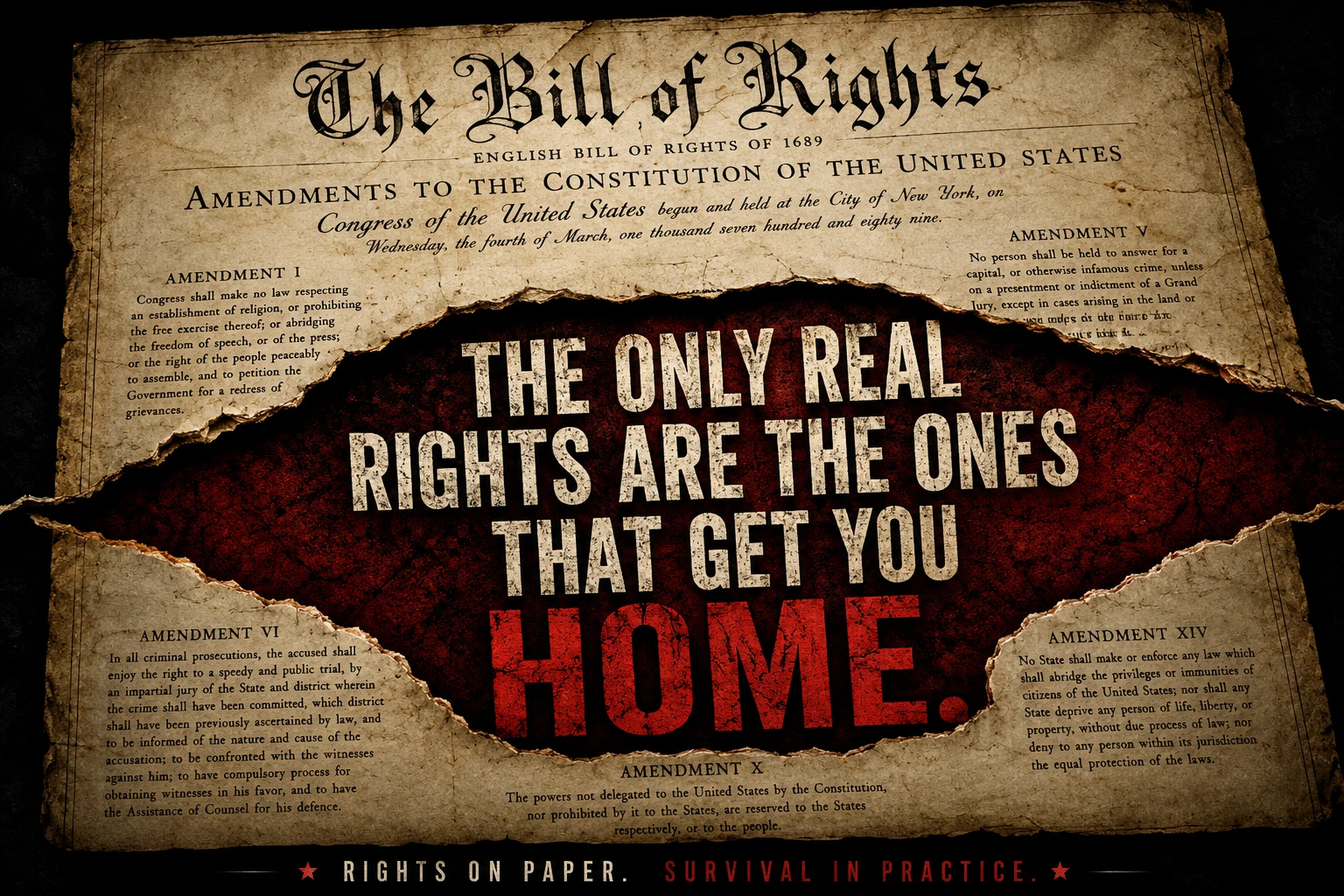
My father taught me something about rights long before I understood constitutional law. He never told me that I didn't have rights. He taught me something harder: having a right and being alive long enough to exercise it are not always the same thing.
Growing up as a young Black boy in New York City, that was one of the lessons he made sure I understood. My father was born and raised in the South. He came from an America where Black people could read about rights in one place and experience something very different when trying to exercise them in another. So when he talked to me about rights, he wasn't giving me a civics lesson. He was giving me a survival lesson.
Years later, I found myself passing parts of that lesson to my own son. That is what bothers me. Somewhere between my father's generation, mine, and my son's, you would think America would have reached the point where this particular lesson was no longer necessary.
But here we are.
Take Your Hood Off
One cold morning, I took my son to the bus stop. He had his hat on and his hood pulled over his head. I looked at him and said, “Take your hood off.”
That's it. A father telling his son to take off his hood.
To somebody else, that might sound ridiculous. It's cold outside. That's what a hood is for. But I wasn't thinking about the weather. I was thinking about how somebody else might see my son.
I wasn't telling him there was anything wrong with wearing a hood. There wasn't. I wasn't saying everybody who saw him would think he was dangerous. I couldn't know that. I was teaching him something my father taught me: what you mean by your appearance may not always be what another person sees.
Research has found racial bias in the way Black children and Black men can sometimes be perceived. Experimental studies have found Black boys judged as older and less innocent than comparable white boys, while other research has found Black men perceived as larger, stronger, or more threatening than similarly sized white men. That does not mean everybody thinks that way, and it does not mean a hoodie causes racism. It means the concern underneath what I told my son did not come from nowhere.
There is a long history in this country of Black people having to think not only about who we are, but about who somebody else might decide we are before we have said a word—before they know our character, our intentions, our family, or our story.
Should it be that way? Absolutely not.
But I am not raising my son for the America that should exist. I am raising him in the America that exists right now.
I'm not raising my son for the America that should exist. I'm raising him in the America that exists right now.
What Are Rights?
So let's talk about rights. What are they?
We have constitutional rights, civil rights, legal rights—rights created through amendments, statutes, court decisions, and generations of people who fought, marched, organized, bled, and sometimes died to secure them. Those rights matter. I believe in them. I want my son to know them.
But there is another side of that conversation that people don't always want to have.
A right written on paper does not physically protect you from someone who has decided not to respect it.
That's the hard part. You can show somebody the Constitution. You can tell them what the law says. You can explain what they are legally allowed or prohibited from doing. And they can still violate your rights.
That's why I keep coming back to one question:
What rights do you have if you're dead?
A lawyer can prove afterward that your rights were violated. A judge can issue a ruling. A jury can award damages. A department can fire somebody. A prosecutor can file charges. The government can apologize. Your family can receive a settlement. A law can even be changed because of what happened to you.
But none of those things return your life to you.
At the moment someone is standing in front of you with a weapon, the Constitution is not physically standing between you and the bullet. The law describes what that person is supposed to do. It does not guarantee that person will do it.
That is the distinction.
You can be completely right and still not make it home.
“I Know My Rights”
We see it all the time now. Somebody is arguing with a police officer. Somebody is arguing with security. Somebody is confronting another person. The camera comes out. The voices get louder.
I know my rights. You can't do this. I have rights.
And sometimes that person is absolutely correct.
But being correct isn't the only thing happening in that moment. If somebody is standing in front of you with a weapon and you believe that person has become frightened, angry, irrational, confused, or convinced that you are dangerous, you have to understand the situation you're standing in.
That person may not care what the Constitution says at that moment. They may not care what your lawyer says tomorrow. They may not care what the video eventually proves. They may make a decision in a fraction of a second.
And once they make that decision, everybody else gets to debate your rights.
Except you.
That's what my father was trying to make me understand. It wasn't cowardice. It wasn't surrender. It was strategy.
Sometimes you lower your voice. Sometimes you stop arguing. Sometimes you keep your hands where they can be seen. Sometimes you remember the badge number, the face, the vehicle, the location, the time—everything you safely can.
And you get home.
Then call the lawyer. Then file the complaint. Then preserve the evidence. Then release the video if appropriate. Then organize. Then protest. Then go to court. Then speak. Then vote. Then fight like hell through every lawful avenue available to you.
But first:
Get home.
The Names Behind the Lesson
This isn't just philosophy. America has names attached to this conversation.
In 1999, Amadou Diallo was standing outside his Bronx building when four New York City police officers confronted him. He reached toward his pocket. The officers believed he was reaching for a gun. He was shot. What he had was not a gun. It was his wallet.
He had rights. He had a wallet. And he was dead.
Then there was Tamir Rice. Twelve years old. Cleveland. 2014. A 911 caller said the person in the park was probably a juvenile and the gun was probably fake. That information was not adequately relayed to the responding officers. Tamir was carrying an airsoft-style pellet gun. Police arrived. Within roughly two seconds, he was shot. He died the following day.
He was twelve years old.
How much constitutional law can a twelve-year-old explain in two seconds? How much time does a child have to explain that something isn't what somebody thinks it is?
Then there was Senior Airman Roger Fortson, a United States serviceman. In 2024, a sheriff's deputy responded to Fortson's Florida apartment. Fortson answered his door holding a legally owned firearm. The sheriff's own investigation later concluded that Fortson did not point the weapon at the deputy, did not physically resist, and made no hostile or attacking movement.
He was shot and killed.
He served his country. He was in his own home. He had rights.
And once again, everybody else got to argue about those rights after the person who possessed them was gone.
And this is not only a story about Black men. Sonya Massey called 911 for help in Illinois. She was shot and killed by a responding deputy inside her own home.
Different people. Different circumstances. Different legal questions. Different investigations. I'm not saying the cases are identical. They aren't.
I'm saying they reveal the same uncomfortable truth:
A right does not become a force field simply because the law says you possess it.
My Father Wasn't the Only Father Having This Conversation
For years, I thought of my father's lesson simply as something my father taught me. Research shows that the conversation is much larger than my family.
Scholars call part of it racial socialization. One part is known as preparation for bias—parents preparing children for discrimination they might encounter and teaching them ways to respond. When that conversation turns specifically toward police encounters, profiling, and authority, it is often called something much simpler:
“The Talk.”
Black parents have sat children down and told them some version of the same thing: stay calm, don't make sudden movements, keep your hands visible, be respectful, understand where you are, understand who you're dealing with, and most importantly, come home.
Research also shows that these lessons can travel across generations. Parents remember what their parents taught them. Then circumstances convince them that their own children need to hear some version of the same thing.
My father taught me. I teach my son.
That isn't just tradition.
That's a warning sign.
Rights on Paper. Survival in Practice.
The phrase “the Talk” may be modern. The problem behind it isn't.
Black Americans have been navigating the difference between rights on paper and safety in practice for generations.
After the Civil War, Black men gained constitutional protection for voting. The Fifteenth Amendment existed. So did intimidation. So did racial violence. So did economic retaliation. Eventually came poll taxes, literacy tests, white primaries, and other methods designed to make exercising that right difficult or dangerous.
The right existed.
The danger existed at the same time.
Decades later, Black Americans had the legal freedom to travel across the country. Yet Victor Green, a Black postal worker from New York City, created *The Negro Motorist Green Book* to tell Black travelers where they could safely stop, eat, buy gasoline, and spend the night.
Think about that.
You could possess the right to travel and still need a book explaining where exercising that freedom might be safe.
That's the contradiction my father understood:
Rights on paper. Survival in practice.
Learning How to Be “Acceptable”
The lesson goes beyond police.
For generations, Black Americans have received another message: if you want to succeed, learn how to make other people comfortable.
Dress a certain way. Wear your hair a certain way. Speak a certain way. Control your tone. Don't appear angry. Don't appear threatening. Learn when to code-switch. Put on the suit.
I've had people tell me that after hearing me speak, they assumed I was someone of another race before they met me.
Think about what that means.
Somewhere in their mind, intelligence had a sound. Professionalism had a sound. Education had a sound. And apparently that sound wasn't supposed to come from somebody who looked like me.
Prejudice doesn't always scream.
Sometimes it whispers.
Sometimes it sounds like:
“Wow. You're very articulate.”
And yes, Black people have learned strategies for navigating those expectations. But survival strategy should never be confused with accepting the prejudice behind the expectation.
My father teaching me how to navigate racism did not make racism my responsibility. Me telling my son to remove his hood does not make another person's stereotype his fault. And teaching somebody how to reduce danger does not make them responsible if someone harms them anyway.
Compliance Is Not a Guarantee
That needs to be said clearly.
Doing everything “right” does not guarantee that you will survive.
There is no magical combination of behavior that makes another human being incapable of making a terrible decision. No perfect tone. No perfect position for your hands. No perfect clothing. No perfect sentence. No perfect amount of compliance.
A survival strategy is exactly that: a strategy.
An attempt to reduce risk.
Nothing more.
If somebody uses unjustified violence against another person, responsibility for that violence remains with the person who used it. My father's lesson was never, “If something happens to you, you must have done something wrong.”
His lesson was:
There may come a moment when being right will not be enough to protect you. Recognize that moment.
Those are completely different ideas.
Responsibility Goes Both Ways
And the entire burden cannot be placed on the citizen.
Police officers carry authority most citizens do not have. They can detain. They can arrest. They can use force under circumstances where the law permits it. They carry weapons.
With that authority comes responsibility.
Research on procedural justice has found that people are more likely to cooperate when officers explain what is happening, listen, treat people with dignity, and act fairly. Research on de-escalation has also found that slowing situations down and changing how officers communicate can reduce uses of force and injuries.
So while I teach my son how to get home, somebody else should be teaching the person wearing the badge how to help make sure he gets home too.
The citizen should not have to carry the entire responsibility for preventing an encounter from becoming deadly.
This Lesson Is Bigger Than Race
My father taught me this lesson because I was a Black boy in America. That history matters. I will not erase it to make the lesson more comfortable.
But I also believe the principle has become useful far beyond Black families.
An armed confrontation can become dangerous regardless of who you are. Police. Federal agents. Security. An angry civilian. Someone committing a robbery. Someone frightened enough to believe you're a threat. Someone irrational. Someone who simply misunderstands what you're doing.
Once a gun is involved, the consequences of misunderstanding become much greater.
Your race may influence the way you are perceived. Your history may influence the lesson your parents gave you. But the basic survival principle applies much more broadly:
Understand when staying alive is more important than winning the argument in that moment.
A Life Is Gone
When somebody dies, politics arrives almost immediately.
People choose sides. Videos are chopped into pieces. Television panels begin arguing. Social media starts investigating. One side searches for everything the dead person ever did wrong. The other side searches for everything the officer or shooter ever did wrong.
Everybody wants to win.
And somewhere underneath all that noise is a family.
A mother. A father. A husband. A wife. A child.
Somebody waiting for a person who is never coming through the door again.
That's the part I don't want us to lose.
A human being is gone.
And this is where my faith challenges me. I'm tired of watching people talk endlessly about how Christian they are while becoming comfortable with human beings dying simply because the person belonged to the wrong race, political party, nationality, religion, or side of an argument.
You cannot preach the value of life only when the life looks like yours.
Human life has to mean something even when we disagree with the human being.
Otherwise, what exactly are we defending?
Know Your Rights Like You Know Your Last Name
Now let me make something very clear.
Your rights are valuable.
Learn them. Protect them. Don't wait until somebody is standing in front of you with a weapon to start figuring out what the Constitution says.
Buy yourself a small copy of the Constitution. Buy yourself a copy of the Bill of Rights.
Trust me. I have two copies of both.
One set is for me. The other set I am preserving for my son, so that he has a better understanding of what his rights are, where they come from, and what they mean.
That matters to me because inheritance is not always money.
Sometimes inheritance is knowledge.
Sometimes the most valuable thing a father can leave his child is an understanding of the rights people before him fought to secure.
So read them. Study them. Question them. Understand them.
Know them like you know your own last name.
But understand when and how to exercise those rights so that you remain alive, free, and able to hold somebody accountable.
Knowing your rights is bigger than knowing how to yell, “I know my rights.” Knowing your rights means understanding what those rights actually are. It means understanding when they apply. It means understanding what government is allowed to do and what government is not allowed to do. And it means understanding the lawful options available to you when those rights are violated.
Sometimes exercising your rights means speaking. Sometimes it means remaining silent. Sometimes it means documenting what happened when it is safe to do so. Sometimes it means remembering names, faces, badge numbers, locations, witnesses, and times. Sometimes it means calling an attorney. Sometimes it means filing a complaint. Sometimes it means challenging what happened in court. Sometimes it means going to the press. Sometimes it means organizing your community. Sometimes it means peacefully protesting. Sometimes it means walking into a voting booth and replacing the people who allowed the problem to continue.
Your rights are not weakened because you chose to survive the moment.
Survival is not surrender. Walking away from a dangerous confrontation does not mean the other person was right. Silence in a dangerous moment does not mean silence forever. Compliance in a dangerous moment does not mean acceptance.
Sometimes it simply means:
I intend to be alive tomorrow when I hold you accountable.
Getting home is not the end of the fight. Getting home allows the fight to continue on ground where your rights may have a better chance of protecting you.
What It Costs to Teach This
There is one part of this lesson I understand differently now that I am a father.
I understand what it must have cost my father to teach it to me.
Imagine looking at your child and having to explain that somebody may fear him before knowing him. Imagine telling your child to think about how his clothes might be interpreted. His voice. His hands. His anger. His movements. How reaching into his pocket might be interpreted.
You are trying to protect your child.
But in order to protect him, you are introducing him to a danger you wish he never had to think about.
Research shows these conversations can be both protective and psychologically burdensome. They can prepare children. They can also create anxiety.
Parents carry that burden too.
The father is scared.
He just doesn't always get to show it.
The Lesson Continues
My father taught me. Now I teach my son. And I hate that parts of this lesson are still necessary.
I would love to tell him that being right will always protect him. I would love to tell him nobody will judge his character by his skin. I would love to tell him every person given authority will exercise that authority responsibly. I would love to tell him the America written on paper and the America standing in front of him will always be exactly the same America.
But fathers don't have the luxury of raising children on wishes.
We have to prepare them for the world they are actually going to walk into.
And preparation does not mean accepting injustice. It means understanding your rights well enough to protect them, understanding danger well enough to recognize it, understanding yourself well enough not to allow pride, anger, or fear to make the decision for you, and understanding that sometimes surviving today gives you the ability to fight injustice tomorrow.
So teach your children their rights. Teach them the Constitution. Teach them the Bill of Rights. Teach them what generations before them fought for.
And then teach them judgment.
Know your rights. Know the moment. Know how to get home. And know what to do when you get there.
Because your rights are valuable. Learn them. Protect them. Carry them with you. Pass them to your children. Know them like you know your own last name.
But never become so determined to prove that you have rights that you forget the one thing every other right depends on:
being alive and free to exercise them.
My father understood that. His generation understood it. My generation understands it. And somehow my son's generation is still being taught it.
So America still has a question to answer:
How many generations of fathers are supposed to keep teaching their sons how to survive their rights before America asks why the lesson is still necessary?
Until that answer changes:
Get home.
Then fight.
Sources & References (77)
PRINCIPAL SOURCES & REFERENCES
Anderson, Leslie A.; Caughy, Margaret O'Brien; Owen, Margaret T. — “The Talk” and Parenting While Black in America: Centering Race, Resistance, and Refuge
Journal of Black Psychology, Volume 48, Issues 3–4, 2022. First published online July 26, 2021.
Primary academic source for the article's discussion of what is commonly called “The Talk.” The study describes these conversations as a form of racial socialization in which many Black parents prepare children for interactions with police and other people in positions of authority.
The study examined conversations between 45 Black American parents or caregivers and their school-age children and discusses preparation for bias, racial profiling, safety, parental responsibility and the difficulty of preparing children for possible danger without portraying every law-enforcement officer as dangerous.
View source:
https://pmc.ncbi.nlm.nih.gov/articles/PMC12302954/
Kurtz-Costes, Beth; Hudgens, Tanée M.; Skinner, Olivenne D.; Adams, Elizabeth A.; Rowley, Stephanie J. — “Parents' Racial Beliefs and Ethnic–Racial Socialization in African American Families”
Merrill-Palmer Quarterly, Volume 65, Issue 1, 2019.
Primary support for the article's discussion of racial-socialization lessons passing between generations. Researchers found relationships between racial-pride and preparation-for-bias messages parents remembered receiving during their own childhoods and the messages their adolescent children reported receiving from them.
The findings support intergenerational transmission of ethnic-racial socialization while also showing that parental perceptions of the racial environment can influence preparation-for-bias messages.
View source:
https://digitalcommons.wayne.edu/mpq/vol65/iss1/3
Adjah et al. — “The Talk and Walk in Black Families: Exploring Racial Socialization Content and Competency in the Context of Parental Worries About Racial Profiling and Adolescents' Internalizing Outcomes”
Family Process, 2025.
Recent research examining 203 Black parents of adolescents and the relationship among parental worries about racial profiling, racial-socialization practices and children's internalizing symptoms.
This research supports the article's careful treatment of racial socialization as potentially protective and adaptive while also recognizing that conversations about discrimination and danger can carry psychological stress, anxiety or fear. The research literature does not support portraying preparation for bias as either universally harmful or universally protective; outcomes depend on context, message content, parental support and other factors.
View source:
https://pmc.ncbi.nlm.nih.gov/articles/PMC13070008/
Goff, Phillip Atiba et al. — Research on the Perceived Age and Innocence of Black Children
Journal of Personality and Social Psychology, 2014.
Experimental research supporting the article's carefully limited statement that Black boys can be perceived as older and less innocent than comparable white boys.
The research should not be interpreted to mean that every person perceives Black children this way or that racial perception determines the outcome of every encounter. It documents measurable patterns observed under particular experimental conditions.
Reference information:
Goff, P.A., Jackson, M.C., Di Leone, B.A.L., Culotta, C.M., and DiTomasso, N.A. “The Essence of Innocence: Consequences of Dehumanizing Black Children.” Journal of Personality and Social Psychology, 2014.
Wilson, John Paul; Hugenberg, Kurt; Rule, Nicholas O. — “Racial Bias in Judgments of Physical Size and Formidability: From Size to Threat”
Journal of Personality and Social Psychology, 2017.
Experimental research supporting the article's discussion of perceptions of Black men as larger, stronger and more physically formidable than similarly sized white men.
Across multiple studies, researchers found that racial categorization could influence judgments of height, weight, strength, muscularity and capacity for physical harm. The researchers also examined how perceived physical formidability could affect judgments about hypothetical uses of police force.
These findings describe experimental patterns and should not be generalized to every individual or every police encounter.
View source:
https://jpwilsonlab.com/wp-content/uploads/2017/10/wilson_etal2017.pdf
Stanford Open Policing Project — Nationwide Traffic Stop and Search Analysis
Large-scale research database examining more than 200 million traffic-stop records collected from jurisdictions throughout the United States.
For the subset sufficiently detailed for rigorous statistical analysis, researchers found significant racial disparities in stops and searches. Their threshold-test analysis found evidence that Black and Hispanic motorists were searched on the basis of lower levels of suspicion than white motorists.
The researchers explicitly caution that traffic-stop data have important methodological limitations. Stop rates alone cannot establish discrimination because driving behavior, exposure to police, geography and other factors can differ among populations. The article therefore uses this research as evidence of documented disparities and statistical patterns, not as proof that every individual police encounter involves racial discrimination.
View source:
https://openpolicing.stanford.edu/findings/
U.S. Department of Justice — Closing of the Amadou Diallo Civil Rights Investigation
January 31, 2001.
Primary federal source for the article's discussion of Amadou Diallo.
The Justice Department described Diallo as unarmed and stated that he had committed no crime and no act of aggression. DOJ concluded that the available evidence was insufficient to prove beyond a reasonable doubt that the officers willfully violated federal criminal civil-rights law and therefore declined federal prosecution.
That distinction is important: the source supports the factual description used in the article while also documenting the Justice Department's decision not to bring federal criminal charges.
View source:
https://www.justice.gov/archive/opa/pr/2001/January/046dag.htm
U.S. Department of Justice — Federal Investigation of the Shooting of Tamir Rice
December 29, 2020.
Primary federal source for the article's discussion of Tamir Rice.
DOJ records state that Tamir was 12 years old. The original 911 caller said that the individual was “probably a juvenile” and that the gun was “probably fake.” Those qualifications were not transmitted to the responding officers.
DOJ states that Officer Timothy Loehmann fired two shots within less than two seconds after opening the passenger door of the arriving patrol vehicle.
The Justice Department ultimately concluded that the evidence was insufficient to establish federal criminal civil-rights violations beyond a reasonable doubt and closed the investigation without federal criminal charges.
View source:
https://www.justice.gov/archives/opa/pr/justice-department-announces-closing-investigation-2014-officer-involved-shooting-cleveland
Okaloosa County Sheriff's Office — Administrative Internal Affairs Investigation Into the Fatal Deputy-Involved Shooting of Roger Fortson
May 31, 2024.
Primary agency source for the article's discussion of Senior Airman Roger Fortson.
The Sheriff's Office administrative investigation concluded that Fortson did not make hostile or attacking movements and that the deputy's use of deadly force was not objectively reasonable under agency policy.
The Sheriff's Office stated that Fortson did not commit a crime and terminated Deputy Eddie Duran following the administrative investigation.
The administrative investigation concerned compliance with agency policy and was separate from the criminal investigation. The article should preserve that distinction.
View source:
https://www.sheriff-okaloosa.org/okaloosa-county-sheriffs-office-releases-administrative-internal-affairs-investigation-into-the-fatal-deputy-involved-shooting-of-roger-fortson-2/
United States Air Force — Senior Airman Roger Fortson
Official Air Force materials identifying Roger Fortson as an active-duty Senior Airman assigned to the 4th Special Operations Squadron at Hurlburt Field, Florida.
Used to support the article's identification of Fortson as a United States serviceman and Senior Airman.
U.S. Department of Justice — Sangamon County, Illinois, Sonya Massey Investigation and Reform Agreement
January 16, 2025.
Primary federal source for the article's discussion of Sonya Massey and the institutional response following her death.
The Justice Department states that its investigation was launched following complaints and reports concerning a Sangamon County sheriff's deputy's fatal shooting of Massey, a Black woman, while responding to her 911 call for help.
DOJ subsequently reached an agreement with Sangamon County, the Sangamon County Sheriff's Office and the county's central dispatch system concerning race and disability discrimination in policing and dispatch services.
The agreement represents a civil-rights and institutional-reform response and should not be confused with the separate criminal proceedings concerning the individual shooting.
View source:
https://www.justice.gov/archives/opa/pr/justice-department-secures-agreement-sangamon-county-illinois-sangamon-county-sheriffs
Library of Congress — The Negro Motorist Green Book
Primary historical source supporting the article's discussion of Black travel during segregation.
The Library of Congress describes Victor Hugo Green's guide as an annual publication created to help African American travelers locate lodging, businesses, restaurants, gasoline stations and other establishments that would serve them during an era of widespread racial discrimination.
The Green Book began in 1936 and expanded from a New York-focused guide to cover much of North America.
The article uses the Green Book as his
The conversation is open
Be the first reader to add a thoughtful response.