
THE QUESTION
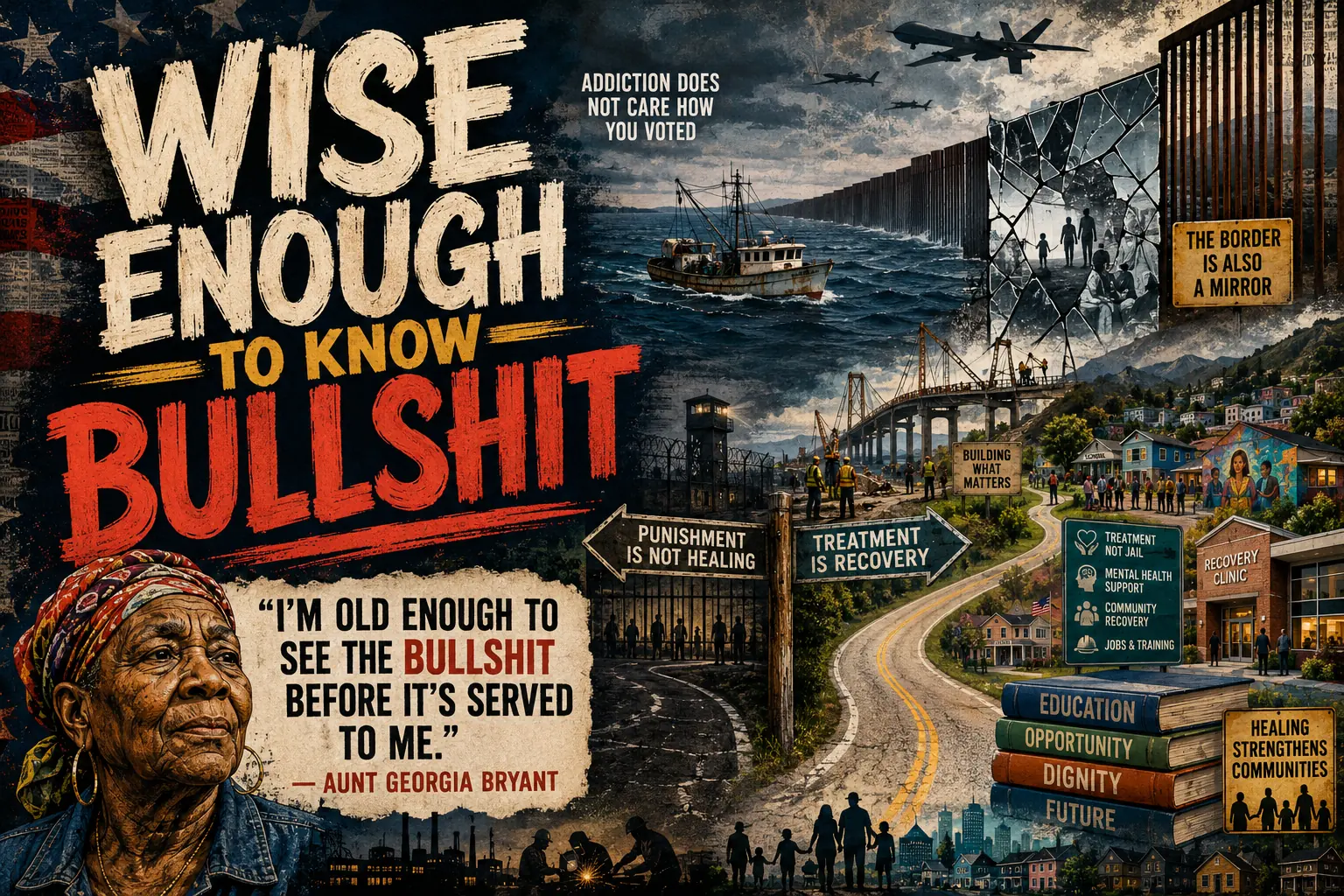
“I’m too old to see bullshit before it serves me, and I’m too Black to be naive.” — Aunt Georgia Bryant
My Aunt Georgia used to say that when something didn’t add up.
The older I get, the more I understand what she meant.
The first part was experience. Live long enough, pay attention long enough, and you start recognizing patterns. The politician may change. The slogan may change. The packaging may change. Sometimes the same old bullshit is still sitting underneath it.
But the second part went deeper.
“I’m too Black to be naive.”
She wasn’t teaching us to walk around angry at the world. She was teaching us to pay attention to it.
For Black families in America, politics has never been something happening somewhere far away in Washington. Laws can reach your neighborhood. Elections can reach your job. Courts can reach your rights. Decisions about education, housing, healthcare, policing, employment, voting and economics eventually find their way to somebody’s kitchen table.
History taught generations of Black Americans that we could not afford to put on rose-colored glasses and assume everything was all right simply because somebody in authority told us it was.
You listen. You question. You remember.
And before somebody serves you something, you take a good look at what is actually on the plate.
That is the spirit of Wise Enough to See the Bullshit.
Not cynicism.
Attention.
Dropping Bombs on Fishermen?
Is that where we are now?
Beginning in September 2025, the United States began using military force against vessels the Trump administration said were involved in narcotics trafficking.
The first publicly acknowledged strike killed 11 people aboard a vessel in international waters in the southern Caribbean. The administration said the boat was transporting narcotics and linked those aboard to Tren de Aragua.
But almost immediately, another question appeared:
What evidence should a government have to present before it kills people suspected of trafficking drugs rather than stopping them, searching the vessel, making arrests and presenting evidence in court?
That question matters.
The administration initially provided limited independently verifiable evidence to the public and Congress about who was aboard individual vessels, exactly what they were carrying, or why traditional interdiction procedures were not sufficient.
Members of Congress asked those questions too.
By late October 2025, at least 61 people had reportedly been killed in 14 strikes in the Caribbean and Pacific, while lawmakers and legal scholars continued debating the domestic and international legal basis for treating suspected drug traffickers as military targets.
And then the story became even more complicated.
Subsequent reporting identified some of the people killed. Among them were poor Venezuelans whose backgrounds did not fit neatly into the image of international cartel bosses being presented to the public. Reporting identified, among others, a fisherman, a bus driver and a former military cadet. Some appeared to have been low-level smugglers.
That does not mean every boat was an innocent fishing boat. It does not mean nobody aboard those vessels was involved in trafficking.
It means reality was more complicated than the sales pitch.
And when governments start killing people, complicated matters.
When did suspicion become enough to replace arrest, evidence, trial and conviction with military force?
I’m not pretending there is no drug-trafficking problem.
I’m asking what happened to the questions we used to ask before somebody pulled the trigger.
The Border Is Also a Mirror
Then there is the border.
Listen to American political conversation long enough and you could easily come away believing that fentanyl is primarily being carried across the desert by migrants illegally entering the United States.
But the government’s own enforcement record tells a more complicated story.
Analysis of Customs and Border Protection records found that from fiscal 2019 through 2024, roughly 81 percent of people caught with fentanyl while crossing through ports of entry were U.S. citizens.
And over the longer period from fiscal 2015 through 2024, roughly 88 percent of fentanyl seized at the southwest border was seized at legal ports of entry.
That does not prove how every bag of fentanyl that escaped detection entered the country. Seizure statistics tell us what authorities caught, not everything they missed.
But they do tell us something important:
The fentanyl trade cannot honestly be reduced to a story about migrants sneaking across the desert.
Americans participate in this market too.
American citizens traffic drugs. Americans buy drugs. American demand helps finance the market. American communities absorb the addiction, the overdoses, the incarceration, the broken families and the economic damage.
Maybe that is why I call the border a mirror.
We spend a lot of time looking outward for somebody to blame.
Sometimes we need to look back at ourselves.
The War We Ignored
America has been fighting a War on Drugs for decades.
But what exactly are we fighting?
If the goal is simply to seize drugs and arrest traffickers, enforcement matters.
Of course it does.
But if the goal is to reduce addiction, overdose and the destruction drugs cause inside American families, enforcement can only be part of the answer.
You still have to talk about treatment, prevention, mental-health care, education, prescription practices, domestic trafficking, money laundering, economic conditions and demand.
Because you can intercept one boat tonight and another one will come tomorrow if millions of dollars are still waiting on the other side. You can arrest one dealer and somebody else will take the corner if the market remains. You can build another prison. You can increase another sentence. You can militarize another operation.
But what happens to the person who is already addicted?
What happens to the family trying to get somebody into treatment?
What happens to the community where the drugs are being sold?
What happens to the child growing up inside the house where addiction has already taken over?
Those questions are harder.
They don’t produce the same television pictures as military strikes.
But they are part of the same war.
Maybe the problem is that we have spent so much time fighting drugs that we forgot to fight why people need them, buy them and become trapped by them in the first place.
Pardons and Missiles
And then something happened that made Aunt Georgia’s voice come back into my head.
On December 1, 2025, President Trump pardoned former Honduran President Juan Orlando Hernández.
Hernández had not merely been accused of drug trafficking.
He had been convicted in a United States federal court of participating in a conspiracy to import cocaine into the United States, along with related weapons offenses.
He had received a 45-year federal prison sentence.
Federal prosecutors said the conspiracy helped move more than 400 tons of cocaine toward the United States.
Now stop for a minute.
On one side, the government was using military force to kill people aboard vessels suspected of drug trafficking without a trial.
On the other side, the president used his constitutional clemency power to free a former head of state whom a U.S. jury had already convicted in a massive cocaine-trafficking conspiracy.
I don’t need to exaggerate that.
The facts are enough.
How do you justify killing suspected low-level traffickers without trial while pardoning a man already convicted in federal court of helping facilitate massive cocaine trafficking?
Maybe there is an explanation somebody believes makes those two things fit together.
Fine.
Serve it to me.
But don’t get mad when I turn the plate around and look underneath it first.
What We Cut
And while all of this is happening, we should also ask what we are doing here at home.
The 2025 reconciliation law made major changes to Medicaid and SNAP while changing taxes and increasing spending in other areas, including defense and immigration enforcement.
According to the Congressional Budget Office, the law is projected to reduce federal Medicaid spending by approximately $1.2 trillion from 2026 through 2035 compared with the previous baseline.
CBO also projects roughly 13.1 million fewer people enrolled in Medicaid in 2035 than under that earlier baseline.
For SNAP—the program millions of families use to help buy groceries—CBO projects approximately $211 billion less in federal spending through 2035.
Those are not “Black programs.” They are not “white programs.” They are not Republican programs or Democratic programs.
The people affected include Black families, white families, Latino families, rural communities, working families, disabled Americans, children, older people, hospitals and healthcare providers.
That matters.
Because one of the oldest tricks in American politics is convincing one group that a program only helps somebody else.
Until your mother needs Medicaid. Until your neighbor loses coverage. Until the rural hospital starts struggling. Until the family down the street cannot keep enough food in the house.
Then suddenly it isn’t somebody else’s program anymore.
It is your community.
So I have another question:
If drugs and addiction are such an extraordinary threat to American life that we are willing to use lethal military force against suspected traffickers overseas, what does it say when we simultaneously reduce resources from systems Americans depend on for healthcare and food security here at home?
Those policies are not identical.
They do not come from the same budget account.
But budgets still tell us something about priorities.
And citizens have every right to ask whether those priorities make sense.
This Is an American Issue
That may be the biggest point.
This is not simply about Black America.
It is not simply about Brown America.
Addiction does not care who you voted for.
Go to rural towns in Appalachia. Go through aging communities across the Rust Belt. Go into suburban families struggling with addiction, healthcare costs and mental illness. Go into Black neighborhoods. Latino neighborhoods. White working-class towns.
Different places.
Same table conversation.
A mother worried about her son. A grandfather raising grandchildren because addiction took their parents. A family trying to find treatment. Somebody wondering how they will pay for healthcare. Somebody wondering why the factory left. Somebody asking why the local hospital closed. Somebody trying to understand why their community keeps getting poorer while somebody on television tells them America is doing great.
Pain does not become less American because it happens somewhere you don’t live.
And maybe that is another piece of bullshit we need to stop accepting:
Their problem.
Their drugs. Their poverty. Their neighborhood. Their children. Their addiction.
Until it lands at your table.
Then suddenly it becomes everybody’s emergency.
Wise Enough to Ask
That is why Aunt Georgia’s words stay with me.
“I’m too old to see bullshit before it serves me, and I’m too Black to be naive.” — Aunt Georgia Bryant
She wasn’t saying she knew everything.
She was saying she had lived long enough to know she needed to ask questions.
Maybe we have gotten away from that.
We hear border crisis, and some of us stop asking questions. We hear war on drugs, and some of us stop asking questions. We hear crime, and some of us stop asking questions. We hear national security, and some of us stop asking questions.
We hear something from the political party we support, and suddenly skepticism becomes betrayal.
But citizenship requires more than choosing a team.
It requires paying attention.
Who benefits?
Who pays?
What happened the last time we tried this?
Does the explanation match the evidence?
What is missing from the story?
What are we being asked to look at?
And maybe more importantly:
What are we being distracted from while we are looking at it?
Because sometimes the biggest piece of bullshit isn’t the thing somebody tells you.
Sometimes it is the thing they keep you too busy to notice.
Maybe wisdom isn’t having all the answers.
Maybe it is living long enough to know when the answer you have been handed deserves another question.
Sources & References (11)
Associated Press — Investigation into the identities and backgrounds of people killed in U.S. strikes on alleged drug-trafficking vessels, including reporting showing a more complicated picture than blanket “narcoterrorist” characterizations.
U.S. Congress / Congressional Record — Senate debates and War Powers proceedings concerning U.S. military strikes against alleged drug-trafficking vessels in the Caribbean.
Office of Senator Angus King — Questions to the White House concerning evidence and legal authority for Caribbean boat strikes.
FactCheck.org — “Assessing the Facts and Legal Questions About the U.S. Strikes on Alleged Drug Boats,” reviewing factual claims, constitutional questions and international-law concerns.
Cato Institute — Analysis of Customs and Border Protection records obtained through FOIA showing that approximately 81% of people caught with fentanyl at ports of entry from FY2019–2024 were U.S. citizens and that roughly 88% of fentanyl seized at the southwest border from FY2015–2024 was seized at legal ports of entry. Seizure data represent detected shipments and do not establish how all undetected fentanyl entered the country.
U.S. Department of Justice, Office of the Pardon Attorney — Official clemency record documenting President Donald Trump’s December 1, 2025 pardon of former Honduran President Juan Orlando Hernández.
Federal court and Justice Department records / FactCheck.org — Hernández’s federal conviction, 45-year sentence and prosecution record involving a conspiracy prosecutors said helped move more than 400 tons of cocaine toward the United States.
Congressional Budget Office — The Budget and Economic Outlook: 2026 to 2036, including projected Medicaid and SNAP effects associated with P.L. 119-21.
Congressional Budget Office — Distributional Effects of Public Law 119-21, examining estimated effects across household income groups.
Congressional Research Service — Health Provisions in P.L. 119-21, the FY2025 Reconciliation Law.
Congressional Research Service — Supplemental Nutrition Assistance Program (SNAP) and Related Nutrition Programs in P.L. 119-21.
The conversation is open
Be the first reader to add a thoughtful response.