
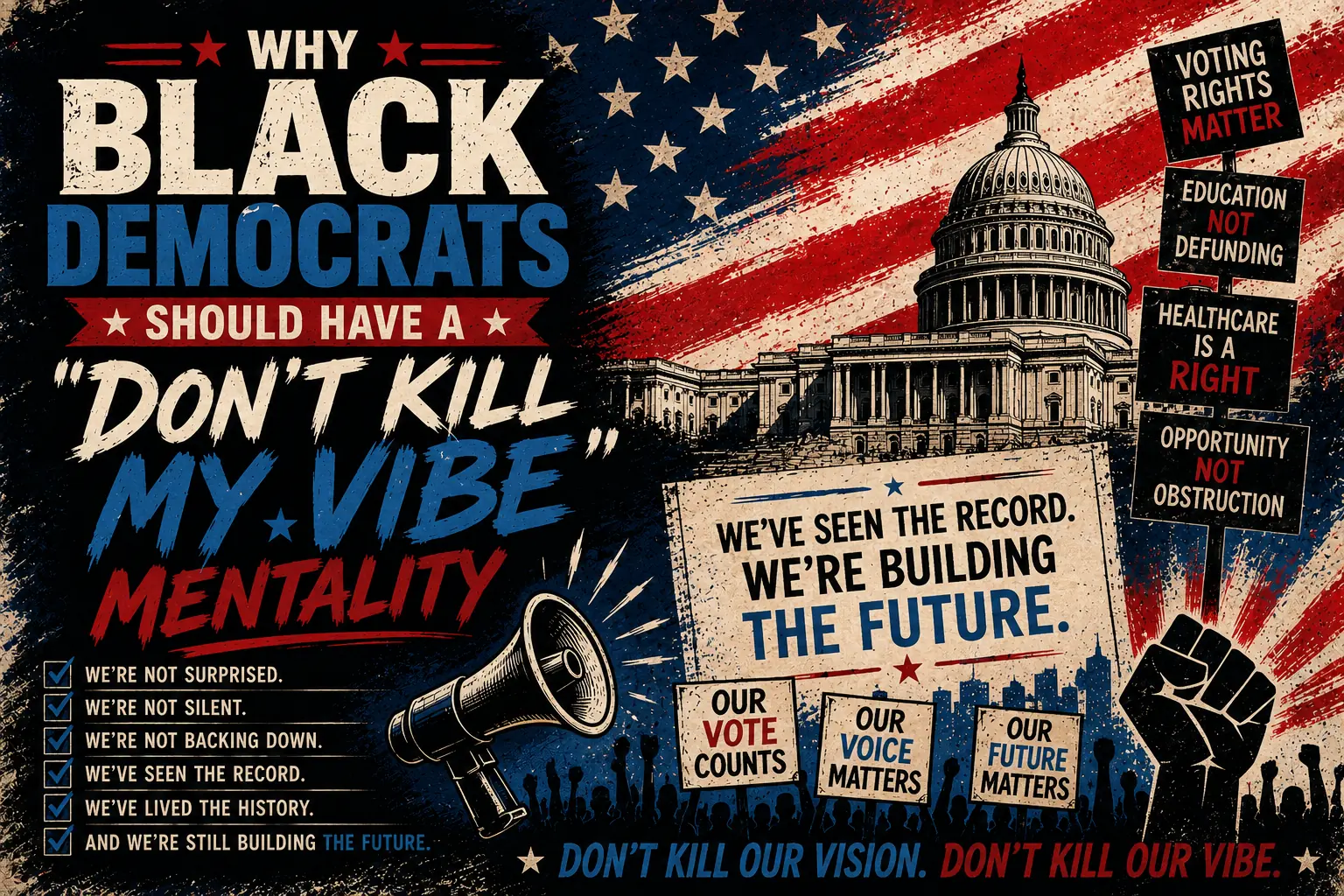
There is a question I keep hearing:
Why aren’t Black Democrats angrier?
Or maybe the real question is:
Why aren’t more of us acting as shocked as everybody seems to think we should be?
I can only speak for myself and for the conversations I’ve had. I’m angry. I’m disappointed. I’m worried. But I’m not surprised. There is a big difference between being angry and being surprised.
I’m angry because I have a son, and I think about what kind of country his generation is going to inherit. I’m angry about voting rights being slowly taken away, education being slowly defunded, healthcare being taken away from millions of people who genuinely need it, and economic opportunity slowly disappearing—year after year, a little less opportunity left for the generation coming behind us.
I’m angry because I don’t want my son’s generation spending half of its life fighting to regain rights and opportunities that previous generations already fought to secure.
So don’t confuse my lack of surprise with a lack of concern. I’m concerned as hell about what’s going on in this country.
I’m just not surprised.
We were here for the election too. We heard the speeches. We saw the advertisements. We watched the debates. We saw the court cases. We knew the records. We heard the warnings.
America had two candidates in front of it.
America made a choice.
Some Americans made the choice not to choose at all.
Now, almost two years later, I keep hearing the questions: What are Democrats going to do? Why aren’t Black Democrats protesting? Why aren’t Black people angrier? Why isn’t everybody raising hell?
My question is much simpler:
What exactly are you asking me to be surprised about?
The Record Was Sitting Right There
You told me crime mattered.
Okay. Then let’s talk about records.
Kamala Harris had been a prosecutor. She became San Francisco’s district attorney, California’s attorney general, a United States senator and then vice president.
Donald Trump wasn’t an unknown quantity either. America had already seen him serve four years as president. Before Americans voted in 2024, a New York jury had convicted Trump on 34 felony counts of falsifying business records. He had been impeached twice, although the Senate acquitted him in both impeachment trials. He also entered the election with unresolved criminal charges, including federal charges connected to alleged efforts to overturn the 2020 election.
And January 6?
We all saw it.
So when people told me crime was one of the issues driving their vote, I couldn’t help asking: One candidate spent part of her career prosecuting cases. The other walked into Election Day already convicted on 34 felony counts.
And you’re telling me your deciding issue was crime?
Make that make sense.
You were free to decide those things didn’t matter. That was your vote.
But don’t tell me you didn’t know.
The record was sitting right there.
And it wasn’t only the legal record. America had already lived through Trump's first presidency.
His administration’s zero-tolerance immigration policy separated migrant children from their parents at the border. His trade war brought retaliatory tariffs that hurt American agricultural exports badly enough that the federal government created multibillion-dollar assistance programs for farmers.
Then came COVID.
No, Donald Trump didn’t create COVID. It was a global pandemic, and pretending otherwise wouldn't strengthen this argument—it would weaken it.
But presidents don’t get judged only when everything is going right. Leadership matters most when everything goes wrong. Preparation, communication, management and the federal response matter.
Trump’s first term ended with America and much of the world experiencing historic economic and social disruption. Businesses closed, schools were disrupted, millions of jobs disappeared, families lost loved ones, supply chains broke down, and everyday life changed.
So when people told me in 2024 that they were voting for Trump because they remembered how good the economy was under him, I kept thinking:
Did you remember the whole four years?
Because I did.
A presidential record isn’t just the part you liked. It’s the whole damn record—the good, the bad, the decisions, the consequences, the crises and the leadership.
America already had four years to examine.
“I’m concerned as hell about what’s going on in this country. I’m just not surprised.”
Then What the Hell Were We Talking About?
This is where the 2024 election really lost me.
Americans told pollsters they cared about the economy, inflation, immigration, healthcare, crime and housing—the everyday issues that determine whether families can actually live.
Those are serious issues.
Yet look at what became one of the loudest cultural conversations of the campaign:
Transgender people in sports.
No, it wasn’t America’s number-one issue according to national polling. But it became one of the loudest. Political campaigns and allied organizations poured enormous amounts of money into transgender-focused advertising. The subject was on television, in campaign ads, at rallies, across social media and throughout everyday political conversation.
And I kept thinking:
Why this?
You told me groceries were too expensive. You told me housing was too expensive. You told me healthcare was too expensive. You were worried about wages, jobs, education and your children’s future.
Then somehow we spent enormous amounts of political energy arguing about transgender athletes.
People can have legitimate questions about fairness and eligibility in competitive athletics. My question is about proportion.
How did this conversation become loud enough to compete with whether you could afford your mortgage, your medicine, your groceries, your child’s education or your future?
And here’s the other part that has always bothered me.
Americans have spent generations being entertained by professional wrestling characters who deliberately played with gender expectations. Gorgeous George. Adrian Street. Goldust.
No, those performers were not transgender. Let’s not rewrite history. But those characters deliberately challenged traditional ideas about masculinity and gender presentation.
Americans watched. We paid. We cheered. We booed. We bought merchandise. Then we came back the next week.
Yes, professional wrestling is scripted entertainment. I know. The industry calls itself sports entertainment. I’m not comparing scripted wrestling with the legitimate questions surrounding eligibility in competitive athletics.
I’m asking about the culture.
If America could spend generations being entertained by characters deliberately playing with gender expectations, why did gender suddenly become powerful enough to help define the emotional atmosphere of a presidential election?
Did the issue suddenly become that much bigger?
Or did politics discover how effective a distraction it could be?
Because while America argued about transgender athletes, families were still worried about jobs, healthcare, mortgages, groceries, education and wages—the things people actually wake up and deal with every morning.
That’s what bothers me.
Somehow, one cultural issue became loud enough to pull attention away from problems affecting millions of Americans every single day.
If that isn’t a distraction, somebody needs to explain to me what is.
You Didn’t Listen With Your Ears. You Listened With Your Eyes.
Politics has always involved emotion. We’re human. Black voters vote with emotion sometimes. White voters do. Republicans do. Democrats do. Independents do.
We vote from experience, identity, fear, hope, anger, loyalty, economic interest and cultural values.
My argument isn’t that voters should become emotionless.
My argument is that emotion cannot replace examination.
Too often in 2024, it felt like America wasn’t listening with its ears.
It was listening with its eyes.
We watched personalities. We watched clips. We watched how somebody laughed. We watched how somebody looked. We watched viral moments. We watched people tell us who we were supposed to fear.
But did we compare records?
Did we read policies?
Did we ask what happened the last time somebody held power?
Did we investigate whether what appeared on our social-media feed was even true?
Did we listen?
Or did we just react?
That is the distinction that matters to me.
You can examine the same facts I examine and reach a different conclusion. That is your right.
But democracy doesn’t stop at the right to choose.
Choice carries responsibility.
You Were Warned
This is another reason I’m not surprised.
Some of the warnings didn’t come from Democrats. They came from people who had actually worked for Donald Trump—former cabinet officials, senior advisers, national-security officials and military leaders. People who had been inside the rooms. People who had watched the first administration operate.
Former senior members of Trump’s own administration publicly warned Americans about what they believed another Trump presidency could mean.
You didn’t have to believe them. You could decide they were wrong. You could decide they were disgruntled. You could decide their warnings didn’t matter.
But you cannot say the warnings weren’t there.
Trump himself wasn’t exactly hiding the direction he wanted to take the country. He campaigned on major changes involving immigration, the federal government, DEI, transgender policy and other parts of American government and culture.
People heard him.
Some celebrated it. Some feared it. Some dismissed parts of it as campaign rhetoric.
Then America voted.
Now, when campaign promises become government policy, why are we acting as though nobody saw them coming?
You were warned.
So Why Are You Asking Me to Be Shocked?
That’s where I am in August 2026.
I keep hearing: What happened? What are Democrats going to do? Why aren’t Black Democrats doing more? Why aren’t Black people protesting? Why aren’t you mad?
I’m mad.
I told you that already.
But why should I perform surprise for you?
I won’t pretend the warnings weren’t there. I won’t pretend the first administration didn’t happen. I won’t pretend the records weren’t public. I won’t pretend the campaign didn’t happen right in front of us.
The information was there.
The record was there.
The warnings were there.
America made its choice.
And democracy doesn’t end with making a choice. It also means accepting responsibility for it.
You voted for this.
Not every future event. Not every decision nobody could reasonably have predicted.
But you voted for the person. You voted for the governing direction he publicly presented. And when that direction was discussed openly before the election, you can’t act as though the destination came completely out of nowhere.
That doesn’t mean Americans have to accept every government decision until the next presidential election. Democracy gives us elections, congressional elections, courts, speech, protest, organizing and the ability to change course.
But accountability begins with being honest about how we got here.
Democracy doesn’t stop at the right to choose. Choice carries responsibility.
I’m Angry. I’m Just Not Surprised.
And this is where the story becomes bigger than Donald Trump, Kamala Harris, Republicans or Democrats.
Eventually, all these politicians will be gone.
Our children will still be here.
My son will inherit whatever kind of democracy our generation leaves behind.
That’s what keeps me thinking.
Democracy requires more from us than walking into a voting booth every four years. It requires attention. Read. Question. Compare. Remember. Research.
Look at what somebody did the last time they had power. Look beyond the advertisement, the slogan, the television personality, the viral clip and the algorithm feeding you exactly what it knows will make you angry.
Then vote.
Vote for the candidate you believe deserves your vote.
But know what you are choosing.
And afterward?
Own it.
Because elections have consequences.
So when you ask me why I’m not shocked by everything happening around us, I can only give you my answer.
I’m angry. I’m disappointed. I’m concerned as hell about this country. I’m concerned about my son’s future.
And I’m concerned that Americans are becoming better at reacting to politics than understanding it.
But surprised?
No.
You don’t get to ignore the warnings and then ask the people who warned you to perform the same shock you now feel.
So while America argues, points fingers and asks how we got here, I’m going to keep paying attention. I’m going to keep asking questions. I’m going to keep voting. And I’m going to keep worrying about the country my son will inherit.
Every once in a while, though, I might sit back, sip my tea and watch America wrestle with the consequences of its own choices.
And borrow a few words from Kendrick Lamar:
Please don’t kill my vibe.
Sources & References (38)
PRINCIPAL SOURCES & REFERENCES
Pew Research Center — “Issues and the 2024 Election”
September 9, 2024.
Research concerning the issues voters identified as important during the 2024 presidential election.
Associated Press — “Trump and Vance Make Anti-Transgender Attacks Central to Their Campaign’s Closing Argument”
November 1, 2024.
Reporting concerning the use of anti-transgender messaging during the closing stages of the 2024 Trump-Vance presidential campaign.
Biden White House Archive — Official Biography of Vice President Kamala Harris
Official archived White House biographical record concerning Kamala Harris and her service as vice president of the United States.
Manhattan District Attorney’s Office — “D.A. Bragg Announces 34-Count Felony Trial Conviction of Donald J. Trump”
May 30, 2024.
Official record concerning the jury verdict finding Donald Trump guilty on 34 felony counts in New York.
United States Senate — Donald J. Trump Impeachment Trial Records and Roll-Call Votes
2020 and 2021.
Official Senate records concerning Donald Trump’s first and second impeachment trials and the senators’ recorded votes.
U.S. Department of Justice — United States v. Donald J. Trump
Federal election-interference indictment, August 1, 2023.
Primary federal court filing concerning the criminal charges brought against Donald Trump related to efforts following the 2020 presidential election.
U.S. Department of Agriculture, Economic Research Service — The Economic Impacts of Retaliatory Tariffs on U.S. Agriculture
Federal economic research concerning the effects of retaliatory tariffs on American agriculture.
U.S. Department of Agriculture — Market Facilitation Program / Trade-Mitigation Assistance Records
2018–2019.
Federal records concerning financial assistance provided to agricultural producers affected by trade retaliation.
U.S. Government Accountability Office — Unaccompanied Children: Agency Efforts to Reunify Children Separated from Parents at the Border
Federal oversight reporting concerning government efforts to identify and reunify children separated from parents at the U.S. border.
U.S. Bureau of Labor Statistics — “Unemployment Rises in 2020, as the Country Battles the COVID-19 Pandemic”
Federal labor-market data concerning unemployment and employment disruption during the COVID-19 pandemic.
Associated Press — Reporting on Former Trump Administration Officials Warning Against His Return to Office
Associated Press reporting concerning former officials from the first Trump administration who publicly opposed or warned against Donald Trump returning to the presidency.
The White House — Second-Term Executive Actions Concerning Federal DEI Policy
Official White House records concerning executive actions affecting federal diversity, equity and inclusion policies during Donald Trump’s second administration.
EDITORIAL RESEARCH NOTE
This commentary draws on election research, official government records, court and congressional documents, federal economic data, and contemporary news reporting.
The sources listed above support specific factual and historical references contained in the commentary. The article’s broader political argument, interpretation and conclusions are editorial analysis and should be understood as such.
The inclusion of a source does not imply that the source endorses Sunday Dinner Media’s interpretation or editorial position.
This source list reflects the research record used in preparing this particular commentary and is not intended to serve as a comprehensive bibliography of the 2024 election, Donald Trump, Kamala Harris, the Democratic Party, the Republican Party, or the broader political issues discussed.
© 2026 Sunday Dinner Media. All rights reserved.
The table is always open. The conversation matters.
The conversation is open
Be the first reader to add a thoughtful response.