
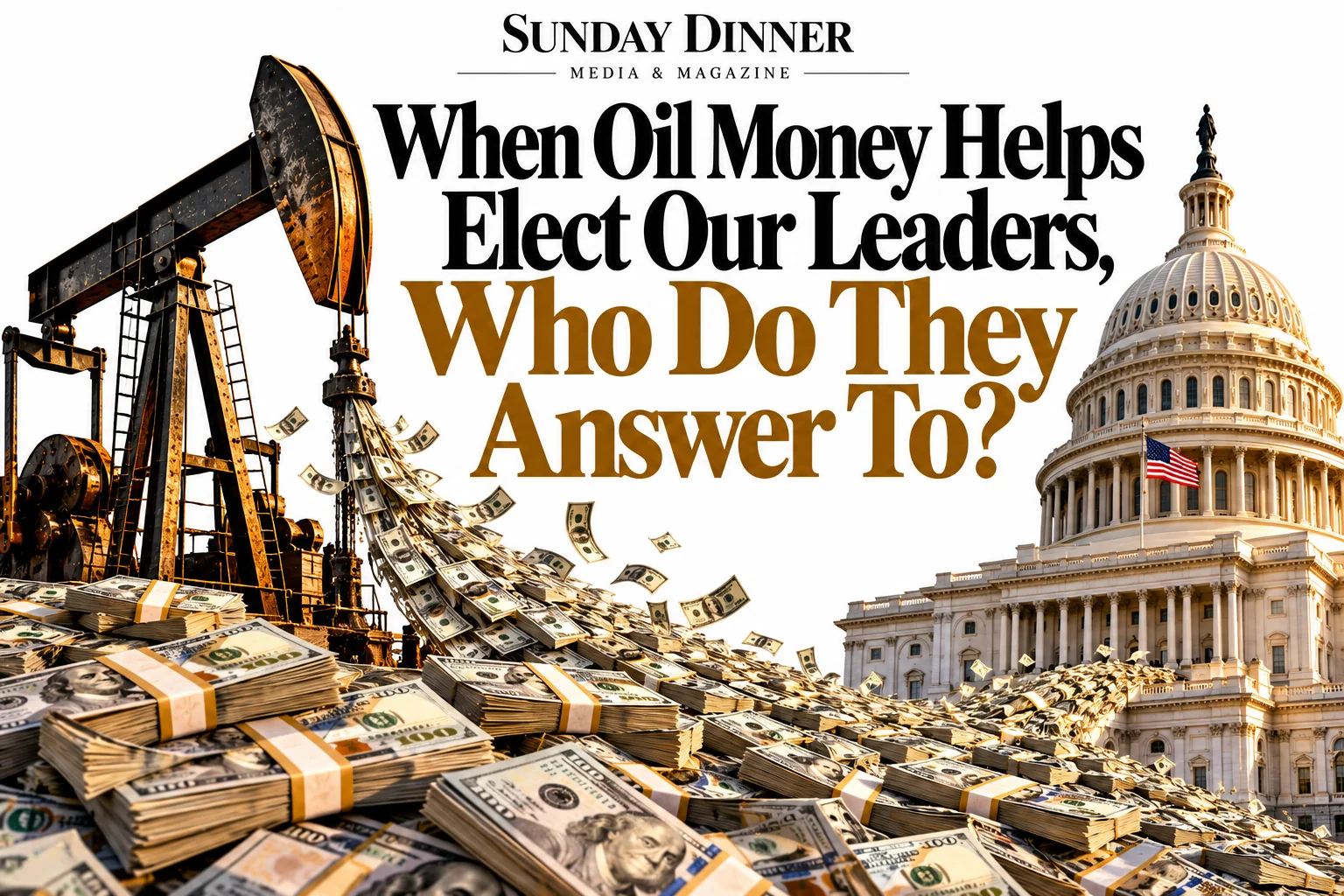
Here at Sunday Dinner, our stories begin with a question. That question usually leads to another, and then another, until we begin to understand what sits behind something we hear every day.
With household expenses pressing on families and another election approaching, promises about affordable energy are everywhere. You have probably heard a politician say America is the greatest oil-producing country in the world. Then comes the familiar expression: “Drill, baby, drill.”
The production claim has a factual foundation. The United States was the world’s largest crude oil producer in 2025, continuing a position it has held since 2018. American oil production is real. But so is the distance between a good deal for an energy company and a good deal for the family paying for energy. [1]
That leaves us with our question: If America produces so much oil, why does it cost us so much?
That question leads to others. Who produces the oil? Who refines it? Who sells it? What does the public receive when companies extract publicly owned resources? And when elected officials help those companies reduce their costs, what makes the savings reach us?
Production Is Real. Control Is Another Question.
When we say “America produces oil,” we are describing production within a country. We are not describing a national oil company that sells every American a discounted gallon.
Businesses make decisions about drilling, investment, refining, and sales. Government establishes rules, taxes, leasing terms, and other conditions under which those businesses operate. Neither the president nor an individual oil company controls every force that determines the price at the pump.
Crude oil trades in a global market. Supply, demand, inventories, transportation disruptions, and decisions by major producing countries affect its price. American production contributes to that supply, but producing oil here does not remove it from the market that buyers and sellers elsewhere participate in. [2]
The Iran conflict illustrates that exposure. EIA’s October 2026 outlook linked higher oil prices to attacks on Middle Eastern infrastructure and disruptions to export routes. American drivers can feel those disruptions even while American wells continue producing. [3]
More production can help supply. It does not give families a guaranteed price.
Why Do We Still Import Oil?
This is another point that can sound contradictory. How can the world’s largest producer still buy oil from other countries?
Part of the answer is that crude oil comes in different grades. Much of the growth in American production has been lighter crude. Many American refineries invested in equipment capable of processing heavier crude, including supplies from Canada. The country can therefore export some domestic oil while importing other grades that suit particular refineries and commercial arrangements. [4]
That does not mean American refineries cannot process American oil. It means production, refinery equipment, transportation, and purchasing decisions must work together. Counting barrels alone does not explain the entire system.
The same distinction applies to gasoline. Oil must be refined into usable products, transported, stored, and sold. EIA identifies four major components of gasoline’s retail price: crude oil, refining, distribution and marketing, and taxes. Refining and retail costs include business margins as well as operating expenses. [5]
A promise to drill more addresses one part of that chain. It leaves several others unexplained.
What Does Public Support Actually Buy?
Oil production requires substantial investment. Wells, equipment, workers, pipelines, and refineries do not become free because a company receives favorable tax treatment.
But public policy can reduce a producer’s costs.
Federal tax rules allow qualifying oil and gas operators to deduct certain drilling and development expenses immediately rather than recover all those costs over time. The treatment varies by company type. These provisions affect taxes and the economics of investment; they do not erase the underlying expense of producing oil. [6]
Public resources also enter the picture through federal leasing. Companies pay for access to publicly owned minerals and pay royalties on production. Those royalties are part of the public’s return for allowing private businesses to extract a public resource.
The 2025 tax-and-spending law returned the minimum royalty rate for new federal onshore oil and gas leases to 12.5%, down from 16.67%. That change reduced the required royalty share under those terms. [7]
Supporters argue that lower costs can encourage investment and production. The American Petroleum Institute publicly supported the reconciliation proposal’s changes to leasing and royalty terms. These were benefits the industry wanted government to deliver. [8]
The public question is what follows. How much additional production results? What happens to public revenue? How much, if any, of the producer’s savings reaches customers?
A lower cost for the company is not automatically a lower bill for the household.
That connection needs evidence.
Follow the Political Money, Too
Following energy costs also means understanding who participates in shaping energy policy.
Campaign contributions and lobbying are different activities. Contributions support political campaigns or political committees. Lobbying seeks to influence government decisions. Both can give an industry opportunities to advance its priorities, but their spending should not be combined and described as money handed directly to a candidate.
Climate Power, a climate advocacy organization, estimated approximately $96 million in fossil-fuel contributions supporting Donald Trump’s campaign and affiliated PACs between January 2023 and November 2024. Its larger estimate of industry political influence also included lobbying and advertising. That larger figure was not all campaign money given to Trump. [9]
The relationship extends to Congress. Industry PAC disclosures and federal filings document contributions to lawmakers who subsequently voted for the 2025 legislation. The records also show that support was not exclusively from oil interests: one senator who voted for the bill received a solar-company PAC contribution before passage. [10–13]
A contribution does not prove that a vote was purchased. But readers are entitled to examine the relationship between financial support, industry requests, and policy outcomes.
Businesses have reasons to seek favorable decisions. Households have reasons to seek affordable bills. Elected officials must explain how their decisions serve the people who depend on them.
Dependence Is Part of the Deal
Energy affordability also depends on the alternatives available to us. Electricity generated from wind and sunlight can reduce the fuel that power plants must purchase. Solar panels can reduce a household’s need to buy electricity from the grid. Building and integrating those resources still costs money, but their availability changes our exposure to fuel prices.
In 2025, Congress passed and President Trump signed legislation that sharply curtailed major clean-energy incentives. The federal credit covering 30% of qualifying residential clean-energy installation costs ended for installations completed after December 31, 2025. The law also imposed substantially tighter eligibility deadlines for new wind and solar generating facilities. [14–16]
The administration presented its approach as protecting affordable, reliable energy and ending subsidies it considered costly and distorting. But research published before passage pointed toward an affordability risk from removing support. [17]
Resources for the Future’s analysis, updated in May 2025, projected that repealing two major clean-electricity tax credits would raise national average electricity rates roughly 5–7% in 2030, compared with retaining them. It modeled a potential repeal scenario. After passage, Rhodium Group separately examined the final law and projected household electricity rates 2–4% higher by 2035 than under its baseline without those legislative changes. Both analyses warned of higher consumer costs. [16, 18]
On Long Island, fuel dependence reaches directly into the electricity bill. PSEG Long Island describes its power-supply charge as a pass-through of fuel and purchased-power costs, primarily natural gas used at local power plants. A family does not have to purchase that gas directly to feel its cost. [19]
Our publisher’s household also shows why alternatives matter. Enough solar panels can cover much of the home’s electricity use on a sunny day. That relief remains valuable, although he reports a difference in what the family pays under peak and off-peak billing compared with its previous arrangement.
That local rate decision has a separate history. LIPA approved it in 2023, before the federal cuts. Its standard higher-priced weekday window runs from 3 to 7 p.m., overlapping with the hours when many families return from work and prepare dinner. LIPA also offers a flat-rate option and first-year bill protection. [20]
The household sees a bill, even though the decisions behind it come from different places. Fuel markets, local rate structures, and federal incentives each affect the choices a family can make.
The administration argued that ending these subsidies would support more affordable, reliable energy. Research available before passage warned that removing clean-electricity incentives could raise household costs, and analysis of the final law projected higher electricity rates over time. Those projections do not tell us how much the cuts have already added to today’s bills. They do give us a clear question to follow: Has this decision made energy more affordable for families—and what do the results show? [16–18]
A Family Needs More Than a Production Slogan
A family balancing groceries, transportation, electricity, and heating is also paying for health insurance, medical care, homeowners or renters insurance, and sometimes life insurance. Parents have child care, school meals, supplies, activities, and the next request for money coming home from school. Energy is one expense among many, but a higher energy bill leaves less room for everything else.
That family needs an explanation that reaches the household budget. More drilling can increase supply, but government permission to produce more does not guarantee that companies will expand production as quickly as possible. Businesses also weigh investment costs, debt, market conditions, and returns to shareholders.
There is evidence of that distinction in the industry’s own statements. Discussing its Permian operations in January 2026, Chevron described a strategy of holding production steady while improving cash generation. Its chief financial officer said, “We’re focused on growing cash flow, not growing production.” The statement concerned a particular part of the business, but it illustrates why a political call for more drilling and a company’s investment priorities may lead in different directions. [21]
A company may decide that maintaining output efficiently serves its investors better than spending heavily to expand. That does not establish that it is manipulating prices. It does mean that a household’s need for cheaper fuel is not the same objective as a producer’s need for a stronger financial return.
Favorable tax treatment may encourage investment. Lower royalties may make certain projects more attractive. Neither tells a parent what next month’s bill will be. The connection between an industry benefit and a household saving has to be demonstrated.
How much additional supply will a policy produce? When should families expect lower costs? And if those savings do not arrive, what will officials change?
Who Should Elected Officials Depend On?
The title’s question remains: when oil money helps elect our leaders, who do they answer to?
One possible response is to reduce candidates’ dependence on large donors through voluntary public campaign financing. A carefully designed system could match small donations or provide qualifying candidates with funding, accompanied by disclosure, audits, enforceable rules, and safeguards against misuse.
Such a system would have a public cost. It would not guarantee good decisions or remove every form of influence. Its purpose would be to give candidates a practical way to compete while relying more heavily on broad public participation.
Protecting that participation also means enforcing the prohibition on foreign-national campaign contributions. Those contributions are already prohibited by federal law; keeping them out requires compliance and enforcement. [22]
Energy companies will continue making their case. Families deserve an equally serious hearing.
America’s production strength is real. Turning that strength into household affordability requires more than another promise to drill. It requires examining prices, public resources, industry benefits, alternatives, and the accountability of the officials making those decisions.
The Sunday Dinner Question
How do we build a system where elected officials depend on the people’s votes more than wealthy donors’ money, while keeping prohibited foreign money out of our elections?
Sources & References (61)
Sources & References
Paste this list into the separate Sources & References field. The numbered references support the article; the additional references document relevant research and counter-evidence.
1. U.S. Energy Information Administration — “The United States produced more crude oil than any other country in 2025.” Establishes the production ranking and its continuation since 2018.
https://www.eia.gov/todayinenergy/detail.php?id=67844
2. EIA — “What drives crude oil prices: Overview.” Explains global supply, demand, financial markets, and other price drivers.
https://www.eia.gov/finance/markets/crudeoil/
3. EIA — October 2026 Short-Term Energy Outlook. Documents Middle Eastern supply disruptions, petroleum prices, and the distinction between observed conditions and forecasts.
https://www.eia.gov/outlooks/steo/archives/oct26.pdf
4. EIA — “The United States produces lighter crude oil, imports heavier crude oil.” Explains crude-grade differences and the role of heavier imports. Its numerical examples concern 2022; the article uses its explanation rather than presenting those figures as current.
https://www.eia.gov/todayinenergy/detail.php?id=54199
5. EIA — “Factors affecting gasoline prices.” Explains crude, refining, distribution and marketing, taxes, and margins.
https://www.eia.gov/energyexplained/gasoline/factors-affecting-gasoline-prices.php
6. U.S. Treasury — Tax Expenditures, Fiscal Year 2027. Explains the tax treatment of intangible drilling costs, including different treatment for integrated producers.
https://home.treasury.gov/system/files/131/Tax-Expenditures-FY2027.pdf
7. Bureau of Land Management — Instruction Memorandum 2026-018. Implementation guidance for the 2025 law’s oil-and-gas leasing provisions, including royalty rates.
https://www.blm.gov/policy/im-2026-018
8. American Petroleum Institute — “API Statement on House Natural Resources Reconciliation Proposal,” May 2, 2025. Primary evidence of the industry association’s support for proposed leasing and royalty changes. This is an industry position, not independent evidence of household savings.
https://www.api.org/news-policy-and-issues/news/2025/05/02/api-statement-on-house-natural-resources-proposal
9. Climate Power — Oil and Gas Influence Report, January 21, 2025. Source of the attributed approximately $96 million estimate for support of Trump and affiliated PACs. Climate Power is an advocacy organization; its broader total includes lobbying and advertising.
https://climatepower.us/wp-content/uploads/2025/01/Oil-and-Gas-Influence-Report-PROG-2025_01_07-DR.pdf
10. ExxonMobil — PAC 2024 Contributions. Lists contributions including Jason Smith: $5,000; Steve Scalise: $5,000; Brett Guthrie: $7,500. These are one PAC’s calendar-year contributions, not total industry support.
https://corporate.exxonmobil.com/-/media/global/files/policy/2024-pac-contributions.pdf
11. U.S. House Clerk — Roll Call 190, July 3, 2025. Documents final House approval and individual votes, including the three lawmakers identified in reference 10.
https://clerk.house.gov/Votes/2025190
12. Mike Crapo for U.S. Senate — July 2025 quarterly filing, Federal Election Commission. Reports $5,000 from Marathon Petroleum’s employees’ PAC on April 8, 2025, and $2,500 from Sunrun PAC on June 27, 2025. See PDF pages 42 and 46.
https://docquery.fec.gov/pdf/139/202507149762822139/202507149762822139.pdf
13. U.S. Senate — Roll Call 372, July 1, 2025. Documents Senate passage and Crapo’s affirmative vote.
https://www.senate.gov/legislative/LIS/roll_call_votes/vote1191/vote_119_1_00372.htm
14. Internal Revenue Service — Clean-energy credit modification FAQs under Public Law 119-21. Establishes the residential-credit termination and installation-completion rules.
https://www.irs.gov/newsroom/faqs-for-modification-of-sections-25c-25d-25e-30c-30d-45l-45w-and-179d-under-public-law-119-21-139-stat-72-july-4-2025-commonly-known-as-the-one-big-beautiful-bill-obbb
15. IRS — Residential Clean Energy Credit. Documents the 30% credit for qualifying installations through December 31, 2025. This concerns installation costs, not a recurring credit simply for owning panels.
https://www.irs.gov/credits-deductions/residential-clean-energy-credit
16. Rhodium Group — “What Passage of the ‘One Big Beautiful Bill’ Means for US Energy and the Economy,” July 11, 2025. Examines the enacted legislation and projects household electricity rates 2–4% higher in 2035 relative to its baseline.
https://rhg.com/research/assessing-the-impacts-of-the-final-one-big-beautiful-bill/
17. White House — Executive Order 14315, July 7, 2025. Documents the administration’s stated rationale for ending wind-and-solar subsidies. The rationale is attributed, not adopted as an independently established result.
https://www.federalregister.gov/documents/2025/07/10/2025-12961/ending-market-distorting-subsidies-for-unreliable-foreign-controlled-energy-sources
18. Resources for the Future — “Effects of Repealing the Inflation Reduction Act’s Tech-Neutral Tax Credits,” updated May 2025. Pre-passage modeling of repealing sections 45Y and 48E, including projected national electricity-rate increases. It is a repeal scenario, not an analysis of the final law.
https://www.rff.org/publications/issue-briefs/projected-impacts-of-repealing-the-section-45y-and-48e-technology-neutral-clean-electricity-tax-credits/
19. PSEG Long Island — Electric Rate Information. Explains the fuel and purchased-power pass-through, primarily natural gas.
https://www.psegliny.com/aboutpseglongisland/ratesandtariffs/rateinformation
20. LIPA — Time-of-Day Rates. Documents approval on March 29, 2023; the standard 3–7 p.m. weekday peak period; flat-rate choice; and first-year bill protection.
https://www.lipower.org/time-of-day/
21. Chevron — Fourth-quarter 2025 earnings-call transcript, January 2026. Source of the statement about growing cash flow rather than production in its Permian business. See PDF page 10.
https://chevroncorp.gcs-web.com/static-files/f0f72c1f-b4ee-46ff-ac07-b123b7603857
22. Federal Election Commission — Foreign Nationals. Explains the prohibition on foreign-national election contributions and expenditures, directly or indirectly.
https://www.fec.gov/help-candidates-and-committees/foreign-nationals/
Additional research and context
23. Rhodium Group — “Caught in the Current: Historical and Prospective Drivers of Changes in US Electricity Prices.” Explains multiple causes of electricity-price increases and why recent increases cannot all be attributed to the 2025 cuts.
https://rhg.com/research/us-electricity-prices-drivers/
24. PSEG Long Island — Net Meter Bank Exchange. Explains existing solar net-metering credits and separate time-of-day credit banks.
https://www.psegliny.com/en/saveenergyandmoney/GreenEnergy/SolarEnergy/TODNetMeter
25. Federal Election Commission — Public Funding of Presidential Elections. Provides an existing example of public campaign financing and mandatory audits. The article’s broader proposal is editorial opinion, not a description of a current congressional financing program.
https://www.fec.gov/introduction-campaign-finance/understanding-ways-support-federal-candidates/presidential-elections/public-funding-presidential-elections/
26. ConocoPhillips — Second-quarter 2026 results, filed with the SEC. Provides counter-evidence against treating every production decline as deliberate withholding: the company identified conflict-related disruptions while reporting organic growth in Lower 48 production.
https://www.sec.gov/Archives/edgar/data/1163165/000116316526000030/cop-20260806x8kexx991.htm
27. Federal Reserve Bank of Dallas — Third-quarter 2025 Energy Survey. Documents regional production, cost pressures, and investment uncertainty. Anonymous executive comments represent respondents’ views.
https://www.dallasfed.org/research/surveys/des/2025/2503
28. Bloomberg reporting by Kevin Crowley, republished by EnergyNow — “US Oil Growth Faces Headwinds as Shale Producers Cut Spending,” August 2026. Explains reduced investment, shareholder priorities, efficiency gains, and producers pursuing different strategies.
https://energynow.com/2026/08/us-oil-growth-faces-headwinds-as-shale-producers-cut-spending/
Publisher account: Clarence C. Mitchell supplied the household solar and billing experience during the development of this article. It is presented as his account, not as an audited bill comparison.
The principal distinctions in this source packet are supported by the original records: contribution examples and votes, separate local and federal decisions, projected costs rather than established current causation, and the prohibition on foreign-national contributions.


The conversation is open
Be the first reader to add a thoughtful response.